AFP
Look out, blue whale — there’s a new contender for your heavyweight title.
A newly discovered whale that lived nearly 40 million years ago could be the heaviest animal to have ever lived, based on a partial skeleton found in Peru, scientists said on Wednesday.
The modern blue whale has long been considered the largest and heaviest animal ever, beating out all the giant dinosaurs of the distant past.
But Perucetus colossus — the colossal whale from Peru — may have been even heavier, according to a study published in the journal Nature.
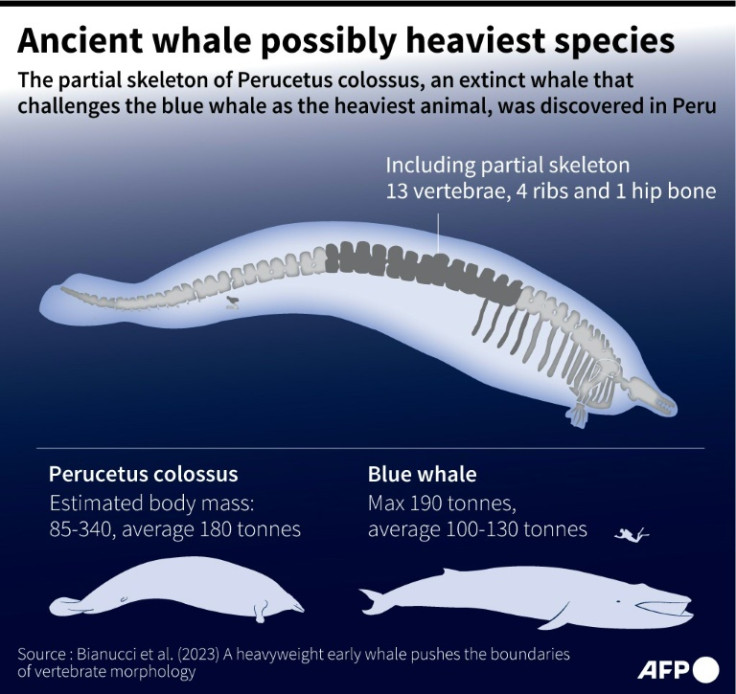
Extrapolating from some massive bones found in the Peruvian desert, an international team of researchers estimated that the animal had an average body mass of 180 tonnes.
That would not take the heavyweight title by itself. The biggest blue whale ever recorded weighed 190 tonnes, according to Guinness World Records.
But the researchers estimated the ancient whale’s weight range was between 85 and 340 tonnes, meaning it could have been significantly larger.
The researchers were careful not to declare the ancient whale had broken the record.
But there was also “no reason to think that this specimen was the largest of its kind,” study co-author Eli Amson told AFP.
“I think there’s a good chance that some of the individuals broke the record — but the take-home message is that we are in the ballpark of the blue whale,” said Amson, a paleontologist at the State Museum of Natural History Stuttgart in Germany.
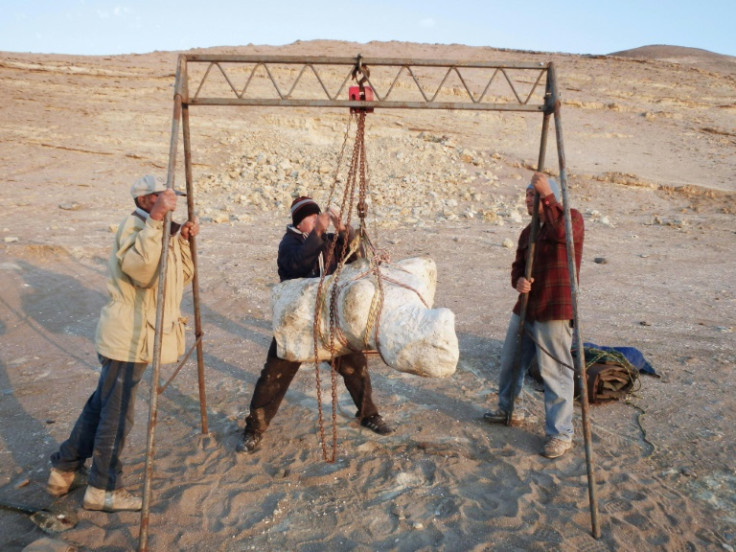
The first fossil of the ancient whale was discovered back in 2010 by Mario Urbina, a palaeontologist who has spent decades searching the desert on the southern coast of Peru.
But what he found “looked more like a boulder” than a fossil, Amson said.
A total of 13 gigantic vertebrae — one of which weighed nearly 200 kilograms (440 pounds) — were found at the site, as well as four ribs and a hip bone.
It took years and multiple trips to collect and prepare the giant fossils, and longer for the team of Peruvian and European researchers to confirm exactly what they had been found.
On Wednesday, they revealed it is a new species of basilosaurid, an extinct family of cetaceans.
Today’s cetaceans include dolphins, whales and porpoises, but their early ancestors lived on land, some resembling small deer.
Over time they moved into the water, and basilosaurids are believed to be the first cetaceans to have a fully aquatic lifestyle.
One of their adaptations at that time was gigantism — they became very big.
But the new discovery indicates that cetaceans reached their peak body mass roughly 30 million years earlier than previously thought, the study said.
Like other basilosaurids, Perucetus colossus likely had a “ridiculously small” head compared to its body, Amson said — though there were no available bones to confirm this.
Lacking any teeth, it was impossible to say for sure what they ate. But Amson speculated that scavenging off the seafloor was a strong possibility, partly because the animals could not swim quickly.
The researchers were confident that the animal lived in shallow waters in coastal environments, due to the strange heaviness of its bones.
Its whole skeleton was estimated to weigh between five to seven tonnes — more than twice as heavy as the skeleton of a blue whale.
“This is — for sure — the heaviest skeleton of any mammal known to date,” as well as any aquatic animal, Amson said.
Perucetus colossus needed heavy bones to compensate for the huge amount of buoyant blubber — and air in its lungs — which could otherwise send it bobbing to the surface.
But just the right balance of bone density and blubber allowed the giant animal to stay in the middle of around 10 metres (33 feet) of water “without moving a muscle,” Amson explained.
Felix Marx, a marine mammal expert at the Museum of New Zealand Te Papa Tongarewa not involved in the study, told AFP that Perucetus colossus “is very different from anything else we’ve ever found”.
He cautioned that extinct sea cows had heavier bones than would be expected for their total body weight, potentially suggesting Perucetus colossus could be on the lower end of its estimated weight range.
The fossils are being displayed at the Museum of Natural History in Lima.
AFP
AFP