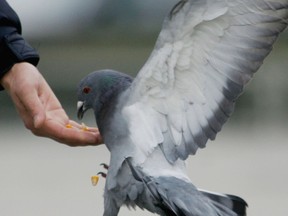
The avian influenza H5N1 has also long been identified as a possible major threat to human health, should it jump between species. Learn more
Article content
There was an unusual occurrence at the intersection of epidemiology and agriculture last week in the United States: Cows were falling ill with an infection that is normally isolated largely to birds.
Cows in Texas, New Mexico, Michigan and Kansas showed signs of low appetite and decreased lactation. The evidence, at this point, according to the U.S. Department of Agriculture, is that wild birds had introduced the highly infectious H5N1 virus to cows.
Advertisement 2

Article content
Article content
Birds, obviously, are not mammals. Cows are. So are humans. The fear among scientists and other experts is that slowly but surely the H5N1 bird flu could work its way up the mammalian chain to infect humans, causing a devastating pandemic.
Here’s everything we know about H5N1.
What is H5N1?
It’s a strain of highly pathogenic avian influenza, a viral infection that affects birds. This can include wild birds, food-producing birds such as chickens and hens, and pet birds.
It’s highly infectious and, to avian species, highly deadly.
H5N1 was was first identified in 1959 in Scotland, but the current strain has been around for about 20 years.
It has also long been identified by scientists as a possible major threat to human health, should it make a jump between species (which it has) and develop a higher degree of efficiency and transmission between humans. The more mammals that are infected, the greater chance there will be a mutation that makes it more transmissible between species, including humans.
The last year has been a big year for H5N1.
“There’s just been more cases. there’s been more birds impacted, and a larger global burden. And this is devastating in birds, right? It kills birds. So you have these massive bird die offs,” said Dr. Isaac Bogoch, an infectious disease expert at the University of Toronto.

NP Posted
Article content
Advertisement 3
Article content
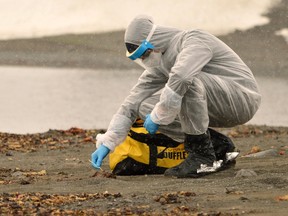
What’s happening with mammals?
There have been a number of instances where mammals have contracted avian influenza. The suspicion, at least in the case of wild mammalian predators, is that they caught it from eating infected birds.
This is not particularly new. Mammals, particularly scavengers and animals that eat birds, have been exposed, fallen ill and died, said Bogoch.
But H5N1 has also been found in animals on farms, and not just birds, but cows as well. That seems to be new.
“While it can be picked up by scavenging mammals, typically it is not very efficiently transmitted from bird to mammal or between mammals,” said Bogoch. “The concern is a greater global burden of infection means there’s more opportunities for mammals to get exposed, which means there’s more opportunities for mammal to mammal transmission, which means there’s a heightened risk of an epidemic or, worst case scenario, a pandemic.”
So far, it hasn’t spread to pigs. This is a noted blessing because pigs are susceptible to both human and avian influenza, and when they’re infected with both, the viruses can swap genetic material, making bird flu more transmissible to humans.
Advertisement 4
Article content
This is what happened with the 2009 swine flu pandemic, when a cocktail of influenzas mixed inside pigs to produce a new viral strain. It ended up killing between 151,700 and 575,400 people, according to the U.S. Centers for Disease Control. (In comparison, COVID-19 killed around seven million people.)
Has it spread to humans?
Yes.
“Infections in humans have primarily been acquired through direct contact with infected animals or contaminated environments,” says the World Health Organization.
Canada had one case of an infected human in 2014. So far, there have been two cases of humans infected with H5N1 in the United States. The first was in 2022 in Colorado. The most recent occurred in Texas, where officials announced this month that a person had come into contact with dairy cows. The U.S. Centers for Disease Control estimates that the risk to humans remains low.
It has, however, killed humans elsewhere in the world. Globally, the WHO says there have been 888 humans infected with avian influenza between 2003 and 2024, the most recent of which occurred in Vietnam.
Advertisement 5
Article content
About 463 of those infected in 23 countries around the world have died.
“Human infection can cause severe disease and has a high mortality rate,” says the WHO.
There is not, however, good evidence of transmission of H5N1 infections between humans.

Is is unusual for avian flu to infect mammals?
It is. Avian influenza is genetically different than the influenza strains that normally infect humans.
The CDC recently sequenced the genome of the virus infecting the Texan patient and those from cattle, wild birds and poultry. It found only “minor” genetic changes in the virus in the human compared to the virus infecting cattle.
“Both cattle and human sequences maintain primarily avian genetic characteristics and for the most part lack changes that would make them better adapted to infect mammals,” the CDC said.
Why is this a concern?
There are essentially two concerns. The first is that there’s a risk to the food supply if livestock are falling ill and are therefore culled. There is very little risk that properly prepared foods such as chicken and eggs will lead to illness, but nobody wants a tainted food supply.
Advertisement 6
Article content
The second concern is that the virus could mutate and transmit more efficiently between mammals or between humans and lead to an epidemic or pandemic.
“It’s not always but almost always people who have close contact with birds and it’s almost always people who are in agriculture, right, so they work on a duck farm or a chicken farm,” said Bogoch.
What’s happening in Canada?
In Canada, the Canadian Food Inspection Agency estimates that more than 11 million food-producing birds have been infected with what’s called “highly pathogenic avian influenza.” That said, so far it has not spread to cattle.
The National Collaborating Centre for Environmental Health notes in a research brief that there have been cases of H5N1 in wild birds as well as wild mammals, largely just among three species: the striped skunk, red fox, and harbour seal.
It has also affected at least one pet — a dog in Ontario that chewed on a dead goose died in April 2023. Cats and dogs — scavengers and inveterate nibblers of dead things — are absolutely at risk of catching H5N1.
The research brief also says that there has been one case of H5N1 in Canada, back in 2014. That person died, and likely acquired the virus while travelling in China.
Recommended from Editorial


Our website is the place for the latest breaking news, exclusive scoops, longreads and provocative commentary. Please bookmark nationalpost.com and sign up for our daily newsletter, Posted, here.
Article content