Roy Roque started with a gas station. In October, this enterprising 70-year-old will open the doors on a 20,000-square-foot soundstage
Article content
Roy Roque knows what the future can look like for Indigenous Canadians.
He’s a member of the Wahnapitae First Nation living on the north shores of Lake Wahnapitei, a popular lake 50 kilometres north of Sudbury, Ont. Roy didn’t grow up on a reserve, but he’s figured out ways to attract commerce to this enclave and retain talented young people. And he prefers to do business without government money — or strings — attached.
Advertisement 2

Article content
“In 1944, my grandfather sold his status card to the Canadian government for $400,” Roy chuckles, “because he wanted to be able to vote, and he wanted to be able to go to the liquor store.” When the feds reinstated his family’s status in 1988, Roy relocated to the Wahnapitae reserve. “At that point in time, when we first came out here,” he says, “there were two people. We had no hydro, no phones, no nothing.”
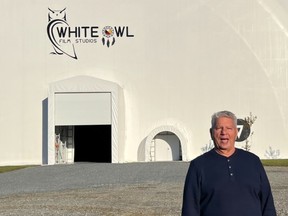
As Roy explains to me in a recent Zoom call, his investments in that community started with a gas station, restaurant and convenience store — services that make the place a “destination” for people. Then he launched a hydroponic cannabis operation, pushing hard against government red tape to build a business that now employs people on and off reserve. In October, this enterprising 70-year-old will open the doors on a 20,000-square-foot soundstage — White Owl Film Studios — built on reserve in partnership with Volume Global, a Los Angeles-based film production company.
The state-of-the-art facility offers filmmakers space for set construction and virtual production and will cost around $15 million once completed, Roy says. Leap-frogging existing technologies, the pop-up facility boasts a 35-to-40 foot tall LED wall that’s “basically 3,500 television screens all clipped together,” Roy enthuses, his blue eyes sparkling.

First Reading
Article content
Advertisement 3
Article content
The studio is booked solid for two years, starting this fall. “Yeah, it’s amazing … and the thing about this, you can do it (filming) year-round,” he continues, “the weather’s not going to interfere in what you’re doing.” He’s been to visit a similar project Volume Global launched in downtown Regina, Sask., to film action TV series.
Filmmakers typically gravitate to jurisdictions with lucrative tax incentives. Volume Global initially targeted the city of Sudbury, “working with these people probably two or three years ago,” Roy explains, “trying to get the studio up and going and there were so many issues, they just couldn’t get to first base with it.” That’s when the possibility of building the studio on reserve land was pitched to Roy.
Initially, Roy was leery because of the reserve’s location. “But,” he shares, “our partners convinced us that it wasn’t such a big deal making a 45-minute drive to our area (from Sudbury), because when you’re in Toronto or Los Angeles or any other big city, it takes that long to get anywhere.”
In what seems like a blink of an eye, Roy was able to secure his community’s support. “I go to chief and council to get permission … explain our business plan to them, and they say ‘yea’ or ‘nay’. This whole process for us on this studio space started last July, early August.” As recently as last July, the trees were still on the property, Roy grins: “By mid-October, we had the trees stripped and we’re in a lot of clay, so we had to remove five or six feet of clay and then refill it with gravel.”
Advertisement 4
Article content
“We’ve paid for it with our own money,” Roy boasts, “we’ve never gotten a government grant or anything for the studio.”
In part, that’s because Roy has built up credibility with outside investors willing to take a calculated risk on a new idea. First Nations don’t own the land, which makes some people uncomfortable doing business on reserve, Rob explains, “but with chattels, it’s a different story. Everything involved with this studio except for the cement pad can be removed if need be.”
That the Wahnapitae First Nation signed off on a historic self-governance agreement in 2022 with the Canadian minister of Crown-Indigenous relations is also relevant. The Anishinabek Nation Governance Agreement allows Wahnapitae First Nation, and a handful of other nations, to get out from under the Indian Act and pass their own laws — on citizenship, elections, language and culture, and fiscal management.
Recommended from Editorial


People know the Vale super-smokestack in Sudbury is coming down — it’s the second-tallest freestanding chimney in the world. But in my conversation with this forthright entrepreneur living on a remote reserve in northern Ontario, I’m rapidly realizing there’s a lot more happening in the region and we need to pay attention.
Advertisement 5
Article content
Opportunities for real estate development on Indigenous-owned land are booming, and will only surge as outstanding land claims get settled. Roy reports, another 20,000 acres is to be added to the Wahnapitae First Nation, based on a settlement reached with the government in 2023.
Roy talks of what it could mean for his community if Australian investor Wyloo moves forward with construction of a battery plant in Sudbury.
And there’s all that cash. Recently, the Supreme Court of Canada unanimously declared the Crown breached the Robinson Treaties, and $10 billion is being doled out to Robinson-Huron treaty members. “We at Wahnapitae First Nation got our money two weeks ago,” Roy reports, and while he doesn’t volunteer details on the size of the cheques, he does note, “75 per cent went to the members; 25 per cent went to the band.”
I bite my tongue. It’s not my business how Roy or his community spends that money.
Roy paints a rosy picture of self-reliance. But, I probe, there must be times when it’s challenging having to get buy-in from the local community on every investment decision. Yes, he admits, on occasion the chief and council do turn him down.
Advertisement 6
Article content
“Right now, the Ontario government just made it possible to sell beer, wine, coolers in your confectionary stores, right?” he posits. Yet his own chief and council declined his request to sell alcohol in the local store. “My argument to our chief and council is you’re being just as prejudiced as the white guy or the brown guy or the green guy down the street,” Roy laments, “saying us as natives can’t control our alcohol consumption.”
Governance; it’s never for the faint of heart.
Our website is the place for the latest breaking news, exclusive scoops, longreads and provocative commentary. Please bookmark nationalpost.com and sign up for our daily newsletter, Posted, here.
Article content