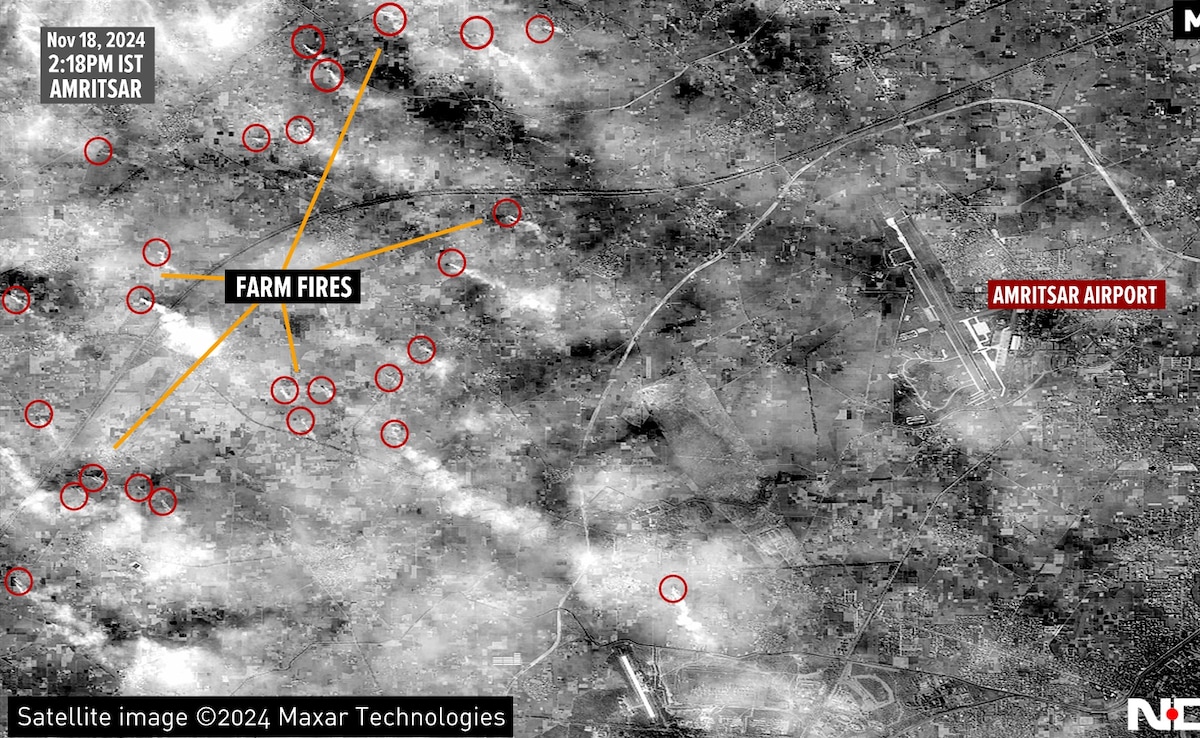
The images accessed by NDTV were captured at 2:18 pm and farm fires were visible in the Maxar imagery.
New Delhi:
Delhi and its adjoining areas are covered in smog and air quality is still in the ‘very poor’ category. The fourth stage of anti-pollution measures will remain in effect for three days as no sign of relief is expected soon.
Several factors contribute to Delhi’s inferior quality, including construction, the city’s vehicular pollution and the stubble burning by farmers in Punjab and Haryana. While the Central Air Quality Management (CAQM), the pollution control body, has appreciated Punjab for significantly bringing down the cases of stubble burning in the state, scientist Hiren Jethva at NASA Goddard Space Flight Centre, differs and told NDTV that farmers are timing stubble burning with NASA satellites overpass time over the subcontinent leading to severe undercounting. Now, exclusive satellite images accessed by NDTV appear to confirm the inference.
Satellite Images Of Punjab Farm Fires
NDTV accessed satellite images of a small area west of Amritsar, to understand the extent of farm fires on November 18 at 2:18 pm. It may look like an image of a warzone, but the smoke is not from the impact of bombs but from farmers burning their agriculture stubble. The red circles indicate the location of farm fires in a small area lying west of the Amritsar airport.
The satellite imagery experts consulted by NDTV, counted at least 26 independent farm fires in the north and west of Amritsar on November 18, shortly after NASA’s satellites with fire-detecting sensors had completed their overpass of the subcontinent.
A zoomed-in image of a farm fire west of Amristar airport shows a large amount of smoke emanating from a single farm fire that burns for several hours, contributing significantly to poor air quality and lowering the visibility in the region.

On November 18, flight operations at Amritsar Airport were impacted due to poor visibility as a result of smog and the smoke from farm fires has converted the Indo-Gangetic plain belt which includes Delhi and its adjoining areas into a gas chamber.
Read more: Exclusive: Wary Of NASA Satellites, How Farmers In Punjab Time Crop-Burning, Scientist Explains
Mr Jethva, earlier told NDTV that, “The overpass time of NASA satellites over the region is around 1:30-2:00 pm but somehow they (farmers) have learnt that they can bypass the satellite overpass time and can burn the crop residue in the late afternoon. This is confirmed by the South Korean geostationary satellite that the majority of the crop burning happens after 2 pm once the NASA satellites overpass the region when there is no surveillance, but the fires cannot be hidden from geostationary satellites which take a picture of the region every five minutes.”
The images accessed by NDTV were captured at 2:18 pm and farm fires were visible in the Maxar imagery and are absent from farm fire data processed by Sumoi-NPP/VIIRS sensors used by NASA.
Another satellite captures an image of an area adjacent to the spot where a single fire emanated a huge amount of smoke. At least eight independent farm fires were spotted by experts who were consulted by NDTV to locate the incidents of stubble burning.

Mr Jethva earlier in an X post, shared satellite images from October 29, taken by the GEO-KOMSAT A2 satellite, showing a timelapse of the crop-burning activities in northwest India. The images show dense cloud cover over the region post-4 pm, when compared to 1:30 pm, suggesting that farmers are burning crops late afternoon to avoid NASA satellite surveillance.
NASA Data
The yellow box next to Amristar is the location of the satellite images accessed by NDTV. The red dots are farm fires which have been detected by sensors from NASA World View, data from which is extensively used in India. The fire sensor data was taken at 2:18 pm on November 18, at the same time when other satellites, except NASA’s, passed over the region

The images appear to confirm that there is a severe undercount of farm fires in Punjab which contribute significantly to the air pollution load this time of the year when farmers burn their agriculture stubble.
Mr Jethva earlier told NDTV, “Yes, farmers can hide the crop burning from the 1:30 pm overpass time but the PM 2.5 data and the pollution load over the Indo-Gangetic plain region, the geostationary satellite data and the burnt…everything is pointing toward fire is still present. Smog towers are a small fix. It won’t work unless we address the issue of crop burning in the region.”
Thermal Inversion – Another Key Factor
Thermal inversion is a big factor behind the sudden spike in dense smog and pollution levels. Mr Jethva explained that “The warmer air sits above the cooler air on the ground and that does not allow the vertical mixing of pollutants and whatever we emit at the surface stays for around 200 metres within the boundary layer. The stronger the thermal inversion, the more pollutants will be trapped near the surface because there is no venting place for the pollutants to go up in the vertical direction.”
“In the satellite images, we can notice that smoke from crop burning is mixed with clouds or is above them and that kind of situation furthers thermal inversion because of the absorption of light-absorbing aerosols and that it further warms the upper layer and increases thermal inversion,” Mr Jethva said.
The particulate matter (PM) acts as a cloud condensation nuclei which favours the formation of fog and when temperatures go down a huge amount of aerosols contribute to fog formation.