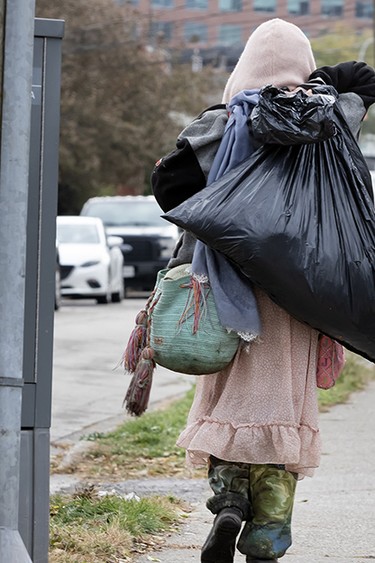
Menace, addiction and human despair have overwhelmed small towns and cities. Some say it’s getting worse. Some just want to leave.
Article content
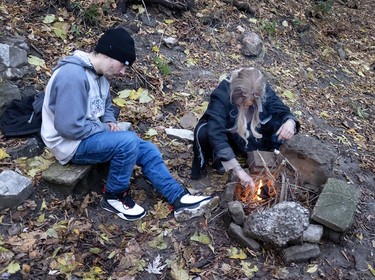
ST. CATHARINES, Ont. — Gigi and Nick are stoking a fire on the right bank of Twelve Mile Creek. It is the sunset hour in St. Catharines, Ont., but the atmosphere is damp and heavy from a November morning rain.
There is not another soul in sight, down here in the riverside parklands below a street called Gale Crescent, a few blocks east of downtown. For kindling, Gigi has scavenged an armful of twigs from the municipal shrubbery. She stacks it inside a makeshift hearth of flagstones and tries to get it to catch, but the twigs are wet and will not accept the flame from Nick’s pocket lighter.
Article content
Article content
Advertisement 2

Article content
Nick Dunits is 25, hooded, mustached and thinly bearded, soft-spoken, downcast, defeated. His running shoes are brand new. Gigi is mature, self-aware, alert, conversational, with streaky brown-blond hair and bright-red lipstick distracting from a broken smile.

Long Story
Article content
“I am a 33-year-old woman,” she announces. “I would like to sit on a real toilet sometime.” But for privacy, the late Niagara afternoon offers only the sky above, the mud below.
Gigi H. — she doesn’t offer her full surname — says that she ran track and played volleyball and badminton in high school in nearby Thorold, half of her lifespan ago. She says that she studied for a time at Niagara College to become an esthetician.
“You didn’t just learn about the outside of the person,” she relays. “You had to learn about the inside — the whole person — too.”
Nick says that he has a seven-year-old child whom he hasn’t seen in five years. Gigi says that she has given birth to four children by “my two baby daddies” and that the kids live comfortably with their respective fathers.
“I was sure when I was 10 years old that I wanted to run an orphanage,” Gigi says.
Now she lives in one, the biggest in the world, as big as our country, the open-air warehouse of the “unhoused.”
Article content
In her faux-leather purse (or maybe it is genuine calfskin) are a makeup palette, some mascaras and a length of plastic tubing connected to what appears to be a pipe for smoking drugs.
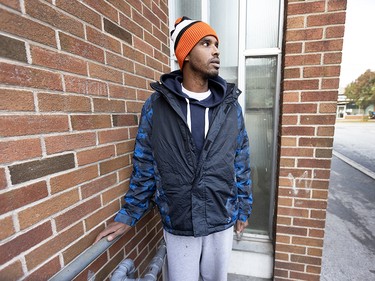
Nick says he has a generous sister who sometimes takes him in, and that he got hooked on the painkiller Percocet at the age of 16, back at St. Catharines Collegiate.
“I did it to fit in,” he says with a shrug, barely whispering.
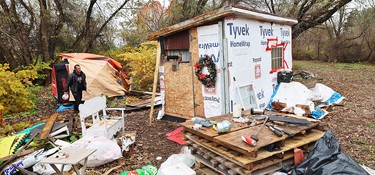
He says that his parents, addicts also, live in a tent by the creek. There used to be a lot of tents on the flats below Gale Crescent before the city swept them away.
Nick says he recently spent a month in jail for stealing a loaf of bread.
It could have been worse. In Victor Hugo’s Les Miserables, Jean Valjean serves 19 years in the galleys of Toulon for the same offence.
“It was just a loaf of bread, but the judge said, ‘Stealing is stealing.’” Nick sighs. When he got out, the street was waiting. It is very patient, the street.
“Homeless people got the biggest hearts,” he says.
An hour earlier, Gigi and Nick had been lounging among the dozens of permanent itinerants in the back lot of the Salvation Army on Calvin Street, a brick dormitory with a cornerstone consecrated, “To the glory of God.” Across the street, outside the doors of a social-service agency called Start Me Up, a woman was writhing and screaming.
Article content
Another fellow carefully spelled out his name as “Abdalla Yaya, from Somalia,” as he propped himself unsteadily against the mission wall.
“One lie,” Yaya said. “One lie. One lie when I was young put me here.
“The voice in my head.
“It is confused.”
* * *
At this same hour of every day, in every season, in Canadian cities and towns and villages of all sizes, darkness is gathering and so are the inhalers, the injectors, the vagrants, the victims, the dealers, the ranters, the scroungers, the abused, the disconnected, the bread-stealers, the convicted, the convulsing, and the Yayas of every description.
Homelessness in this country as 2025 concludes is a public catastrophe composed of tens of thousands of private collapses. It is big-city and it is small-town. It is pharmaceutical, and it is macroeconomic. There are no answers, and many answers. There are initiatives, institutions, jurisdictions, community forums, police incursions, devoted volunteers, Christian pieties, tent cities, dung heaps, tiny houses, bulldozers, needles scattered like fescue seeds, and no end of free shoes and soup.
The unhoused of 2025 are not the rail-riding hobos of the Great Depression — W. O. Mitchell’s “strange men (who) swung down from the trains, their blanket rolls slung over one shoulder, bright flannel shirts open at the neck, their lean faces dark with coal dust.”
Article content
Article content
And they are not the beggared legions with whom George Orwell wandered incognito across Britain in 1933, only to conclude that “a tramp’s sufferings are entirely useless. He lives a fantastically disagreeable life, and lives it to no purpose whatever … the problem is how to turn him from a bored, half-alive vagrant into a self-respecting human being. A mere increase of comfort cannot do this.”
Overwhelmed by the commercial and chemical genius of the Mexican cartels, their Canadian middlemen and the Chinese laboratories that supply them with ever more potent drugs that are killing an average of 18 people a day, Canada’s homeless and those who must cross their ragged existence, are caught between charity and condemnation. Some Canadians feed who they can; others are simply fed up.
A recent Nanos poll found a majority of Canadians — nearly 60 per cent — say they supported communities declaring states of emergency to clear homeless encampments in parks and public spaces.
A three-day drive around small towns and cities in Southern Ontario brought us face-to-face with Canada’s homeless crisis, but it could have been anywhere.
It could have been in Medicine Hat, Alta., where a 2021 claim that it was the first Canadian city to end homelessness lasted just five months. Community opposition has halted the operation of the only daytime service centre for vulnerable residents and forestalled the centre’s bid to add some overnight beds.
Article content
Article content
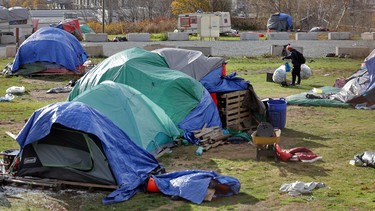
It could have been on Salt Spring Island, B.C., until recently the province’s highest per capita capital of homelessness, where, according to the president of the local chamber of commerce, “derelict sailboats and multiple people living on little floating rafts” can be seen in Ganges Harbour.
It could have been in Shubie Campground, in Dartmouth, N.S., where the city is helping to cover the costs of people renting RV spots over the winter as a housing option.
In a count taken in the fall of 2024, the federal government estimated nearly 60,000 people in 74 communities in nearly every province and territory were experiencing homelessness on a single night. This was part of the “Point in Time” enumeration, which captures a one-night snapshot of homelessness.
Next May, Statistics Canada will add two questions to the national census asking respondents if they have experienced sheltered or unsheltered homelessness or if they have been compelled to bunk with friends or family members.
* * *
Back on Twelve Mile Creek in St. Catharines, the fire has gone out, in more ways than one.
“A spirit guide told me that 33 was going to be a bad year for me,” Gigi says. “And now I’m 33.”
As a last resort, she removes her right shoe and peels off her knee-high hose, clicks her lighter and watches the fabric sizzle and flare.
Article content
They’re in business.
“We would like to get on with our evening now,” Gigi says, gently urging a visitor back up the hill toward the city and the autumn night.
In 2025, mushrooming tents and middens of trash are as much a part of any Canadian townscape as the library, the arena and the bandshell in Centennial Park.
Thus it happened that, over the past few years, an untended triangle of lumpy lawn at the corner of Niagara and Church streets in St. Catharines, behind the Salvation Army, became strewn with rotting food, jettisoned charity, and enough syringes to deliver poison to kill every citizen of the Garden City two or three times over.
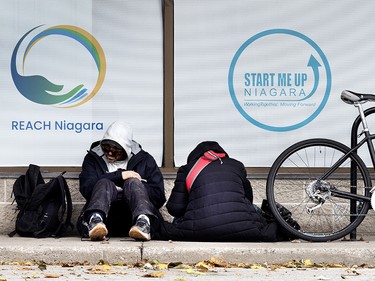
“You drive by there and there’s garbage everywhere. You see crack pipes, you see all the stuff lying all over the place,” a concerned resident of the city is reporting. “You see all of their cotton balls, their alcohol swabs.
“The city of St. Catharines did clean up the encampments that were along Gale Crescent. They cleaned all of that up. Wonderful, fabulous. But we still have the drugstores, and I don’t care if this is government-funded or not, but like, let’s hand out free meth to all these people? Right?
“So, these people line up at the drugstore every day, same time. They sit on the street, they throw their garbage everywhere, and they get their stuff, and then they’re whacked out for however long. And they make a mess. They piss, they sh-t, and there are no consequences. No consequences.”
Article content
This is from Tim Toffolo, a tall and garrulous man who dresses for a Niagara winter in sandals and a Hawaiian shirt, and his partner, the more sartorially sensible Silva Leone. They are at a Tim Hortons a few blocks from Calvin Street, and Abdalla Yaya, and Gigi and Nick.
Toffolo is a real estate sales rep who was a pretty good hockey player before he mangled his shoulder beyond repair in junior and later bought the team down in Port Colborne, Ont. Now out of the hockey business, he and Leone recently acquired a property not far from the unkempt corner of Niagara and Church.
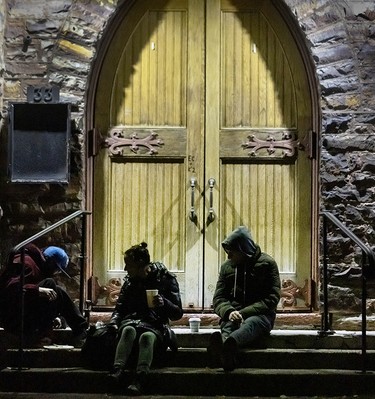
“It angered us and it saddened us,” he says of their daily drive-by. “It got to the point after seeing it so long, it just kept on going through my head, OK, there’s no way the mayor hasn’t seen this. There’s no way the councillors haven’t seen this. There’s no way that city workers haven’t seen it. There’s a fire station right across the street!
“We started making phone calls and asking questions, and we started to go around in a circle on the mayoral merry-go-round. No institution and no government entity was doing anything.
“And we just said, OK, enough’s enough. We’re going to go do it ourselves.”
In early November, the couple went to the site — it is registered to a numbered corporation — and stuffed as much crap as they could into black garbage bags, taking care not to impale themselves on the hundreds or even thousands of needles resting in the weeds.
Article content
“I couldn’t believe what was being thrown away in that lot,” Leone says. “Running shoes that had never touched the ground. New clothes that still had the tags on them. Those do-gooders who are giving this stuff away — and I am one of them — they need to know that it’s just going to be burned for a fire.
“Some people are probably going to say that we’re cruel to the homeless,” she says with a shrug.
“Enough’s enough,” Toffolo repeats. “If we don’t fix this problem now, 15 years from now it’s going to be worse.
“It’s got to be that, if you’re doing drugs, you’re going in an institution to get cleaned up and you don’t have a choice,” Toffolo says.
“As a country, we need to take care of our own,” he continues. “And that’s not happening. It’s pretty scary that we, the people of Ontario, of Canada, have let our cities get to this point.”
Article content
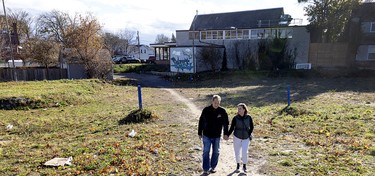
“Is ‘destroyed’ too strong?” the couple is asked.
“I don’t think so,” Toffolo replies. “Our culture, our safety has been destroyed.
“I can walk down the street on any given day at any given time, and I guarantee you I can see somebody on the side of the road smoking crack, injecting themselves. What are we doing about it?
“You can keep talking all you want, but boots on the ground are what makes the changes. Hopefully, we’re going to have people joining us and saying, ‘Hey you know what? We’re not going to accept this.’ But it’s going to take boots on the ground.”
Article content
* * *
Three days before Halloween, Chad Nikiforow of Owen Sound, Ont., was awakened at 4 a.m. by a disturbance in the unlocked “mud room” of his home on Third Avenue West. The clothes dryer was running, its door propped open by a ski pole. Chad’s wife Ruth and their two school-age children were slumbering upstairs.
Long known humorously by a fluke of geography as “the elephant’s asshole,” Owen Sound is the seat of Grey County, population about 21,000, and the commercial gateway to the scenic Bruce Peninsula. (Look at the map: the Bruce is the elephant’s tail, Windsor is at the tip of the trunk, Niagara forms the beast’s front legs, and so on.)
Downtown Owen Sound offers a wallet-draining gallery of high-end boutiques, including a certain gourmet cheese shop that, one local resident notes, “is about as frou as you can frou.”
As October ended, the big car ferry that plies up to Manitoulin Island — the 50-year-old MS Chi-Cheemaun — was tying up in dry dock for the winter a few blocks from Chad and Ruth Nikiforow’s address. But so was one of the largest per capita rosters of homeless in the province. For the Nikiforows, the crisis everyone in Owen Sound had been talking about for years had literally hit home.
Article content
“At first I didn’t even realize anybody was in there,” Chad reports. “I thought an animal had gotten in because it didn’t dawn on me — why would anybody be on my back porch? And then, OK, it was probably some person, because there’s food here and a big mound of sheets on the floor.
“Then I see somebody’s hiding their face in the sheets, just the head poking out of a hoodie. I stood there for a couple of minutes and then I’m like, OK, well, I don’t necessarily want to have a confrontation here at four in the morning.”
I think things are just going to get worse and worse until everybody wants to leave.
Chad Nikiforow
“He didn’t immediately want to talk to them because he didn’t want to be a big, bad bully,” says Ruth. “So, then the police come, and they’re like, ‘Male or female?’ My husband’s like, ‘I don’t know.’
“There was no pee on the sheets. There was no sign that it was drug-related. It was a human being looking for food and shelter.”
Even in little Owen Sound, the hooded woman or man on the back porch was hardly an outlier.
“Every night there’s anywhere between 50 and 100 people in the same situation,” says Chad. “Across the street, they had all their sheds broken into, and they stole all their power tools like chainsaws and weed whackers. If you’re going to be kicking through fences and breaking into sheds trying to steal power tools, you’re probably pretty desperate.
Article content
Article content
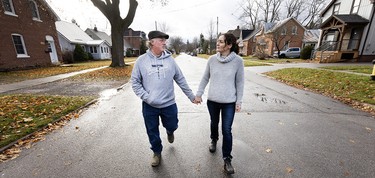
“But that’s no excuse. There’s tons of people, millions of people around the world that have bad lives and traumas and stuff like that. It’s all about the choices you make. You can let that affect you or you can choose to get on with your life and try to make something of it.
“The way I figure it is, I pay enough tax dollars. I pay enough fees and licensing and registrations to the government, which is supposed to deal with things like that. It’s the government that should fix it somehow. Quit wasting money.
“I just don’t think it’s going to be solved in my lifetime. I think things are just going to get worse and worse until everybody wants to leave. In the 50 years that I’ve been alive, I wouldn’t say things have improved at all.
“Two years ago, we did a big trip to Thailand and Vietnam. Those places are listed as Third World countries, but then when you compare the quality of life here to the quality of life there, for the average person I would say Canada is a Third World country. As far as homelessness goes, you don’t see the same kind of homelessness and drug addiction over there.”
“So, are you ready to pack up and move?” Chad Nikiforow is asked.
“Yeah, I would go for sure. Take the kids, put them in an international school. I just got to convince my wife. She still thinks this is as good as it gets.”
Article content
* * *
That frou-frou fromagerie in downtown Owen Sound is The Milk Maid, after the painting by Vermeer. It offers a splendid array of domestic wines and pungent cheeses at equally pungent prices, not to mention curated charcuterie boards and crusty sourdough that resemble the loaves depicted by the 17th-century Dutch Master. The Jean Valjeans of the world would be sorely tempted.
“Yeah, we’re the elephant’s asshole, but in this region we’re the main hub, right?” says Robin Miller, the shop’s co-owner. “We’ve got the biggest hospital around here, we’ve got all the recovery-type, the rehab-type facilities, safe needle spots, soup kitchens, that sort of thing, but not a huge amount of industry or tourism as opposed to a lot of the other communities in the area. And so, I think we just kind of get a lot of the problem cases.
I feel like it’s going to keep getting worse.
Robin Miller
“Dregs is not the word, obviously, I wouldn’t want to demean anyone, everyone’s life matters. But yeah, we get a lot of folks who are struggling with different things, lower income stuff. You know, the housing cost is crazy everywhere, but it’s especially so here. There’s not a lot of affordable options.”
The first four people a reporter meets in Owen Sound all warn him not to go downtown, especially after dark. Do your dining and shopping up the hill along the usual strip of Tim Hortons, Harvey’s and Home Hardware, they advise.
Article content
“At one time it could have been said that shoppers and visitors just felt uncomfortable downtown, but that feeling has changed. It is now a feeling of being unsafe and this is no longer acceptable,” Owen Sound Police Board chair John Thomson wrote in May.
Even tiny Wiarton, Ont., one-tenth the size of Owen Sound, had a $300,000 drug bust in mid-October. The Ontario Provincial Police called it “a significant disruption to the illegal drug trade in our region.”
“Obviously, there is a drug and a homeless side of it,” Miller says. “But there’s a full demographic of folks, and we like being one of the spots downtown that, when people come in here, it’s like a little safe spot, and they just get this little bubble in here and enjoy themselves.”
Owen Sound has a social agency infrastructure, homeless response teams, shelters, harm-reduction facilities, medical treatment. “So, does this end with this generation of homeless, do you think?” Miller is asked.
“I feel like it’s going to keep getting worse,” he answers. “We are, thankfully, in an era where there is more awareness and acceptance and money going into mental health, which is good. And more people are understanding, that it’s not just, ‘Oh, throw them in jail.’
Article content
Article content

“Unfortunately, I don’t see it getting any better. They can’t help themselves, especially when it comes to the most scientifically designed drugs that are made to hook them and keep them hooked forever.”
Yet for the desk clerk at a motel up the hill on Sixth Street in Owen Sound, it wasn’t forever.
Jennifer Shute, now 43, once was the vulnerable princess of a family she labels “riddled with addiction.” She says she tried to kill herself when she was 17.
“There was sexual abuse and then I was in physically abusive relationships,” Shute says. What followed was addiction to injectable drugs and winter nights in her car, running the heater until the gas ran dry.
Eleven months in a treatment centre got her clean. “It worked, but you have to want it,” she says. “All you can do is meet them at their level. If you put them on a bus and ship them to Toronto, that’s what Toronto does right back to us, because we have detox, we have treatment centres, we have mental-health facilities.”
“Can you lock them in a cell or a treatment centre so they can’t get the stuff?” she is asked.
“Oh, they can get it in jail. It just costs more money, but they can abuse all kinds of things in jail. I’ve seen them take methadone, drink it down, vomit it back up and share it,” says Shute.
Article content
Despite the drugs, the trauma and the homeless, Shute says she’s stayed in Owen Sound because of her family. “If I can’t be clean and sober here, where my kids are, I’m just running from the triggers head-on, I’m just running from the problem.
“I have a car again. I have a life. I have an apartment of my own. My kids are with me.
“I’ll never be sure it’s permanent for me. All I can do is today.”
* * *
Higher than the single-night count by the federal government, the Association of Municipalities of Ontario estimates more than 80,000 persons were homeless in the province in 2024.
Of these, the handsome village of Cayuga enumerated exactly one. Or maybe two. But not at the same time.
It’s a sunny November morning along the Grand River and the local folks are trying to help an out-of-towner track down a man who is described as being in his 60s, and who is as elusive — probably on purpose — as Bigfoot.
“He usually sleeps on the cement slab behind the restaurant,” someone offers.
“He hangs out by the abandoned mill on the river.”
“You can find him over by the picnic tables …”
“He’s very to himself,” says Jordan Fowler, who, with his wife Whitney, has operated the lovely Carolinian Café and Eatery in Cayuga for the past seven years. “Like, you’ll ask him a lot of questions, and he’ll just kind of have one-word answers. So, you don’t try to try.
Article content

“He has never been a threat. I think that there inevitably is this reaction of, ‘Who is that?’ It’s a stigma that gets perpetuated that homeless people should be feared. And I just think it’s patently untrue.”
Fowler estimates that 75 per cent of Cayugans would try to help the elusive man, “and 25 per cent,” he says, “are like, ‘Get him out of here.’”
“Would you let him live in your backyard?“ Fowler is asked
“I would certainly put him in a position, if he wanted it, to gain traction, if he showed an inkling for wanting change, if he showed to me that he wanted to get a job and do better for himself, I would, yeah. The only way to help is to be compassionate. The homeless already know that they’re making the wrong mistakes.”
“What if there was not one, but 50, and tents and needles and garbage and junk. Would people get fed up then?“ Fowler is pressed.
“I can certainly see how that would get to somebody,” he says.
“Has it reached that point in Cayuga?”
“Oh, God. Not even close.”
“It’s like we put homelessness into one big box,” Whitney Fowler says. “People say, ‘they are drug addicts. They are derelicts.’ But no, they’re all different. They’re human beings just like all of us working-class people.
“We’re putting them all into one box but we’re all so f–king different.”
Article content
* * *
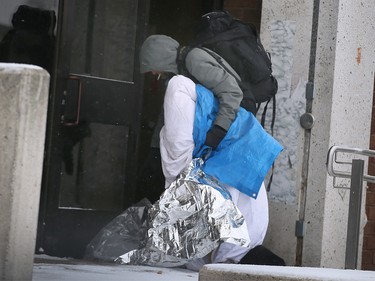
The top 10 for per capita homelessness in Ontario starts with Sudbury, North Bay and Thunder Bay. St. Catharines and Owen Sound and little Cayuga don’t even make the top five.
Down at No. 10 is Barrie, once one of those idyllic villages Stephen Leacock described as lying in “a land of hope and sunshine where little towns spread their square streets and their trim maple trees beside placid lakes almost within echo of the primeval forest.”
Barrie isn’t a village anymore, and that forest got pretty darn primeval last January, and again this summer, when one of Ontario’s 80,000 unhoused citizens murdered two of his tent-neighbours and sliced them into pieces.
But progress is being made, depending on how you measure progress. In early November, two months after he proclaimed a state of emergency, “strong mayor” Alex Nuttall declared his city had scoured 39 camps, trucked away 400 tonnes of waste, and helped move some 68 people from tents into indoor spaces.
“You want to live in a tent on the side of the road, in a forest, or in an environmental protection area or in a park, Barrie’s not the place for you,” the mayor said.
“Morally cruel,” one advocate spat back.
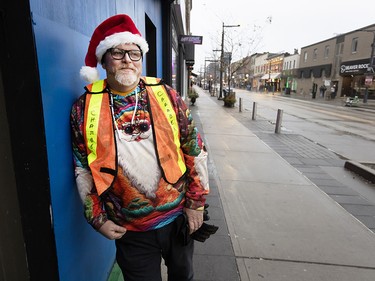
A reporter rolls into Barrie on an absolutely wretched afternoon, just in time for the Santa Claus parade. Of course, the rain stops the instant the Jolly Old Elf’s float gets rolling up Lakeshore Drive. The sidewalks are packed and, for one night at least, the city is what a city should be at holiday time.
Article content
“We shouldn’t have let it get to the point where we had to make a state of emergency, but the mayor had to do something,” one man in Christmasy regalia observes. This is retail butcher Aaron Kell, who retains one outlet in Cookstown after being forced to close his Barrie outlet because of an absolutely wretched economy.
“Why do you think it happened here?” Kell is asked.
“Because this is a great place to be homeless,” he replies. “I think that the Barrie police do what they can. I think the citizens in Barrie are a big-hearted people.
“I feel bad for these businesspeople that have to deal with all of this. I can see why some people would think that Barrie is destroyed. But I also think that there’s certain parts of Toronto that are destroyed, but I don’t live there.
“To be homeless is just one paycheque away for a lot of people. You never know — one bad decision or somebody laying you off, suddenly you can’t pay your rent and you’re homeless.
“It could be you. If it was me, I’d pick Barrie.”
* * *
Back to the Garden City and Twelve Mile Creek and Gigi and Nick.
“It’s all about outlook,” Gigi, the former high school athlete, is saying by her sad circle of stones.
Towering above the creek and the man and the woman and their feeble little fire is a highrise apartment building, bright-lit and inviting, a safe home for many someones.
“Are you jealous of those people?” a well-fed stranger wonders.
“No,” says Gigi H. “I am happy for them. If I would have a million dollars, I would still live in a one-bedroom.
“Nobody owes me anything,” she says. “I owe it to myself.
“I love my country. Canada doesn’t owe me a thing.”
Article content