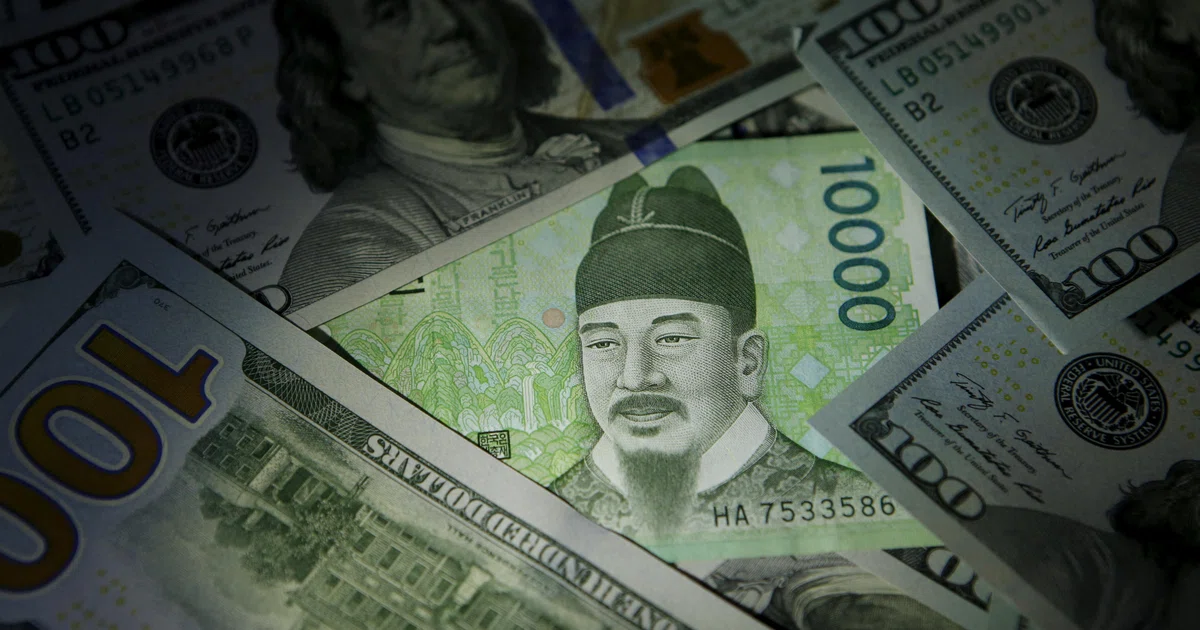
The won has been Asia’s worst-performing currency in the second half of the year
[SEOUL] In South Korea, calls for action to stem the won’s decline are getting louder by the day.
On Thursday (Dec 18), the finance ministry warned of increased volatility and said it would take swift measures if needed, while the government eased FX rules to boost onshore US dollar liquidity.
Presidential policy chief Kim Yong-beom is set to hold an emergency meeting with seven conglomerates to discuss FX issues, Korea Economic Daily reported, citing people in the presidential office it did not identify.
The pressure comes as the currency nears the psychologically important 1,500 level – a threshold breached only during the global financial crisis and the Asian currency meltdown in 1997 – even after authorities leaned on a raft of familiar defences in recent months.
The country’s National Pension Service (NPS) was said to have sold US dollars to bolster the won, while South Korean brokerages have decided to halt new marketing of overseas equities.
The won has been Asia’s worst-performing currency in the second half of the year, sliding about 8 per cent against the US dollar. A sharply weaker currency risks importing inflation and accelerating capital outflows, complicating the Bank of Korea’s efforts to ease policy to support faltering growth.
A disorderly depreciation could also erode foreign investor confidence in the country’s financial stability, potentially creating a vicious cycle where a weaker won drives further outflows.
“The authorities need to forcefully push back against long-US dollar sentiment and draw a clear red line,” said Gyeong-Won Min, an economist at Woori Bank. When US dollar-buying accelerates “peripheral measures can’t contain the rise in the exchange rate – in the end the authorities need to step in with actual intervention.”
The won’s slide coincides with broader currency strains across Asia. Japan is grappling with renewed yen weakness amid fiscal concerns and the Bank of Japan’s slow pace of rate hikes. India’s rupee has fallen to record lows on US tariffs and equity outflows, prompting the central bank to intervene through US dollar sales this month. A stabilisation in the greenback after months of declines has only amplified the pressure on regional currencies.
South Korean authorities have begun widening their response. The government eased FX rules to lure inflows, and said supervisory burdens tied to enhanced FX-liquidity stress tests for financial institutions would be eased through the end of June next year, according to an emailed statement Thursday.
Bank of Korea governor Rhee Chang Yong also signalled discomfort on Wednesday, saying the current exchange rate poses risks for both inflation and growth.
The won weakened “unnecessarily” due to domestic factors, and the FX policy has room to address not just volatility but also the currency’s level through coordination, he added.
The NPS remains a key lever. In December, the fund – which held about US$542 billion of foreign assets – was said to have begun selling US dollars as part of a tactical hedging strategy. The organisation, which usually acts on policymakers’ behalf to support the FX market, has said it will be more flexible in its hedging strategies. The move signalled to the market that the NPS may act more preemptively than investors had thought.
But even after the push back, the won has continued to weaken. It dropped for a third straight day to 1,478 per US dollar on Thursday, close to its weakest since April.
The sell-off has been fuelled by a relentless exodus of foreign capital despite the boom in semiconductor exports, as well as local investors’ outbound investments and fears that increased investments in the US – planned as part of tariff negotiations – could put pressure on Korea’s FX market.
The next move by authorities will need to be well-calibrated, said Wee Khoon Chong, senior APAC market strategist at BNY.
“FX smoothing requires delicate but forceful manoeuvreing, and an ineffective operation might yield undesirable effects, with depreciation momentum becoming unhinged,” he said. BLOOMBERG
Decoding Asia newsletter: your guide to navigating Asia in a new global order. Sign up here to get Decoding Asia newsletter. Delivered to your inbox. Free.