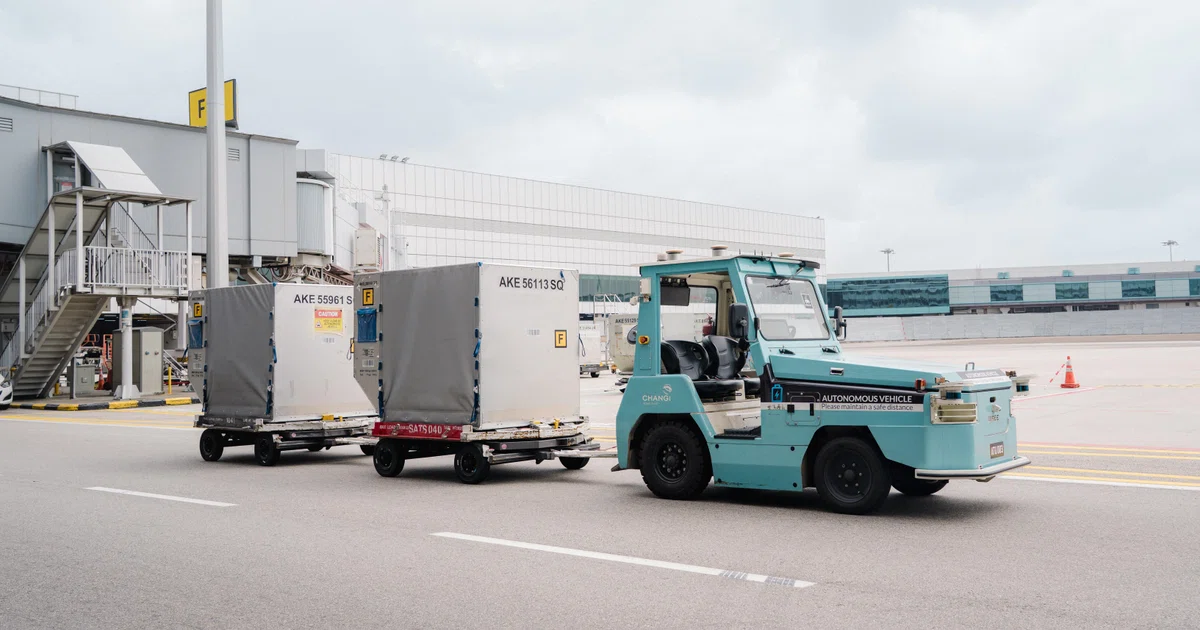
[SINGAPORE] Changi Airport on Tuesday (Jan 20) announced that it has deployed its first fleet of fully autonomous tractors for airside operations following almost a year of trials.
The world’s fourth-busiest airport is now using two such tractors to transfer passenger bags between Terminal 1 and Terminal 4’s baggage handling areas in live operations, having completed more than 5,000 test trips.
Autonomous tractors free up airside workers from driving tasks, enabling them to focus on “last-mile operations”, said Changi Airport Group (CAG). The launch also “signals Singapore’s commitment to pioneering smart airport technologies” and increases “manpower productivity while enhancing safety and reliability”.
Each tractor has more than 10 sensors and cameras to enable the vehicles to navigate the “complex airside environment in all conditions”. The autonomous tractors are also monitored in a control centre during operations where a remote operator can intervene instantly, if needed, said CAG.
Another six such autonomous tractors will be deployed to a different route between Terminal 2’s baggage handling area and aircraft stands later this year to support baggage operations under a collaboration between ground handler Sats and CAG.
The fleet will be expanded to 24 vehicles by 2027 and more autonomous tractors will be deployed to tow cargo and equipment, in addition to baggage.
Navigate Asia in
a new global order
Get the insights delivered to your inbox.
This project is co-funded by the Civil Aviation Authority of Singapore (CAAS) and “aligns with Changi Airport’s broader innovation strategy”, which the group said includes the integration of autonomous technology into airside operations, the use of artificial intelligence in initiatives such as “Aircraft 360”, as well as automation and robotics to increase manpower productivity.
“As Changi scales up to meet the operational requirements of Terminal 5 by the mid-2030s, such innovations will enable CAG and its partners to redesign and upgrade the job scopes of airside workers, to improve their productivity,” said CAG.
“Such productivity improvements and upgrading of airside roles are critical to grow the Singapore air hub to meet the future demands of air travel,” it added.
The Singapore aviation sector could see 30 per cent of the existing workforce – primarily in ground handling – undergoing job redesign in the next five years, according to CAAS’ Aviation Jobs Transformation report in July 2025.
Angela Ng, director of aviation industry at CAAS, said: “The scaled deployment of autonomous tractors allows CAAS, CAG, Sats and our unions to work together to implement the technology, develop new systems and protocols and set up job redesign programmes to help our workers adopt technology and transition to higher-value work.”
She added: “Lessons learnt here will be useful for the sector’s wider technology adoption and job transformation efforts.”
Decoding Asia newsletter: your guide to navigating Asia in a new global order. Sign up here to get Decoding Asia newsletter. Delivered to your inbox. Free.