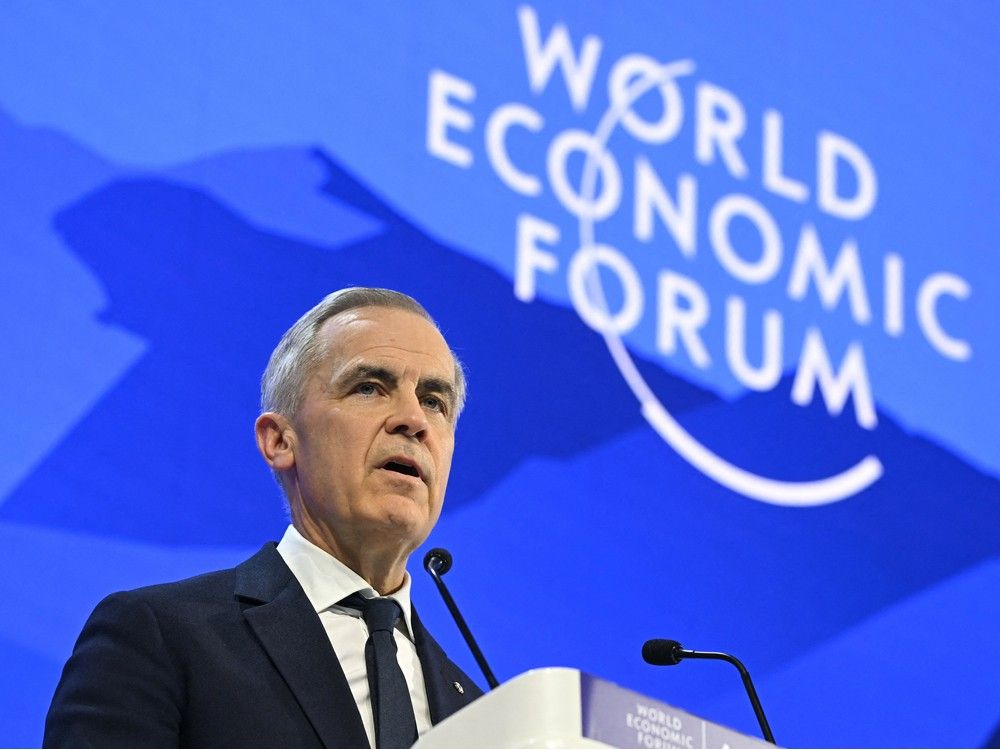
OTTAWA — Surrounded by global elites and influencers, Mark Carney stepped on the global stage and crystallized what many had been thinking: it’s time to accept that the world order of the last 80 years has dramatically and permanently changed.
It’s a “rupture,” Carney told the World Economic Forum audience at Davos, Switzerland on Jan. 20, “not a transition.” The “rules-based international order” is gone and not returning any time soon, the Canadian prime minister said in a speech that attracted global attention.
Without naming names, the Canadian prime minister told the gathering that the United States could no longer be relied on to lead the international alliance of democracies, or to follow the rules that it largely created. Those rules and America’s hegemonic ability to enforce them, he said, had largely been responsible for international order in recent decades, not to mention stable economic and financial systems.
But that’s now all up for grabs, Carney said.
To confront this new world, Carney offered at least the starter kit to build a collective resistance to the new order: the notion that “middle powers” such as Canada need to work together to try to act as a counterweight to the superpowers and to rework key international institutions.
While this notion of middle powerdom may seem like a novel approach in an era dominated by two superpowers, it’s in fact an echo from more than a couple of generations ago, an era that many international affairs specialists refer to as “the golden era of Canadian foreign policy.”
Foreign policy specialists, however, warn that the two eras are very different and a return to that so-called golden era, where Canada punches above its weight by leaning into its role as an honest broker and middle power, is unlikely.
The key difference, said Fen Hampson, a foreign affairs specialist at Carleton University in Ottawa, is that Canada no longer has a special relationship with the U.S.
“The golden age was very different,” said Hampson, also co-chair of the Expert Group on Canada-U.S. Relations at Carleton. “We’re not in the middle — we’re on the menu.”
That past era, usually seen as a two-decade stretch from the end of the Second World War to roughly the mid-1960s, is nostalgic for many Canadians who were around at the time, or have studied foreign policy from that period. North America was the envy of the world in its prosperity, life for tens of millions on this continent seemed to be on the constant upswing, and much of the world – pretty much every key region outside China, the Soviet Union’s Eastern European bloc and a few satellite countries – was under the leadership of the U.S., Canada’s neighbour and closest ally.
That gave Canada some pull and prestige on the international stage. Ottawa used the leverage of that relationship for its own political, economic and security benefits, while choosing its moments to act as broker between the U.S. and other countries, particularly the European powers, to advance stability and other aims. That golden era for Canada in the world reached a zenith in 1957 when then foreign affairs minister Lester B. Pearson won a Nobel Peace Prize for his role in preventing war during the Suez Crisis a year earlier and in creating the first United Nations peacekeeping force.
For those intrigued by the idea that Carney’s speech may be the start of a return to this era where Canada plays a special middle-power role, foreign policy specialists say it’s highly unlikely.
There are similarities, however. Canada is once again pushing back against a superpower. Today, it’s of course Trump’s America, whereas during the Suez Crisis, it was mostly two weakened, post-war European powers: Britain and France. Another overlap is that Canada’s response in both cases was to emphasize the need for a rules-based international order and the potential for middle powers to collaborate.
But foreign policy specialists say that’s pretty much where the comparison ends. The critical difference between the two periods, Hampson said, is not just that Ottawa has lost its special status in Washington, but that the two North American neighbours are clearly at odds.
“The problem we face now is there’s zero respect and it’s mutual,” said Hampson. “What’s different now is that Washington is the problem: it’s gone rogue.”
The U.S. was arguably the biggest beneficiary and leading creator and enforcer of the rules-based world after the Second World War. Washington led the way in designing international institutions such as the International Monetary Fund (IMF), World Bank and the United Nations itself, locating each on home turf.
But Carney said the world needs to face that that is now history.
“Nostalgia is not a strategy,” he told the international crowd.
So where to from here?
Mark Manger, a professor of political economy at the University of Toronto’s Munk School of Foreign Affairs, said
Carney’s speech may turn out to be a good start or framework for Canada and others to move forward but that there are many questions ahead, particularly how much distance the U.S. wants from its former allies.
“It’s untested if this has any purchase when the U.S. is not interested,” he said.
Manger said focusing on other middle powers is a sound strategy for Canada, but that revising international institutions and rules within the new landscape won’t be easy. “This is all a work in progress.”
Faced with a hostile American neighbour who repeatedly says it doesn’t need Canada, Carleton’s Hampson said this country has never been so exposed during the post-war period. Any international collaboration among mid-sized or smaller countries is likely to be more transactional or sectoral in a “mini-lateralism” way, Hampson added, as opposed to any sweeping partnership that could be compared to the relationship that Canada and the U.S. have had on trade, security, resource management and other issues.
“We’re kind of out on a limb here,” he said.
If the tone and productivity of the bilateral relationship over the coming years is now largely in Trump’s court, it’s not off to a good start post-Davos. Beyond rescinding his invitation to Carney to join his peace board, Trump fired back that Canada “lives because of the United States.” Again, without naming names, Carney responded by saying that his country “thrives because it is Canadian.”
National Post
Our website is the place for the latest breaking news, exclusive scoops, longreads and provocative commentary. Please bookmark nationalpost.com and sign up for our daily newsletter, Posted, here.