
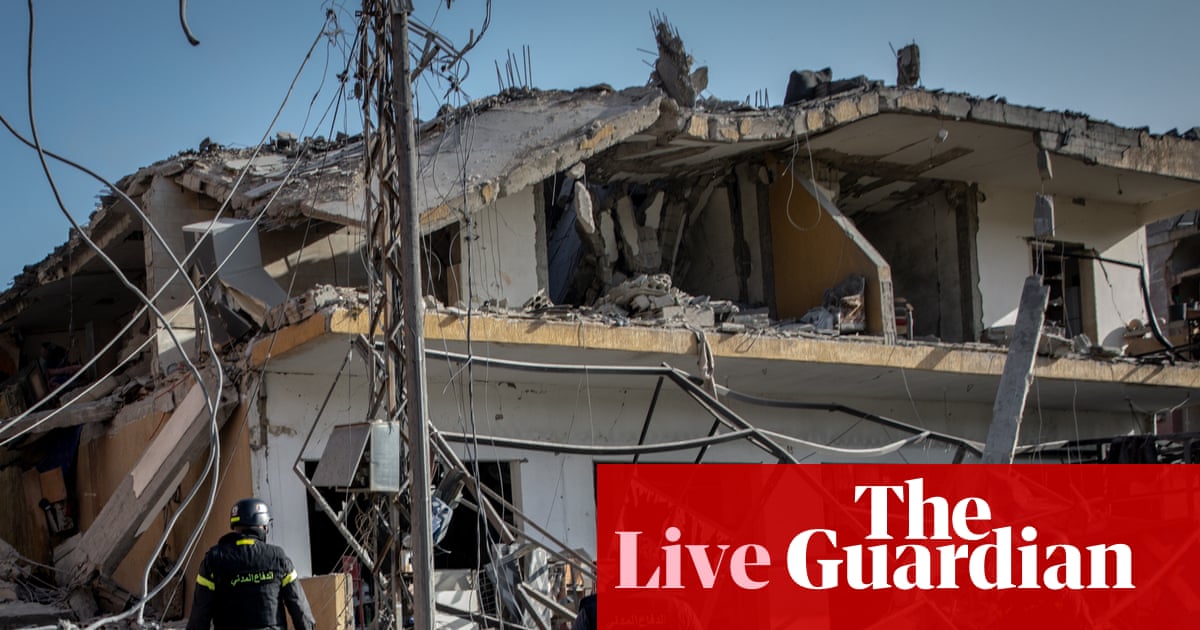
Middle East crisis live: US blockade of strait of Hormuz begins as Hezbollah urges Lebanon to pull out of talks with Israel
Hezbollah says it will not abide by agreements from Lebanon-Israel talks
The Lebanese militant group Hezbollah will not abide by any agreements that may result from direct Lebanon-Israel talks in the US, negotiations it firmly opposes, a senior Hezbollah official has said.
Wafiq Safa, a high-ranking member of Hezbollah’s political council, spoke on the eve of talks expected in Washington between Lebanese and Israeli ambassadors to the US.
It will be the first time in decades that envoys from Lebanon and Israel, which do not have diplomatic relations, meet face-to-face in direct talks.
“As for the outcomes of this negotiation between Lebanon and the Israeli enemy, we are not interested in or concerned with them at all,” Safa told the Associated Press.
Separately, the leader of Hezbollah urged Lebanon to pull out of the talks with Israel. Naim Kassem spoke in a televised address on the eve of the scheduled meeting.
The latest round of fighting was sparked by Hezbollah firing rockets into northern Israel on 2 March, after the US and Israel attacked Iran.
At least 2,055 people have been killed in Israeli strikes in Lebanon, the health ,inistry says, among them 252 women, 165 children and 87 medical workers, while 6,588 others were wounded. More than 1 million people have been displaced.
Lebanon’s government – which says it is committed to disarming Hezbollah – had called for direct talks early on in the war. Last week, Israel announced its approval of talks.
Key events
The day so far
It’s 9.30am in Tehran, 9am in Tel Aviv and 2am in Washington DC – and if you’re just joining today’s live coverage of the US-Israel war on Iran, here’s a summary of the latest to bring you up to speed.
-
The US blockade of ships using Iranian ports in the Gulf began on Monday, turning the six-week-old conflict between the US-Israeli coalition and Iran into a test of economic endurance.
-
Iran’s president, Masoud Pezeshkian, warned that any threat to the strait of Hormuz would have “widespread consequences for the world”, according to Iranian media. Pezeshkian reportedly told French president Emmanuel Macron yesterday that the US’s “excessive demands” had thwarted an agreement during the weekend talks in Pakistan.
-
US Central Command said the blockade would apply to any ships entering or departing Iranian ports or coastal areas, while ships using non-Iranian ports would not be impeded.
-
Donald Trump claimed at the White House that “we’ve been called by the other side”, which would “like to make a deal very badly”. He insisted the US would not agree to any deal that would permit Iran to have a nuclear weapon, saying: “We can’t let a country blackmail or extort the world.” News reports indicated US officials were continuing talks with Tehran.
-
Oil prices plunged and stocks rose on Tuesday on hopes for a deal to end the war.
-
Iran criticised the US blockade around its ports on Monday as a “grave violation” of its sovereignty amid the fragile ceasefire. The “unlawful” blockade also “constitutes a serious violation of the fundamental principles of the international law of the sea”, Iran’s ambassador to the UN, Amir Saeid Iravani, wrote to UN secretary general António Guterres in a letter.
-
US vice-president JD Vance accused the Iranian government of engaging in an “act of economic terrorism” by blocking traffic through the Hormuz strait.
-
Talks are expected in Washington between Lebanese and Israeli ambassadors to the US. It will be the first time in decades that envoys from Lebanon and Israel, which do not have diplomatic relations, will meet face-to-face in direct talks. Lebanese officials are looking to broker a ceasefire with Israel.
-
Hezbollah would not abide by any agreements that may result from the Lebanon-Israel talks – negotiations the Lebanese militant group firmly opposes, senior Hezbollah official Wafiq Safa said. Hezbollah’s leader, Naim Qassem, urged Lebanon to pull out of the talks.
-
The Israeli military said one of its soldiers was killed in combat in southern Lebanon and three others injured.
-
Iran proposed suspending its uranium enrichment for up to five years after the US sought 20 years at the talks in Pakistan, the New York Times reported, saying the Trump administration rejected the five-year offer.
-
A tanker sanctioned by the US travelled through the strait of Hormuz on Tuesday, shipping data on LSEG showed, testing the US naval blockade. The tanker Rich Starry is Chinese-owned and has Chinese crew onboard, Reuters cited the data as showing.
Here are some of the latest images coming in from the Middle East in the seventh week since the war began and amid a fragile US-Iran ceasefire.
Iran’s representative to the UN has demanded compensation from countries it says participated in the US and Israeli war effort against Iran.
Iran’s state media reports the nations include Bahrain, Saudi Arabia, Qatar, the United Arab Emirates and Jordan.
Iran’s official news agency, Irna – cited by the AP – said the country’s representative to the UN, Amir-Saeid Iravani, claimed the countries had violated international law and had to “make full compensation for the damages caused to the Islamic Republic of Iran, including payment of compensation for all material and moral damages resulting from their international violations”.
As reported earlier, Iravani denounced the US blockade around its ports on Monday as a “grave violation” of its sovereignty.
Oil prices plunged and stocks rose on Tuesday on hopes for a deal to end the war, with Donald Trump saying Tehran had called to seek an agreement, even as the US blockade of Iranian ports came into force.
While the weekend peace talks in Pakistan ended with no breakthrough, investors took heart from the two sides finding some areas of agreement, with the Islamic republic saying they had been “inches away” at one point, AFP reports.
Meanwhile, April could shape up to be a tougher month than March for energy markets and the economy, the head of the International Energy Agency said.
Fatih Birol said March saw delivery of cargo loaded before the crisis in the Middle East, but “during the month of April, nothing has been loaded”.
“The longer the disruption is, the more severe the problem becomes,” he told reporters after a meeting at the International Monetary Fund in Washington on Monday.
Russian foreign minister Sergei Lavrov has touched down in Beijing and hopes to boost cooperation on issues including the war in the Middle East.
China welcomed a string of leaders of countries that have been impacted by the war and its economic fallout on Tuesday, including Vietnam’s To Lam and Abu Dhabi’s Crown Prince Mohamed bin Zayed Al Nahyan.
Lavrov will hold talks with China’s top diplomat Wang Yi, with Russia’s foreign ministry saying they would discuss the war in Ukraine and the situation in the Middle East.
Wang held a call with Lavrov on 5 April, when the pair agreed Beijing and Moscow would work together to deescalate tensions in the Middle East, AFP reports.
Chinese premier Li Qiang, meanwhile, told the UAE leader that Beijing was ready to help restore “peace and tranquility in the Gulf region”.

Patrick Wintour
In a move designed to increase pressure on the US to make compromises in its conflict with his country, Iranian foreign minister Abbas Araghchi has been briefing European capitals on the nature of the offer Iran had been willing to make about its stockpile of highly enriched uranium and future stewardship of the strait of Hormuz during the weekend talks in Islamabad.
After the inconclusive talks, Araghchi held phone briefings with the French and German foreign ministers, Jean-Noël Barrot and Johann Wadephul, as well as the Saudi, Omani and Qatari foreign ministers.
It is understood he stressed that Iran did not regard the Pakistan-led process as exhausted, even after 21 hours of intensive talks.
Europe has been sidelined on the Iran file by Donald Trump for more than a year, as the US president focused on working with Israel, while Tehran has largely dismissed European governments, seeing them as inveterate creatures of America. But the signs of the deepening transatlantic split, and the intense pressure being applied to European economies, has led Iran to review its stance on Europe as a potential lever on Trump.
See the full story here:
The Israeli military says one of its soldiers has been killed in combat in southern Lebanon and three others injured.
“In the incident in which Sergeant Major (Res.) Ayal Uriel Bianco fell, a reservist was moderately injured, and two additional reservists were lightly injured,” the IDF posted on X.
It added the soldiers were evacuated to receive medical treatment at a hospital and that their families had been notified.
Israeli strikes on Beirut and its southern suburbs have reportedly stopped since last Wednesday but intense fighting has continued in southern Lebanon, where ground troops have invaded and Israel says it is creating a buffer zone for security.
South Korean president Lee Jae Myung has said rising tensions around the strait of Hormuz make it hard to be optimistic about the fallout from the Iran war, warning that high oil prices and supply-chain strains are likely to persist for some time.
Lee told a cabinet meeting on Tuesday the government should treat prolonged disruption in global energy and raw materials markets as a given and reinforce its emergency response system.
For the time being, difficulties in global energy and raw materials supply chains and high oil prices will continue … I ask that we pursue the development of alternative supply chains, medium- to long-term industrial restructuring, and the transition to a post-plastic economy as top-priority national strategic projects.”
Industry minister Kim Jung-kwan said disruptions to shipping through the Hormuz strait were still affecting supplies and that even if the passage normalised, it could take about 20 days for Middle Eastern cargoes to reach South Korea.
Lebanon and Israel have not talked directly in decades – but the Iran war has upended the way we understand Middle East politics, as a new Guardian podcast explains, and on Tuesday the two countries are due to begin talks that could help steer the region towards peace.
The negotiations come less than a week after Israeli attacks in Lebanon that killed 357 people – and strained the US-Iran truce that had just been announced. Yet the talks in Washington will not include Hezbollah, which Israel wants to remove from Lebanon.
William Christou reports for the Guardian from Beirut and says it is hard to overstate how surprising the talks are.
Lebanon and Israel have been at war in some form since the early 1980s. You’re not allowed to enter Lebanon if you have an Israeli stamp in your passport. The two don’t have diplomatic relations. So the fact that these talks are happening directly between the two governments is something that’s really astonishing.
So why, asks Nosheen Iqbal, are these talks taking place? Because the US is putting pressure on Israel and Iran also wants a ceasefire so Hezbollah is allowing them to happen.
Yet, Iqbal hears, if the talks result in the Lebanese government and Israel working together to neutralise the Iran-backed militant group, that is also a worry for the Lebanese people because it could lead to civil unrest. “Tensions are ratcheting up,” says Christou.
The podcast is here:
US-sanctioned tanker passes through Hormuz strait
A tanker sanctioned by the US travelled through the strait of Hormuz on Tuesday, shipping data on LSEG showed, testing the US naval blockade.
The tanker Rich Starry is Chinese-owned and has Chinese crew onboard, Reuters cites the data as showing.
Bloomberg reported earlier in the day that the medium-range tanker – earlier known as Full Star – was blacklisted by Washington in 2023 for helping Tehran evade energy sanctions. It was not clear on this occasion whether it visited Iranian ports before its transit or was carrying cargo.
The report continued:
This exit from the Persian Gulf is a second attempt for the carrier in less than 24 hours. Just as the blockade came into effect, Rich Starry was making its way into the narrow waterway near Iran’s Qeshm Island and turned back – only to restart its exit just hours later, broadcasting that it has a Chinese owner and crew. This is a safety mechanism frequently used by vessels, but will test US resolve to challenge vessels tied to the world’s largest oil importer.
The global shipping community and energy traders have been on edge since Trump announced a naval blockade of Iran beginning on Monday at 10 a.m. New York time, leaving them scrambling to understand the fine print. Most of those reached by Bloomberg across the Middle East and Asia said they would pause moves until the detail of the US blockade – intended to restrict Iran’s capacity to sell its oil – was clear.
Earlier today US vice-president JD Vance said negotiations with Iran “did make some progress”, specifically on the US insistence that nuclear material is removed from Iran, as well as on a mechanism to ensure uranium cannot be enriched in the future.
“They moved in our direction,” Vance said in the interview with Fox News. He said he thought Iranian negotiators were “unable to cut a deal” and needed to get approval from others in Tehran.
Vance also said US negotiators made clear that Trump “would be very happy if Iran was treated like a normal country, if it had a normal economy”, but he did not go into details about what he meant.
There really is, I think, a grand deal to be had here. But it’s up to the Iranians, I think, to take the next step.”
Pakistan has reportedly proposed hosting a second round of talks between the United States and Iran in Islamabad in the coming days, before the end of the ceasefire, the Associated Press has reported.
The officials, who spoke on condition of anonymity because they were not authorised to discuss the matter with the press, said the proposal would depend on whether the parties request a different location.
One of the officials said that, despite ending without an agreement, the first talks were part of an ongoing diplomatic process rather than a one-off effort.
The White House has not responded directly to queries about whether new talks were being weighed.
“President Trump, Vice President Vance and the negotiating team have made the US red lines very clear. The Iranians desperation for a deal will only increase with President Trump’s highly effective Naval blockade now in effect,” White House press secretary Karoline Leavitt said.
Iran proposes suspending nuclear activities for up to five years – report
Iran has proposed suspending its uranium enrichment for up to five years after the US sought 20 years at the weekend talks in Pakistan, the New York Times is reporting.
It said the Trump administration rejected the five-year offer, citing Iranian and US officials.
The report could not be immediately verified.
The Times said that while the US and Iran traded proposals for suspending Iranian nuclear activities during the weekend negotiations, the countries remained far apart on the length of any agreement, according to the officials.
But it said the discussions “suggested that there may be a path to a peace deal”, even as the US began blockading Iranian ports.
Iran condemns US blockade as ‘grave violation of sovereignty’
Iran criticised the US blockade around its ports on Monday as a “grave violation” of its sovereignty amid the fragile ceasefire.
“The imposition of a maritime blockade constitutes a grave violation of the sovereignty and territorial integrity of the Islamic Republic of Iran,” Iran’s ambassador to the UN, Amir Saeid Iravani, wrote to UN secretary general António Guterres.
The “unlawful” blockade also “constitutes a serious violation of the fundamental principles of the international law of the sea”, Iravani added in the letter, seen by Agence France-Presse.
Donald Trump ordered a blockade of ships entering or leaving Iranian ports and coastal areas in the Gulf that came into force at 1400 GMT Monday, despite the US and Iran agreeing last week to a two-week ceasefire.
Trump warned that any Iranian attack boats that challenged the blockade would be destroyed.
Guterres on Monday called on “all parties” to respect freedom of navigation in the Hormuz strait.
Mediator Pakistan and the gulf state Qatar have continued calls for the truce to be respected as diplomatic efforts continue.
Australia’s PM will seek further assurances on the country’s fuel supply amid the Middle East war during the first prime ministerial visit to Brunei in more than a decade.
Anthony Albanese departed Sydney on Tuesday for a four-day visit to Brunei and Malaysia for talks aimed at safeguarding the flow of petrol and diesel.
Both nations play important roles in Australia’s fuel supply chains, and the trip will build on Albanese’s recent visit to Singapore, another vital exporter.
He will meet with Brunei’s Sultan Hassanal Bolkiah on Wednesday, where fuel will be high on the agenda, reports Australian Associated Press.
Swinburne University engineering expert Prof Hussein Dia described the trip as part of regional “fuel diplomacy” efforts aimed at ensuring long-term supply.
Brunei ships about 9% of Australia’s diesel while Malaysia is the third-biggest supplier, according to the government.
“I don’t think it’s a sign of immediate shortage or to say ‘give us priority’, it’s really to maintain flow,” Dia said, adding the government was likely “planning for a prolonged period of uncertainty”.
Hezbollah says it will not abide by agreements from Lebanon-Israel talks
The Lebanese militant group Hezbollah will not abide by any agreements that may result from direct Lebanon-Israel talks in the US, negotiations it firmly opposes, a senior Hezbollah official has said.
Wafiq Safa, a high-ranking member of Hezbollah’s political council, spoke on the eve of talks expected in Washington between Lebanese and Israeli ambassadors to the US.
It will be the first time in decades that envoys from Lebanon and Israel, which do not have diplomatic relations, meet face-to-face in direct talks.
“As for the outcomes of this negotiation between Lebanon and the Israeli enemy, we are not interested in or concerned with them at all,” Safa told the Associated Press.
Separately, the leader of Hezbollah urged Lebanon to pull out of the talks with Israel. Naim Kassem spoke in a televised address on the eve of the scheduled meeting.
The latest round of fighting was sparked by Hezbollah firing rockets into northern Israel on 2 March, after the US and Israel attacked Iran.
At least 2,055 people have been killed in Israeli strikes in Lebanon, the health ,inistry says, among them 252 women, 165 children and 87 medical workers, while 6,588 others were wounded. More than 1 million people have been displaced.
Lebanon’s government – which says it is committed to disarming Hezbollah – had called for direct talks early on in the war. Last week, Israel announced its approval of talks.
Opening summary
Welcome to the Guardian’s continuing coverage of the crisis in the Middle East.
The US blockade of ships using Iranian ports in the Gulf began on Monday, turning the six-week-old conflict between the US-Israeli coalition and Iran into a test of economic endurance.
US Central Command (Centcom) made no formal announcement of the start of the blockade but had said it would take effect at 5.30pm Iranian time on Monday, and would apply to any ships entering or departing Iranian ports or coastal areas. Ships using non-Iranian ports would not be impeded.
Donald Trump claimed that 34 ships had passed on Sunday through the strait of Hormuz, the gateway to the Gulf, but gave no supporting evidence. Speaking to reporters at the White House, the president also claimed: “We’ve been called by the other side,” who he said would “like to make a deal very badly”.
In other key developments:
-
Trump said the blockade would be on all Iranian ports along the strait from Monday onward. About 20% of the global oil and gas supply moved through the waterway before the war. Seafarers as well as the United Kingdom Maritime Trade Operations received advisories indicating Trump’s blockade would apply to all ship traffic, regardless of the vessel’s flag.
-
Trump claimed that Iran wanted to reach a deal. He insisted the US would not agree to any deal that would permit Iran to have a nuclear weapon. “We can’t let a country blackmail or extort the world,” he said at a last-minute press conference at the White House on Monday.
-
After receiving a McDonald’s delivery at the beginning of the presser, Trump invoked bellicose language in discussing Iran. “Iran will not have a nuclear weapon, and we’re going to get the dust back. We’ll get it back, either we’ll get it back from them, or we’ll take it,” he said. At one point, when questioned about some sort of prior ultimatum regarding Iran, Trump said: “I don’t want to comment on that but it won’t be pleasant.”
-
Talks are expected in Washington between Lebanese and Israeli ambassadors to the US. It will be the first time in decades that envoys from Lebanon and Israel, which do not have diplomatic relations, will meet face-to-face in direct talks. Lebanese officials are looking to broker a ceasefire in the Israel-Hezbollah war.
-
There were reports indicating US officials were continuing talks with Tehran. One official told CNN: “There is continued engagement between the US and Iran and forward motion on trying to get an agreement.” Meanwhile, some administration officials were having internal talks about how a second sit-down with Iranian officials might look should the opportunity arise, the network reported.
-
Trump blasted Pope Leo XIV on social media in response to the pontiff’s call for an end to the war. The president claimed the pope was trying to appease the “radical left”. The pope said he had “no intention to debate” Trump over Iran but would continue to advocate for peace. US vice-president JD Vance urged the Vatican to “stick to matters of morality”.
