
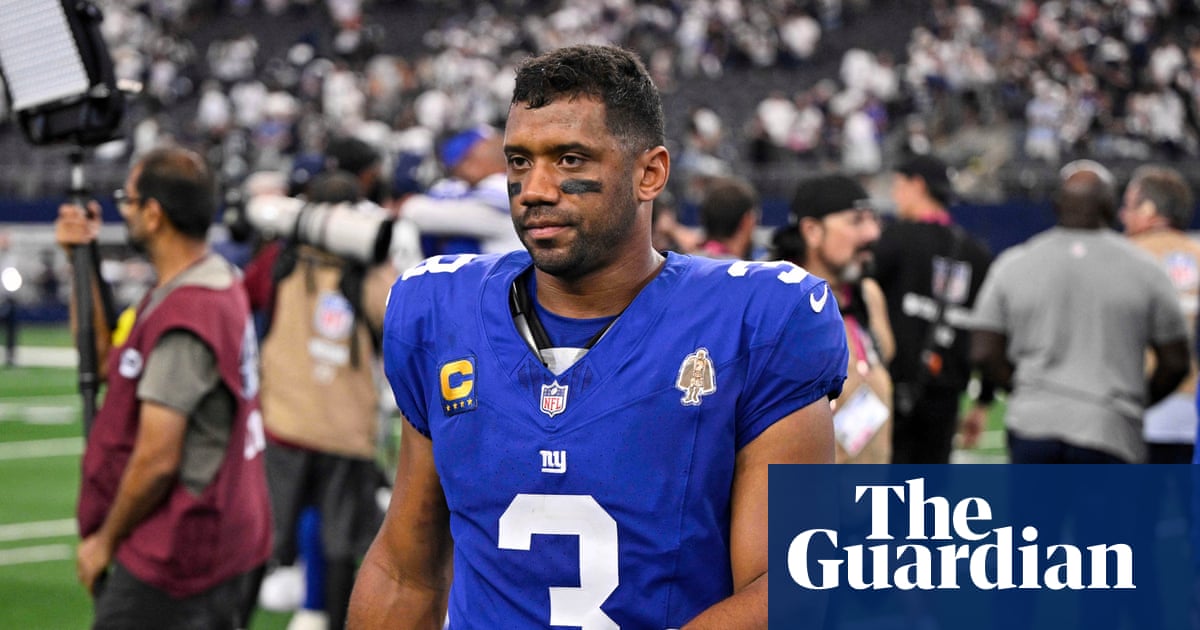
Russell Wilson has retired: is he a surefire Hall of Famer or the NFL’s everyman?
When a quarterback makes 10 Pro Bowls, wins the Walter Payton Man of the Year Award, and leads his team to one Super Bowl win and (almost) another, you’d expect his Hall of Fame discussion would be fairly uncomplicated.
But in the case of one Russell Carrington Wilson, who appeared to announce his retirement on Wednesday after 14 seasons to join CBS Sports as an analyst, that discussion is multi-layered – much like Wilson’s career and legacy.
Wilson should be seen as an uplifting example of a guy who beat all the odds. Despite an outstanding college career, Wilson had to wait until the 75th overall pick in the 2012 draft for his name to be called. It was still an era when Black quarterbacks were treated with skepticism by many scouts and, besides, Wilson was small for his position: 5ft 11in and 206lbs.
It looked at first like Wilson would struggle to play at all. The Seattle Seahawks, who selected him, had just signed former Green Bay Packers quarterback Matt Flynn to a three-year, $19.5m contract. But it didn’t take long for Wilson to demonstrate that he would be the starter no matter what. His teammates were amazed at how he took to the NFL right away. As a Seattle-based reporter who had covered the team since 2010, I watched three deep throws from Wilson during his first day of rookie minicamp. I turned to a colleague and said, “I don’t care how much they paid Matt Flynn. That guy is going to be the Day 1 starter.”
And so it was, after a tremendous preseason that made the difference clear. Wilson made his first Pro Bowl, finished third in the Offensive Rookie of the Year voting, and turned out to be the missing piece in the Seahawks’ championship formula. The Seahawks traded Flynn to the Oakland Raiders in April 2013 for a couple of throwaway draft picks; they knew they had their man.
It all clicked in Wilson’s second season. Along with the power of running back Marshawn Lynch, and one of the best defenses ever in the Legion of Boom, the Seahawks macheted their way through the NFL, ending their season with a Super Bowl beatdown of Peyton Manning’s Denver Broncos, one of the best regular-season offenses in NFL history.
That Super Bowl victory could – perhaps should – have been the beginning of a dynasty, but it wasn’t. Wilson’s last-minute goal-line interception against the New England Patriots in the next season’s Super Bowl resulted from a play call so bad it fractured the team. Many of the Seahawks lost confidence in head coach Pete Carroll, and it never really returned. The Seahawks were unable to reach those heights again in the Carroll era.
Wilson’s antiseptic public persona, about which much has been said and written, eventually rubbed his teammates the wrong way. These were often the same teammates who swore by his modus operandi in earlier years. Wilson was an island. His locker was in a corner of the Seahawks’ locker room, and he was not a creator of community. Most great quarterbacks are leaders; Wilson was not.
This rankled a lot of people, but given the number of alphas in the Seahawks locker room during the Legion of Boom era – including Richard Sherman, Kam Chancellor, Bobby Wagner and Michael Bennett – it could also be said that if Wilson was yet another dominant personality, it would have upset the balance.
The 2022 trade that sent Wilson to the Broncos turned out to be one of the most lopsided in NFL history. For Wilson and a 2022 fourth-round pick, the Seahawks received quarterback Drew Lock, tight end Noah Fant, and defensive lineman Shelby Harris, as well as two first-round draft picks, two second-round picks, and a fifth-rounder. The Seahawks used those picks to help build their next championship roster, while Wilson and Broncos head coach Sean Payton never hit it off. Payton is an exacting designer of offenses. But when you have Russell Wilson, you have to accept that you’re going to play Russell Wilson’s offense: Heavy play-action and shot plays, along with more improvisation than Payton wanted.
Wilson’s two seasons in Denver were bad enough that the team willingly took a $85m dead salary cap hit (the largest in NFL history) just to release him. Two mediocre seasons – with the Steelers in 2024 and the Giants in 2025 – followed, during which his idiosyncrasies came to the fore – and not in a good way.
And because Wilson didn’t have the late-career rebound that other quarterbacks such as Kurt Warner and Rich Gannon enjoyed, there will be very few calls at this point for Wilson’s admission to the Hall of Fame when he’s eligible in five years.
Perhaps with time and distance, that may change.
From 2012 through 2021 – his 10 seasons in Seattle – Wilson’s passer rating of 101.2 was the NFL’s third-best for quarterbacks with a minimum 3,000 passing attempts. That’s behind only Aaron Rodgers and Drew Brees, both slam-dunk, first-ballot Hall of Famers. During that span, Wilson also ranked sixth in passing yards (40,845), his touchdown-to-interception ratio of 317-99 was about as good as it gets (only Tom Brady and Rodgers had more touchdown passes), and if you include the postseason, only Brady (138) played in more wins than Wilson’s 113.
And while Wilson was often dismissed as a quarterback who relied on his team’s run game and defense, as opposed to being a true franchise-defining quarterback, there is the matter of the 2017 season, when the Seahawks’ offensive talent hit its nadir. The offensive line was a disaster, Lynch was gone, and Wilson accounted for all but one of Seattle’s offensive touchdowns. He led the NFL with 34 touchdown passes, and he led the team with three touchdown runs – running back JD McKissic was the only other Seahawk who managed one. The 9-7 Seahawks didn’t make the playoffs that season (the first time in Wilson’s career that they failed to do so), but he carried that team on his back. As all great quarterbacks must at times.
Wilson also set the stage for shorter quarterbacks to find traction in the NFL without the bias he and others had received. The Arizona Cardinals may never have selected the 5ft 10in Kyler Murray with the first overall pick in the 2019 draft without Wilson blazing that particular trail.
Wilson’s legacy is complicated. He was a very good and sometimes transcendent player who did the best he could with what he had, and found that it wasn’t quite enough to convince the world that he was an all-time great.
In that regard, Wilson may be more the everyman than he ever wanted to be.
