
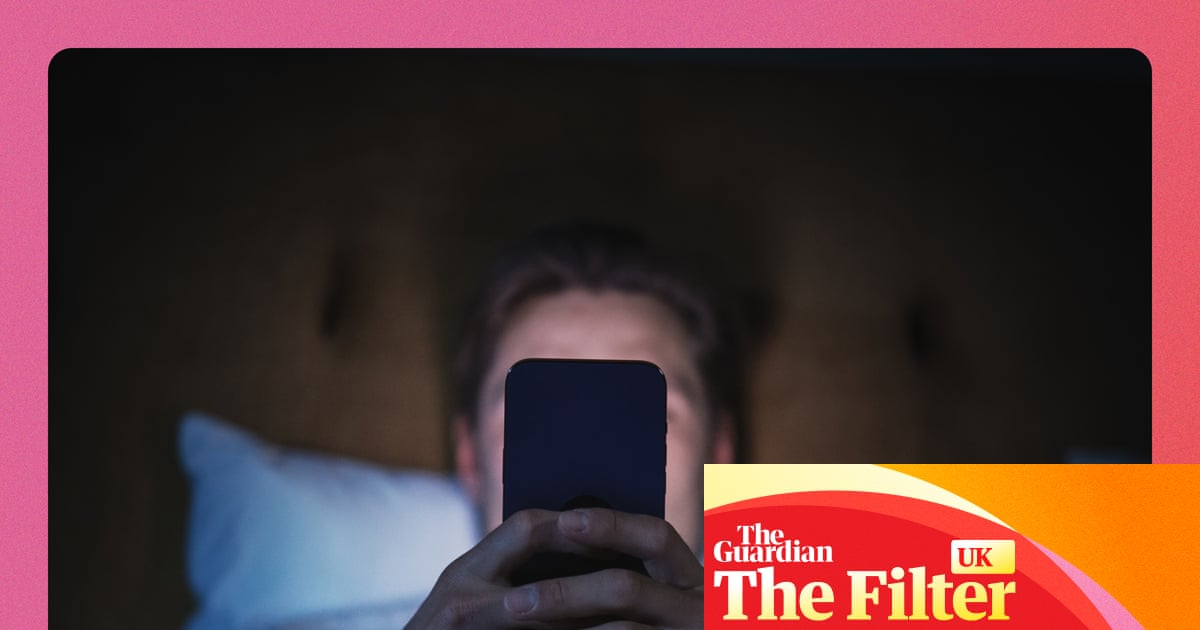
I was addicted to my phone – but one screen time hack actually made a difference
I recently learned through Apple’s Screen Time app that I was spending about eight hours a week on my phone browsing Reddit and Instagram. That’s 17.3 days a year spent consuming entertaining but ultimately pointless fluff. So my piece looking for solutions for phone addicts was highly personal.
The warning signs are if your phone is the first thing you look at in the morning and the last thing you look at in bed, says Prof Marcantonio Spada, emeritus professor of addictive behaviours and mental health at London South Bank University and chief clinical officer at Onebright, who I spoke to for my article.
That’s a tick for me and, I suspect, a lot of readers. Too many of us have “outsourced our brain to California”, Spada says, but that’s not completely our fault: “There are behavioural scientists and neuroscientists who are working daily to ensure that it’s outsourced. I know some of them really well.”
The point of using any of the techniques outlined in the piece is to see what we’re missing, he says, not just to act on a puritanical urge to purge technology from our lives for the sake of it. “I’m generation X, so I had the benefit of access to the real world, real emotions, the heart racing in anticipation of meeting somebody, which has been numbed by virtual existence,” he says. “Stay there [in the real world] long enough, and you can get massive rewards.”
Phones also suck our time. “We all complain: ‘I don’t have time to exercise, cook healthy food or read novels,’” says Hilda Burke, psychotherapist and author of The Phone Addiction Workbook. “But then we look at how much time we spend on YouTube, TikTok, Instagram – we find there is time to do those things.”
Changing habits can be daunting, she says, but, like Spada, she insists that the rewards are worth any early discomfort. “Initially there’s that twitchiness, but I guess what happened [for me] was a kind of a positive reinforcement where I was like: ‘Actually, this is quite nice.’”
What worked for me
The trick that worked best for me was Brick, a small, grey, magnetic square you stick to a metal surface – in my case, the front door, because it’s reinforced with metal. It’ll set you back £54, which is undoubtedly a big ask for something so simple, but if time is indeed money, you can make a case that it will quickly justify the outlay.
Touch your phone to it, and apps that rely on you opening them without thinking can’t be tapped. To regain access, you have to physically get up and unlock your problem apps with another touch – which is just enough of a pain to make you reassess your priorities.
You can choose what to lock down, and I’ve been quite conservative. WhatsApp is a social lifeline for those of us who work from home, for example, and Gmail is essential for work. Podcasts expand the mind, and even Netflix is something I only use in the gym, so it’s a wellbeing positive overall.
But Reddit, Instagram, Bluesky and Facebook? I have them locked all day except when I leave the house (what else am I going to do on the tube?). I’m especially vigilant at bedtime, so there’s no temptation to doomscroll in bed or delay getting up in the morning.
The friction that Brick adds has made all the difference, and I’m already feeling the benefit. I feel more focused, and my brain feels calmer. I still check in on social sites on my desktop work PC, but these are easily closeable tabs rather than full-screen, infinitely scrolling apps. It’s genuinely a quick break – after all, who wants to sit at their desk any longer than they have to?
By my earlier back-of-an-envelope sums, I’ve already lost about three days of 2026 to mindless scrolling. But I’m excited about what I’m going to do with the recovered 15.
This week’s picks
Editor’s pick
The men’s World Cup is almost upon us. According to recent research, 73% of us are planning to watch the games at home. So, rather than buying a few four-packs and emptying some ready salted into a bowl, why not take inspiration from the cuisine of the 48 qualifying countries to serve something more adventurous?
Filter food and drink writer Joanne Gould has spoken to locals to find out what they snack on in every nation, from Turkey to Tunisia, Scotland to Spain – and where to buy everything. Don’t watch a game without reading her guide first.
Hannah Booth
Editor, the Filter
In case you missed it …
Alan Martin has also been busy testing to update our guide to the best electric toothbrushes – and has been impressed with the latest models. His new favourite left his mouth feeling “cleaner than ever”.
Get involved
Finally dusted off the barbecue for the summer? What kit do you swear by, whether for cleaning, cooking or taking your food to the next level? Let us know by replying to this newsletter or emailing us at thefilter@theguardian.com.
