
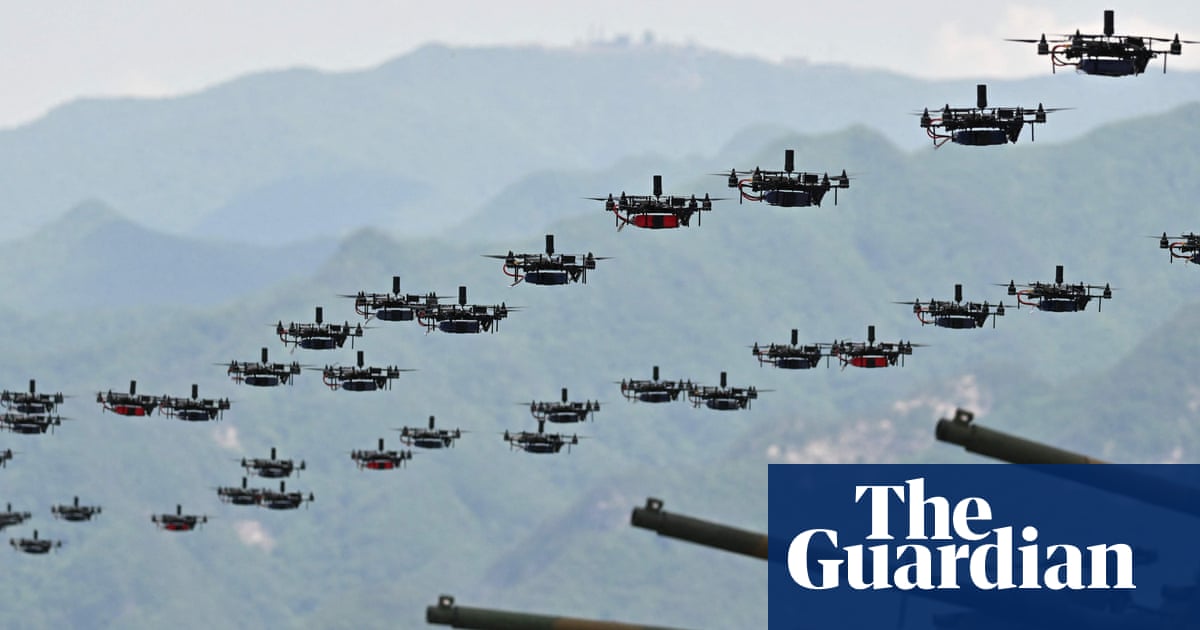
South Korea to train half a million military personnel to become ‘drone warriors’
[ad_1]
All of South Korea’s military forces will be trained as drone operators in a sweeping overhaul of its warfare strategy, the defence minister has said.
“All soldiers should be able to use drones like a second personal firearm,” Ahn Gyu-back, who heads the defence ministry in Seoul, said on Friday.
The plan envisages training 500,000 authorised military personnel across the army, navy, air force and marines to become “drone warriors”, the ministry said.
Wars in Ukraine and the Middle East had shown that drones were now a “gamechanger on the battlefield”, Ahn said.
“Low-cost drones operated in large numbers are fundamentally changing the nature of warfare,” Ahn said, warning North Korea was also continuing to develop its weapons capabilities, increasing threats to military and civilian facilities in the South.
The military planned to procure about 11,000 commercial drones for training purposes by the end of this year, rising to 60,000 by 2029, alongside more than 20,000 low-cost disposable combat drones by 2030.
Seoul also said it would fast-track a domestically developed long-range loitering munition dubbed K-Lucas. The system takes its name and concept from the American Lucas (low-cost uncrewed combat attack system) drone, itself reverse-engineered from Iran’s Shahed-136 suicide drone, which Russia deploys extensively in Ukraine.
South Korea’s plan includes expanding counter-drone systems such as laser and high-power microwave weapons.
The announcement comes against a backdrop of concern about North Korea’s drone capabilities and follows a deeply embarrassing episode for Seoul’s security forces in 2022 when five small North Korean drones breached South Korean airspace.
One entered the no-fly zone above the presidential office in Seoul. The military scrambled jets and attack helicopters and fired about 100 shots, failing to down a single drone.
North Korea’s drone capabilities have grown considerably, in part through its deepening military partnership with Russia, which analysts say has given Pyongyang access to battlefield data and tactics it would otherwise have taken years to develop.
Pyongyang has deployed thousands of troops to fight alongside Russian forces in Ukraine, giving its military direct exposure to drone warfare at scale.
North Korea announced on Friday that leader Kim Jong-un had overseen tests of tactical ballistic missiles and an upgraded rocket artillery system with a firing range of 90km in what Pyongyang said were efforts to bolster firepower along its southern border.
Kim has, meanwhile, pledged to expand North Korea’s nuclear arsenal at what he called an “exponential rate”, describing nuclear expansion as the “most correct and unique way” to confront an increasingly unstable world.
[ad_2]
Source link
