
What did Ukraine target in Moscow and how significant was the drone attack?
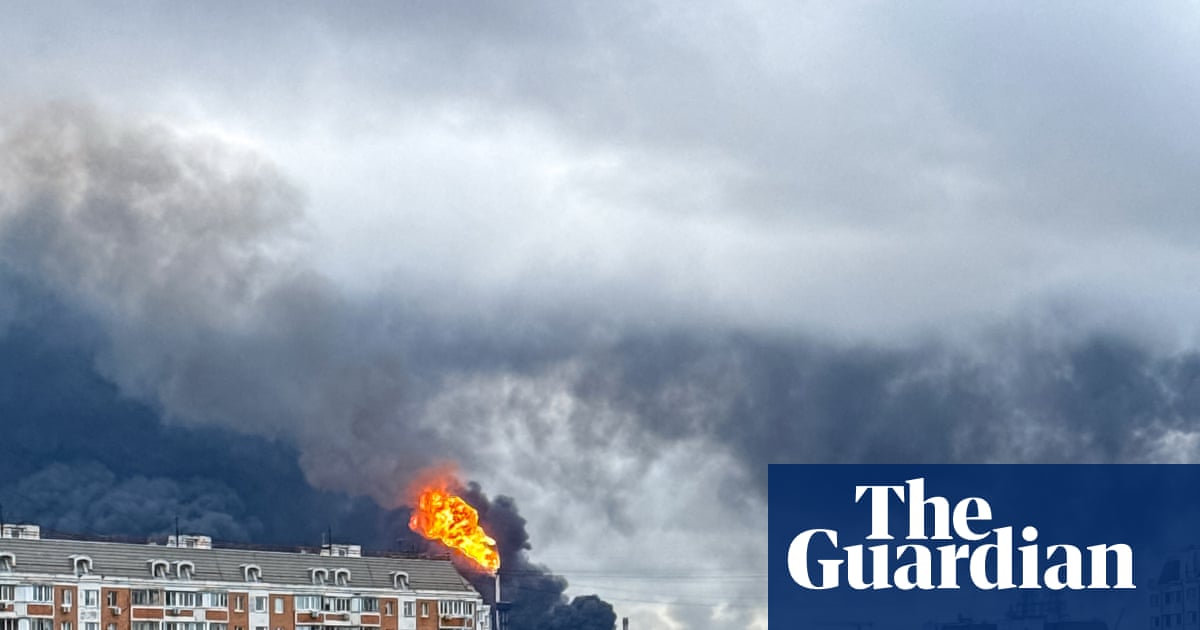
Ukraine hit Moscow with nearly 200 drones in its largest-ever attack on the capital on Thursday, striking a Russian oil refinery and sending huge plumes of smoke billowing over the city’s south.
The towering plumes of smoke rising above Moscow offered a stark demonstration of Ukraine’s growing ability to strike deep inside Russia with its increasingly sophisticated, largely domestically produced long-range drones.
What was hit?
The main target was the major oil refinery in Moscow’s Kapotnya district on the capital’s south-eastern edge, which had already come under attack earlier this week. Footage shared online showed a fuel tank detonating, sending part of its roof soaring into the air before flames engulfed one of Moscow’s most important energy facilities.
The refinery supplies up to 40% of the capital’s petrol and around half of its diesel fuel. At least one high-rise residential building, an industrial facility and several private homes were also damaged in the attack, with Russian authorities reporting 17 injuries.
How did Ukraine do it?
Ukraine frequently launches drone attacks against Moscow, but the vast majority are intercepted by the capital’s extensive air-defence network, the densest in the country. This time was different.
The sheer scale of the attack appears to have strained Russian air-defence systems. Videos circulating online showed Ukrainian drones flying over the Russian capital largely unchallenged, suggesting some were able to penetrate Moscow’s layered defences.
Footage circulating online also showed a Russian operator with a shoulder-launched Manpads missile system scrambling to shoot down a Ukrainian drone moments before it struck the Moscow oil refinery.
The mix of weapons used may also have played a role. Alongside conventional long-range strike drones typically deployed against targets deep inside Russia, Ukraine appears to have employed jet-powered missile drones during Thursday’s attack on the Moscow refinery and other sites around the capital.
Kyiv publicly unveiled several such missile-drone systems in late 2024 and early 2025, including the Bars hybrid drone-cruise missile, which was used in the strike. Faster and more difficult to intercept than conventional propeller-driven drones, they pose a growing challenge for Russian air defences.
Moscow also faces constraints in how it deploys its air-defence systems. Interceptors that miss their targets, or falling debris from destroyed drones, can pose a serious risk in a city densely packed with high-rise apartment blocks, raising the prospect of significant civilian casualties.
What are the lasting effects?
By targeting a key oil refinery, Ukraine hopes to bring the consequences of the war closer to ordinary Russians. Previous attacks on energy infrastructure have led to fuel shortages in parts of the country, most notably in Russian-occupied Crimea, where residents have spent hours queueing at petrol stations. Much will depend on the extent of the damage to the refinery, Russia’s ability to redirect fuel supplies from elsewhere, and Ukraine’s capacity to sustain further strikes.
But arguably the greater impact will be psychological. For the first time since Russia’s full-scale invasion of Ukraine, many Muscovites could look out of their apartment windows and see smoke rising over the capital.
Russian social media was flooded with videos of residents reacting to the strikes. In one widely shared clip, a woman could be seen in tears. “The war is here,” she said. “My windows are shaking. The air is dark and smells of smoke.”
Residents of Balashikha, a town east of Moscow, described a “black rain” after the refinery strike, sharing photographs of cars, streets and buildings coated in a dark, oily residue.
Taken together, the apocalyptic images served as a stark reminder that, despite years of war, Moscow and its suburbs are no longer insulated from the conflict and are increasingly a part of it.
How will Putin respond?
Vladimir Putin, who is attending a summit with several Asian leaders in Kazan, has yet to comment publicly on the strike. The Russian president typically avoids addressing sensitive developments immediately, preferring to leave initial responses to officials and state media.
Russian hardliners, however, were quick to react. Several influential nationalist figures took to social media to demand retaliation, with some even urging the Kremlin to consider the use of nuclear weapons against Ukraine.
The most likely response, however, is a renewed wave of large-scale missile and drone strikes on Ukrainian cities. In the past, Moscow has frequently answered high-profile attacks on Russian territory with barrages targeting urban centres across Ukraine, often resulting in significant civilian casualties.
