
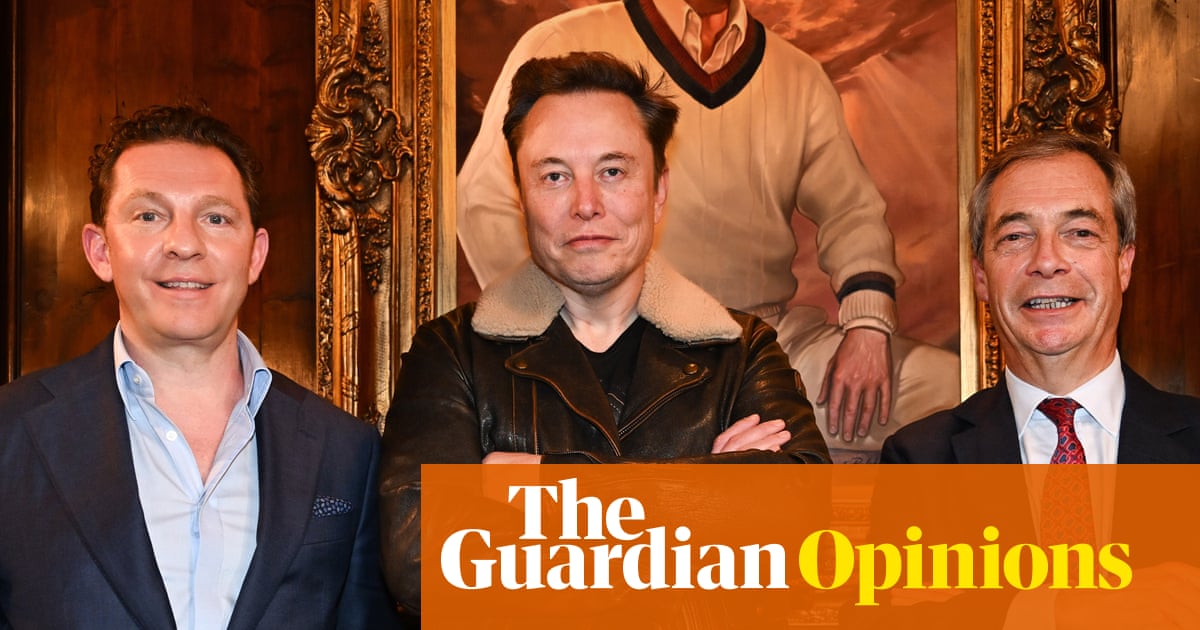
UK must cap political donations to stop the rich buying influence | Heather Stewart
Just as Nigel Farage kicks off a summer of “arguing with a bin”, as the chancellor, Rachel Reeves called it, Labour’s bill to clean up politics returns to the House of Commons this week.
As more questions emerge about the financing of Reform UK and Farage’s mega-donor chums – through the brilliant reporting of Guardian colleagues – MPs should seize the opportunity to toughen it up.
Britain’s party finance and campaign spending rules have long been criticised as too lax. But the emergence of a class of billionaires keen to sweep away all impediments to their global reach – and pay the minimum in tax – makes reform all the more urgent.
Donald Trump’s presidency has repeatedly revealed the risks of the immense economic power wielded by tech billionaires and crypto grifters, being translated into political heft.
Elon Musk was gifted his own slash-and-burn government department to run; regulation has been loosened; crypto bros banged up during the Biden administration for financial irregularities have been pardoned by Trump.
Being prime minister in the UK does not bring with it quite such sweeping powers; but Singapore-on-Thames style deregulation and low taxes are likely to be an alluring prospect for big-money donors. That may be especially true in the face of a Labour government that has already raised capital gains tax, and may go further under Andy Burnham.
At the same time, as a report from the Institute for Public Policy Research (IPPR) said this week, there is a dangerous nexus between some of the men who made fortunes in Silicon Valley and far-right, nativist politics.
As the authors put it: “New alliances are emerging between new, extractive forms of capital and a paradoxically global network of ethnonationalists, hostile to the norms of democratic politics.”
Rupert Lowe, the Restore Britain MP who wants to see “the most ambitious programme of mass deportations ever seen” in the UK, is being openly backed by Musk, with his views – once far beyond the pale of mainstream politics in this country – constantly amplified on X.
In the face of these urgent threats, Keir Starmer’s representation of the people bill, which turns out to be among his final acts as prime minister, does make important progress. It prevents foreign companies from donating to UK parties unless they have revenues here, for example, and obliges parties to enquire more rigorously into who is funding them.
But with Reform’s funding under growing scrutiny, Labour MPs have tabled amendments seeking to strengthen the bill, some of which they hope Starmer may accept.
They include the call by the business and trade select committee chair Liam Byrne for the temporary ban on crypto donations envisaged in the legislation to be made permanent. Given how well-adapted crypto is for shifting vast sums of money around the world anonymously, and its frequent propensity for just happening to turn up alongside criminal activity, that seems an obvious move.
The Labour backbencher and former Financial Times journalist Yuan Yang is calling for the financing of new parties to face more scrutiny; while the former development minister Anneliese Dodds wants to see overall campaign spending limits cut by about a third, curtailing the extent to which a bumper budget can be used to sway voters.
It is unclear as yet how Burnham, the new MP for Makerfield, will vote next week, though he has repeatedly signalled his interest in political reform.
If the PM-in-waiting wants a remaking politics moment, he could go further, and back the campaigning backbencher Stella Creasy’s call for a £100,000 annual ceiling on individual donations, to curtail the influence of the mega-rich.
While the wealthy have always sought to influence politics, UK parties’ dependence on a handful of super-donors is relatively new.
The anti-corruption campaign Transparency International pointed out recently that in 2015, only 1% of private donations to political parties came from companies or individuals giving £1m or more. By 2024, that had risen to more than a third.
“Parties turning to wealthy donors for cash is making them dangerously reliant on a small group of individuals, which increases the likelihood they will have undue influence on public policymaking,” it argued.
Transparency International cited polling showing that 84% of the public,quite understandably, believe that wealthy individuals use donations to further their personal interests. More than two-thirds support a cap on donations of £50,000 or less; or an outright ban.
Like Creasy, the IPPR called for a £100,000 cap on individual donations, which the thinktank wants to be lowered to £10,000 over the next decade. It linked this and other changes – including a call for compulsory voting – to the need to reverse a widespread and corrosive sense of disconnection from politics.
Creasy’s amendment appears to have less support than some others, because MPs fear that a donations cap would cause party funding to collapse, necessitating some taxpayer support, a move deemed unlikely to be popular with voters.
But as the IPPR points out, other countries manage this just fine: France has a €7,500 (£6,390) cap on donations, for example, and parties are part-funded by the state, in line with their showing at the last election. Germany, too, has state funding.
And voters’ visceral reaction to the free glasses Starmer was given by the Labour donor Lord Alli – whose largesse was on a far smaller scale than that of Farage’s benefactors – showed how queasy the public feel about the rich financing political figures.
Existing laws and standards, together with his own thin-skinned fury, may yet be enough to see off Farage. But it is wrong in principle, and dangerous in practice, for a new class of mega-donors to bankroll British politics. Donations should be capped; and if Starmer does not act, his successor must.
