
Who are India’s Cockroach Janta party and why are they staging protests?
How did the Cockroach Janta party emerge?
The Cockroach Janta party (CJP) might have started out as an online joke, but – driven by millions of discontented young people in India – it has swiftly grown into one of the most unexpected challenges to the powerful rightwing government of Narendra Modi.
The CJP was founded in May by Abhijeet Dipke, 30, an Indian national who recently graduated from university in the US. Enraged to hear comments made by the chief justice of India, who compared the country’s unemployed youth to “parasites” and “cockroaches” during a supreme court hearing, Dipke jokingly put out a call on social media: “What if all cockroaches came together?”
The response was overwhelming. Dipke built a website and social media accounts for a satirical Cockroach Janta party – a poke at Modi’s ruling Bharatiya Janata party (BJP) – complete with a biting manifesto taking aim at the government and a tagline: “A political party for the people the system forgot to count.”
Within two weeks, the CJP’s Instagram page had more than 22 million followers, overtaking the BJP. The Modi government, highly intolerant of criticism, attempted to block its social media accounts on national security grounds but were not successful.
What are the causes championed by the CJP?
As the CJP began to mobilise support, Dipke focused the movement on a burning issue for many of India’s millions of students: leaks of medical entrance exams, which have repeatedly been sold to the highest bidder.
The pressure on students to succeed is cripplingly high: more than 2 million students compete for just 130,000 places. Many families spend their life savings and get into high levels of debt to pay for their children to be coached for these notoriously gruelling exams, known by the acronym NEET. More is now spent in India on private tuition than the government’s entire higher education budget.
A string of exam leaks has forced millions of students into re-takes and been linked to dozens of suicides in recent years. The NEET exams are also not the only papers to have been leaked.
The Modi government has been accused of not taking responsibility for the exams fiasco. The CJP began to rally supporters around the issue; calling for the government to be held accountable for exam leaks and for the education minister, Dharmendra Pradhan, to resign.
For many of India’s gen Zs and millennials, the CJP has also given voice to wider frustrations over an education system in crisis and a job market that has been systematically failing them. According to one recent study, almost 40% of India’s graduates below 25 are unemployed.
When did the CJP first take to the streets?
The CJP’s first offline protest took place in Delhi in early June, calling for the resignation of Pradhan. Dipke returned from the US to lead the demonstration, first in Delhi and then at events across the country.
Later that month, CJP supporters held their second major protest in Delhi, where this time they pledged not to move until Pradhan was gone. The protesters were joined by Sonam Wangchuk, an eminent engineer and education activist from the Indian state of Ladakh, who was last year arrested and detained under terror laws by the government for his activism.
Wangchuk announced he would embark on a Gandhian hunger strike in solidarity with the students and would not eat or drink until the education minister stepped down.
As the protest and Wangchuk’s hunger strike went on into July, they were visited by multiple senior opposition figures. However, the Modi government did not engage with the CJP or Wangchuk and Pradhan dismissed them as the “B-team of terrorists”.
How has Sonam Wangchuk mobilised support?
As Wangchuk’s conditioned worsened more than two weeks into his hunger strike, the government faced mounting criticism. After 18 days, the Delhi court ordered for his health to be monitored on a daily basis.
On Sunday morning, 20 days into his hunger strike, Delhi police sparked national outrage after they arrived early morning and forcibly removed Wangchuk to a government hospital against his will. The police said it was to protect his health – his wife condemned it as “illegal detention”.
From his hospital bed, Wangchuk called on CJP supporters to march to parliament on Monday and demand Pradhan’s resignation.
How large was Monday’s protest?
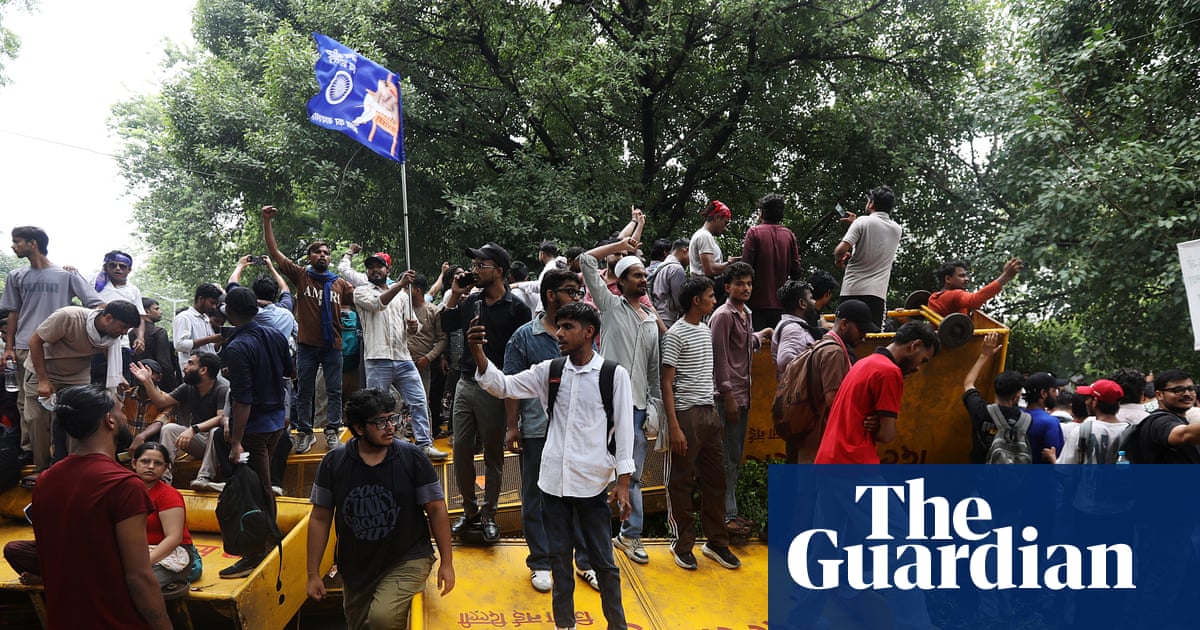
The CJP protest on Monday swelled into one of the largest anti-government protests in years. By early morning, thousands of protesters began to flock to the streets of central Delhi, joining hundreds who had already been camped out overnight.
The crowd was largely made up of students and other young people, but parents whose children had been affected by the leaks were also present in high numbers.
The Delhi police refused permission for the protesters to march on parliament. Roads across the city were blockaded with barriers, the internet was shut down and protesters were kettled into a designated protest site about a mile away from parliament. However, protesters still continued to arrive in droves, with more than 20,000 people gathered by the early afternoon.
As the crowds tried to push towards parliament, police responded with violence, including baton charges and teargas, prompting criticism from CJP leaders and opposition politicians. Protesters and police were injured in the clashes. Dipke condemned the police response as “absolutely brutal”.
What happens next?
After weeks of ignoring the CJP movement, the Modi government offered a meeting on Monday morning. At a brief 10-minute interaction, three CJP demands were put forward but so far “no commitments were made”, according to the CJP’s spokesperson.
There was no public response to the protest by Pradhan. By late on Monday, even as the police tried to clear the Delhi protest camp, Dipke emphasised that as long as Pradhan remained in his position, they would not be moved. “This peaceful protest is not ending!” read the party post on X.
