
Europe solar eclipse live: millions flock to viewing spots in Spain, UK and Iceland
Welcome to the greatest show off earth
Jakub Krupa
Got your eclipse glasses at the ready?

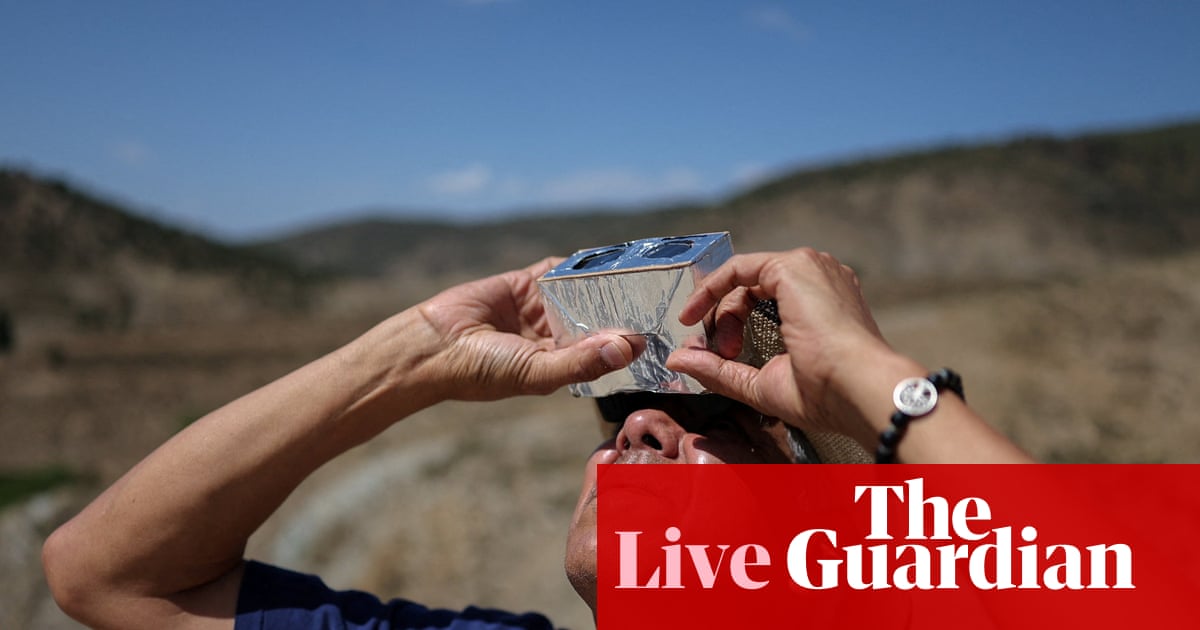
Do not fret if not. Not everyone is prepared like this guy.

We’ve got you covered.
Welcome to the live coverage of today’s total eclipse, which will be seen in parts of Europe, including Iceland, the UK, and Spain.
Over the coming hours, we’ll bring you:
-
Tips on how to view the phenomenon safely
-
First-hand reports from places where crowds are gathering
-
A quick look at the science behind the shadow
-
The best pictures and videos from key viewing spots
And yes, there will be a live stream, too.
It’s Wednesday, 12 August 2026, it’s Jakub Krupa here, and this is Europe Live.
Good afternoon.
Key events
Lava spews as Mount Etna puts spectacular display and disrupt flights

Lorenzo Tondo
in Palermo, Sicily
For several days, Mount Etna, one of the world’s most active volcanoes, has been putting on a spectacular display, spewing incandescent magma, sending long streams of lava down its slopes and showering the surrounding area with ash.
Explosive activity has been recorded on Etna’s north-eastern flank, where new fractures have opened, while the Voragine crater has continued to produce towering plumes of ash reaching heights of about 4,500 metres.
The latest eruptive phase on Europe’s highest active volcano was continuing from vents at altitudes of 2,750 metres (9,022ft) and 2,360 metres, feeding several lava flows and creating extensive lava fields, according to Italy’s National Institute of Geophysics and Volcanology (INGV).
INGV’s Volcano Observatory Notice for Aviation (VONA) remained at red, its highest alert level, indicating an ongoing risk to aircraft from ash emissions.
The volcanic ash has caused widespread disruption at Catania airport, forcing the cancellation of numerous flights. On Tuesday, the ash cloud drifted as far as Malta, about 220km (140 miles) south of Etna, forcing airlines to cancel flights to the Mediterranean island at the height of the tourist season.
At the same time, the eruptions have drawn thousands of tourists to Etna, fascinated by the spectacle of fire and glowing lava illuminating the volcano after dark.
In recent years, experts have observed that Etna has been spewing so-called “primitive magma”, a term used to describe magma whose composition has changed relatively little from that of the Earth’s mantle where it formed. Rising from deeper within the volcano, this magma carries a greater concentration of gas and is therefore capable of producing the spectacularly high lava fountains that have become a feature of Etna’s recent eruptions.

Jakub Krupa
While tonight’s eclipse will the “the greatest show off earth,” as the Guardian called it the last time it happened in 1999, it’s not the only show around.
Let’s go to Lorenzo Tondo for more.
You can check the expected eclipse timings at your location using special websites offered by various European metereological services, like this one.
In Iceland, the show will begin earlier than elsewhere: around 4.45pm local time (5.45pm UK time), and end just before 7pm (8pm).
At the Guardian HQ in London, the partial eclipse will begin at 6.17pm, reach its maximum stage at 7.13pm, and end at 8.06pm.
And Spain will be again a bit later than the UK.
People flock to Cornwall to watch the solar eclipse

Steven Morris
in Land’s End, Cornwall
The roads and car parks of west and north Cornwall are clogged as people gather to watch the solar eclipse.
Residents and holidaymakers are set to witness about 95% coverage – about 5% more than London according to the Royal Observatory, Greenwich.
And, yes, there is a shortage of eclipse glasses. There were notices on shops in Penzance saying they had none; in St Ives, dozens of people queued at a phone repair shop when it announced a new batch had arrived.
The eclipse comes with health warnings. The Falmouth coastguard has told people not to get too close to cliffs as the darkness gathers while the RNLI is advising those intending to watch from kayaks or surfboards or take an eclipse dip in the sea to remember that it is going to turn a little colder and, of course, visibility will be poorer.
There was a full eclipse in Cornwall in 1999 and civic leaders spent two years planning for it but poor weather meant there wasn’t the influx of visitors that had been expected.
Twenty seven years (and one day on), the vibe is a little more laid back but fine weather means the view of the eclipse should be excellent.
Eclipse glasses shortage hits Madrid as anticipation grows

Sam Jones
in Madrid
I can confirm that eclipse glasses are also in short supply here in Madrid.
Our local library had run out of the free glasses supplied by the city council two days ago, and an inquiry at a nearby optician was met with a rather curt “agotadas” (all gone) before we’d got to the end of the sentence.
Safety recalls have also been issued over six models of eclipse glasses that had been on sale here.
We’ve managed to buy some online and are getting ready for tonight in the mountains north of Madrid.
Younger members of the family are already impatient. It’s going to be a long, hot few hours…
What it looked like in 1999? – in pictures
1999: Beyond the clouds, a spectacle that put everything else in the shade
The last significant partial eclipse was reported in the UK in 1999.
Here is how we covered it at the time at the Guardian:
“Britain was brought to a standstill for almost an hour yesterday as millions of people left their homes, offices and factories to watch the last eclipse of the millennium.
The rush to watch the skies in the West Country and across the country resulted in the biggest power surge ever recorded on the National Grid and is estimated to have cost the country £500m in lost business.
More than a million people gathered in Cornwall and Devon for the once-in-a-lifetime event, with a last minute dash to the West Country by an estimated 60,000, bringing the total number of visitors to Cornwall to 270,000, double the normal number for August.”
For many, though, it was down to the luck of the meteorological draw whether they actually succeeded in glimpsing the eclipse through the thick cloud covering the counties.
For many, umbrellas rather than solar eclipse viewers were needed when, an hour before the eclipse, a torrential rainstorm lashed west Cornwall and heavy cloud completely blocked the view.
While the Scillies enjoyed 106 seconds of totality under clear skies, the thousands gathered in Penzance, Marazion and Falmouth found cloud and rain blotted out their view.
Within an hour of the eclipse, more than 100 people called a helpline at Moorfields Eye Hospital in London, complaining of problems after watching the solar spectacular.
Many hospitals cancelled eye operations to make way for emergencies and will remain on 24-hour standby until the weekend for worried eclipse watchers who fear they have damaged their vision.”
Jakub Krupa
It’s nice of Bónus bosses to offer their employees a chance to go out and experience the eclipse.
For all we know, there isn’t usually that much interest in supermarket shopping during the phenomenon – with Waitrose chief even complaining about it in 1999, the last time we had a solar eclipse in the UK…
People flock to watch eclipse in Iceland but weather concerns dampen spirits

Miranda Bryant
Nordic correspondent
In Iceland, people have flocked by air, land and sea to watch the total solar eclipse – the country’s first in 72 years.
But the forecast is not looking promising, with low clouds expected to cover much of the country.
The eclipse will start in Iceland at about 4.45pm local time (5.45pm UK) and end at about 6.50pm (7.50pm UK).
The total eclipse will only be visible in western Iceland, with the longest in Látrabjarg in the Westfjords where it will last for 2 minutes and 13 seconds. A road in the area was closed overnight due to heavy traffic and people were not permitted to stay at the site, which is part of a nature reserve, overnight.
Record numbers of cruise ships are headed to the water around Iceland in the hope of witnessing the eclipse.
The Icelandic artist Björk is hosting a one-day festival to coincide with the eclipse at Hafnarfjörður near Reykjavík. The eclipse is featured in the set list at 5.48pm between DJ sets by Arca and Björk.
The boss of supermarket Bónuss has told store managers they can close for 15 minutes to allow employees to see the eclipse.
Where will the solar eclipse be visible in Europe?
Nicola Davis and Oliver Holmes
A wide band of north and central Spain, plus a sliver of Portugal and parts of Greenland and Iceland will experience a rare total eclipse.
The light of the setting sun will be virtually blocked out across much of western Europe, including the UK, France, Belgium, Switzerland and northern Italy.
This total eclipse will be the first in mainland Europe in two decades.
The last event of this kind visible from the UK occurred in 1999, when parts of Devon and Cornwall were in the path of totality.
The next total solar eclipse visible in the UK is not due to occur until 2090.
‘It’s going to be spectacular’: Millions flock to Spain seeking best view of total solar eclipse

Ashifa Kassam
The online forums are abuzz as people debate potential cloud cover and trade tips on the best viewing points. Hours before wide swathes of Spain were set to experience the country’s first total solar eclipse in more than a century, the excitement was palpable.
“It’s going to be spectacular,” said César González, an astronomer and science communicator at the Madrid Planetarium. “A total solar eclipse is one of the best spectacles in nature.”
Officials have estimated that as many as 6 million people could flock to the eclipse path on Wednesday, which stretches about 200km from A Coruña in Spain’s northwest to the Mediterranean island of Mallorca. A small strip of Portugal and parts of Greenland and Iceland will also experience the rare total eclipse.
Tens of millions more will be watching across western Europe, with the path of the eclipse virtually blocking out the sun in many countries including the UK, France, Belgium, Switzerland and northern Italy.
Welcome to the greatest show off earth
Jakub Krupa
Got your eclipse glasses at the ready?
Do not fret if not. Not everyone is prepared like this guy.
We’ve got you covered.
Welcome to the live coverage of today’s total eclipse, which will be seen in parts of Europe, including Iceland, the UK, and Spain.
Over the coming hours, we’ll bring you:
-
Tips on how to view the phenomenon safely
-
First-hand reports from places where crowds are gathering
-
A quick look at the science behind the shadow
-
The best pictures and videos from key viewing spots
And yes, there will be a live stream, too.
It’s Wednesday, 12 August 2026, it’s Jakub Krupa here, and this is Europe Live.
Good afternoon.
