
How Belmont Park’s $555 Million Rebuild Is Relaunching Horse Racing on Long Island
Key takeaways
- Belmont Park reopened Sept. 18, 2026, after a three-year, $555 million rebuild funded mainly by a state loan.
- The new five-story grandstand covers about a quarter of the old building’s footprint and gave the public infield access for the first time.
- The rebuild was tied by law to Aqueduct’s closure, which took place in 2026, and to the site’s future redevelopment; full completion of Belmont’s grandstand is expected in early 2027, ahead of the Belmont Stakes and a Breeders’ Cup return.
Belmont Park reopened for live racing on Sept. 18, 2026, closing out a three-year rebuilding project that had sent New York’s biggest races to Saratoga and Aqueduct. The Long Island track’s new five-story grandstand, four rebuilt racing surfaces and first-ever public infield are meant to carry the sport through the scheduled return of the Belmont Stakes and the Breeders’ Cup World Championships in 2027.
Gov. Kathy Hochul led a ribbon-cutting ceremony for the reopening, and a sold-out crowd of 6,000 attended a nine-race card headlined by the $1 million Grade 1 Jockey Club Gold Cup. The New York Racing Association, which now runs Belmont and Saratoga after Aqueduct’s closure earlier this year, financed the $555 million project mainly through a loan the state approved in 2023, under legislation that also tied Belmont’s future to Aqueduct’s closure.
A Grandstand a Quarter of the Size
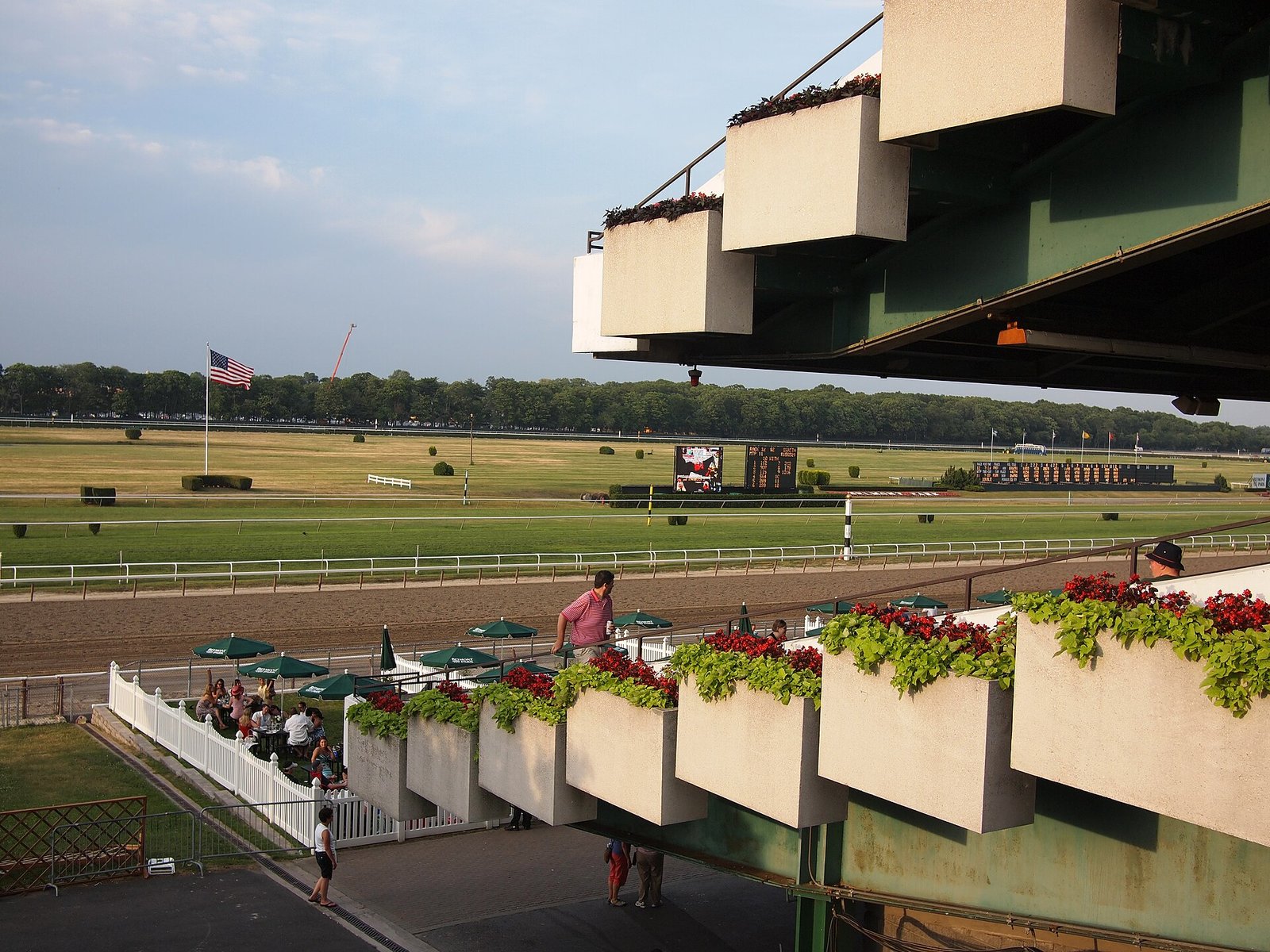
The grandstand that closed after Belmont’s final card on July 9, 2023, had opened on May 20, 1968, cost $30.7 million to build and was designed by architect Arthur Froehlich. It covered roughly 1.25 million square feet and could seat about 30,000 people, with room for many more on its apron and backyard. Demolition began in 2024.
Its replacement, designed by stadium architecture firm Populous and built by AECOM Tishman, is about a quarter the size at roughly 300,000 square feet across five stories. NYRA has said the new exterior uses 869 glass panels and about 3,568 aluminum panels, along with 620 televisions and three video boards, including a main infield screen measuring 65 feet high and 115 feet wide. New pedestrian and vehicular tunnels connect the grandstand to the infield.
Because the new building has a smaller footprint, NYRA opened Belmont’s 45-acre infield to the public for the first time in the track’s history and enlarged the paddock by about 50%. A roughly 200-year-old Japanese white pine on the grounds was preserved through construction. Meg McWilliam, one of the project’s designers, said the goal was bringing spectators closer to the racing while making the building useful beyond major race days.
The new building’s dining and hospitality options include Big Red’s, the Homestretch Market, Silks and the Trackside Lounge, along with premium spaces such as the Turf Club Restaurant, which features menus curated by chef Marc Forgione, Champion Suites and an area called the Stretch View. NYRA President Marc Holliday said the design was meant to put fans and athletes “closer than ever before.”
The Original Grandstand
Belmont Park’s previous grandstand opened May 20, 1968, cost $30.7 million and was designed by architect Arthur Froehlich; it ran its final race card on July 9, 2023, before demolition began the following year.
Four Surfaces Built for Every Season
Belmont’s four racing surfaces were all newly constructed: a 1½-mile dirt oval described as the largest dirt track in North America, two turf courses, and a 1-mile Tapeta all-weather synthetic track meant for winter racing and bad-weather days. The synthetic surface is intended to let Belmont run races year-round for the first time.
The rebuilt track also moved its finish line 125 feet forward compared with the previous course configuration. During construction, Belmont’s fall meets were held at Aqueduct, and the Belmont Stakes itself moved to Saratoga for three straight years, from 2024 through 2026. Belmont’s 2026 fall meet, its first since reopening, is scheduled to run through Dec. 6.
How New York Financed the Rebuild
Legislation authorizing the state to lend NYRA up to $455 million for the project was introduced on April 30, 2023, as part of that year’s budget process. The money runs through the state’s Urban Development Corporation, also known as Empire State Development, and is backed by income tax or sales tax revenue bonds. NYRA added about $100 million of its own funds, bringing the total project cost to $555 million.
NYRA is repaying the loan using its share of revenue-sharing proceeds from video lottery terminals — slot machines — at the Resorts World casino at Aqueduct. Accounts of the loan’s term differ on how long that repayment runs: BloodHorse, reporting on the legislation itself, put the term at 20 years with annual payments of up to $25.8 million including interest, while a critic quoted in Gothamist’s 2023 coverage of the proposal called it a 30-year loan; Gothamist’s own reporting cited the same $25.8 million annual payment figure from the governor’s proposal.
The legislation attached conditions to the loan, including requirements for minority- and women-owned business participation, electric-vehicle charging stations and a geothermal heating network, plus guarantees of union labor during construction. NYRA President and CEO David O’Rourke said at the time the project would “secure the future of Thoroughbred racing in New York State.” Separately, the state’s project description lists new dormitories, an upgraded medical clinic and recreational facilities on Belmont’s backstretch, where stable workers live; two dormitories have been completed and a third is expected to be finished this fall.
The deal drew objections before it was approved. Assemblymember Linda Rosenthal questioned subsidizing an industry in which, she said, “horses die on the track all the time.” Animal-welfare advocate John Scheib noted that NYRA’s state franchise to operate its tracks runs only through 2033, about a decade before the loan’s repayment period was set to end under the shorter estimate, raising questions about who would be responsible for any remaining debt. Edita Birnkrant, of New Yorkers for Clean, Livable and Safe Streets, compared the arrangement to public stadium subsidies and pointed to years of declining racetrack attendance nationally. State Sen. Joseph Addabbo supported the loan, citing the potential to redevelop Aqueduct’s property near John F. Kennedy International Airport.
What Happens to Aqueduct
The legislation ties Belmont’s rebuild to the future of Aqueduct Racetrack in Queens: NYRA was required to terminate its lease on Aqueduct once Belmont’s construction became substantially complete, and Aqueduct — which sits on more than 100 acres near JFK Airport — closed to racing in 2026, clearing the way for the state to pursue commercial or residential redevelopment of the site. A six-member local advisory board, with appointees from the governor, the New York City mayor, other elected officials representing the area and the local borough president, is charged with evaluating redevelopment proposals.
The law also states the Legislature’s “intention” that Aqueduct’s racing dates shift to Belmont now that Aqueduct has closed. If NYRA and horsemen’s groups cannot agree on how those dates should be divided, the state Gaming Commission has authority to decide independently.
The building that reopened this month covers roughly 300,000 square feet, about a quarter of the 1.25-million-square-foot grandstand it replaced.
What Opening Day Looked Like
The first race of the new era, a 1¼-mile turf event, was won by the filly Lisa Joy, who paid $26.72. The card’s marquee event, the $1 million Grade 1 Jockey Club Gold Cup, went to Forever Young. Country singer Dierks Bentley performed as part of the day’s entertainment.
General admission was $10 for the opening weekend; NYRA has set it at $7 in advance or $10 on race days afterward. More than 3,700 union construction workers built the project over about two and a half years, with roughly 300 tradespeople on site on a typical day.
The Road to the 2027 Belmont Stakes
NYRA expects the grandstand’s top three floors to be finished by early 2027, ahead of the Belmont Stakes’ scheduled return to the track on June 5, 2027 — its first time back at Belmont since the race relocated to Saratoga in 2024. Once the upper floors open, NYRA has said grandstand seating will grow to about 10,000, with total capacity for major events exceeding 50,000, comparable to Saratoga.
Belmont is also slated to host the Breeders’ Cup World Championships in the fall of 2027, which would be the first time the event has run in New York since 2005. Gov. Hochul’s office has estimated the rebuild generated roughly $1 billion in construction-related economic activity and supported 3,700 union jobs, and projects the finished venue will produce about $155 million in annual economic output and roughly $10 million a year in new state and local tax revenue once fully operating. Coverage of the project ahead of its reopening noted that economic projections for large venues have a mixed track record, and that Belmont’s finances will depend heavily on nonracing use of the building between race days.
Photo: nakashi from Chofu, Tokyo, JAPAN · CC BY-SA 2.0 · via Wikimedia Commons
