How a Weather-Forced Doubleheader Squeezes the Yankees’ Rotation Rest Before October
A nor'easter forced the Yankees and Orioles into Friday's doubleheader, giving New York one final tune-up while raising questions about how to manage rest for the pitchers who'll carry the team in…
The National Weather Service issued a high wind warning with gusts up to 50 miles per hour for Friday through Saturday night, forcing Major League Baseball to restructure the Yankees’ final regular season days. MLB moved Saturday’s game between New York and Baltimore into a Friday doubleheader, with first pitch at 4:05 p.m. and a second game following shortly after. The Yankees enter the doubleheader already locked into a playoff berth, with the postseason set to open the following Tuesday.
The schedule change, while minor in competitive stakes, carries real consequences for the Yankees’ pitching staff and roster. With the postseason beginning immediately after the regular season ends, every day of rest matters. The team must now compress its final preparation while managing how much additional work to ask of Gerrit Cole, Cam Schlittler, Max Fried and Carlos Rodon—the core of a rotation that has been called perhaps the most talented in baseball. At the same time, it’s looking like Aaron Judge will not be available for the Wild Card Series because of a calf injury, eliminating the team’s primary offensive threat and shifting strategic weight even more heavily toward dominant pitching.
The nor’easter reshuffles the Yankees’ final week
The National Weather Service’s high wind warning and coastal flood watch alerts left MLB with limited choices. Rather than risk playing through severe weather on Saturday, the Yankees and Orioles agreed to move their series into Friday’s doubleheader format, a single-admission event that allowed both teams to complete their regular season series before conditions deteriorated.
The decision had minimal competitive stakes for New York. The Yankees had already clinched a playoff spot and were not fighting for division seeding like the Boston Red Sox and Chicago Cubs, who faced similar weather-driven schedule changes elsewhere. For the Yankees, the doubleheader functioned as a final opportunity to test their lineup and bullpen against major league competition before the playoff intensity begins.
Cam Schlittler’s 2026 regular season
The AL Cy Young Award favorite finished with a 1.95 ERA and 239 strikeouts, achieving the third-best ERA in Yankees franchise history behind Spud Chandler (1.64 in 1943) and Ron Guidry (1.74 in 1978).
Aaron Judge’s injury reshapes offensive strategy
The doubleheader comes against a backdrop of roster uncertainty that extends beyond pitching decisions. It’s looking like Aaron Judge, the team’s primary offensive engine, will not be available for the Wild Card Series because of a calf injury. Judge’s absence removes the Yankees’ most productive hitter from the postseason lineup—a loss that cannot be fully replaced by backup options or role players.
The loss of Judge’s offensive production raises the stakes for the pitching staff dramatically. In a typical playoff series, a team with Judge’s power can weather some offensive struggles while benefiting from his at-bats in high-leverage situations. Without him, the Yankees must rely on their pitching depth to carry them through a potent Red Sox offense. Boston counters with a strong lineup featuring Roman Anthony, Ceddanne Rafaela, Adley Rutschman, Willson Contreras and Wilyer Abreu batting in their top five spots, a group with no easy outs for Yankees pitchers to exploit.
The best-of-three format and the importance of rotation management
The Yankees are on track to face the Boston Red Sox in a best-of-three Wild Card Series, expected to be played entirely at Yankee Stadium across three consecutive days beginning September 29, 2026. This format represents a significant change from past decades: there is no longer a one-game Wild Card playoff with a sudden-death format. Instead, the first team to win two games advances to the Division Series, where they would face a higher-seeded team that received a first-round bye.
The three-game series intensifies the pressure on rotation construction. The Yankees, likely the AL’s No. 4 seed, would host the Red Sox with all games in the Bronx — though Boston had not yet clinched the AL’s No. 5 seed as of Friday morning. The Red Sox appear set to start rookie left-hander Payton Tolle in Game 1, with veteran Sonny Gray slated for Game 2. If the series extends to Game 3, Ranger Suarez anchors the mound for Boston.
Schlittler’s rest becomes a strategic question mark
The doubleheader raises an unexpected complication for the Yankees’ rotation planning: how much work should the team ask of its best pitcher in the final days before October? Cam Schlittler, the leading AL Cy Young Award candidate, finished the regular season with a 1.95 earned run average and 239 strikeouts—the third-best ERA in Yankees franchise history, behind only Spud Chandler’s 1.64 in 1943 and Ron Guidry’s 1.74 in 1978.
Rather than guarantee Schlittler a start in Game 1 of the Wild Card Series, manager Aaron Boone has openly considered holding him for Game 2. The reasoning involves mathematical subtlety: a pitcher starting Game 2 enters a potential American League Division Series with the possibility of pitching Games 2 and 5, both on the road, where Schlittler has pitched better than at home. The alternative—starting Schlittler in Game 1—guarantees him the most pressure situation early but potentially depletes rest before the Division Series begins.
A pitcher starting Game 2 enters a potential American League Division Series with the possibility of pitching Games 2 and 5, both on the road, where Schlittler has pitched better than at home.
Rest mathematics favor a flexible approach
The Yankees’ rotation operates on a complex rest calendar heading into the postseason. As of this week, Gerrit Cole, the veteran ace, was lined up to start Game 1 of the Wild Card Series on five days of rest, with Schlittler following in Game 2 also on five days’ rest — though the Yankees have also weighed starting Fried in the opener instead. That leaves Fried and Carlos Rodon to fill a potential Game 3 on four days of rest rather than the standard five.
If Cole starts Game 1, Schlittler would shift to Game 2, giving the Cy Young candidate the second contest rather than the highest-pressure opener. Should the Wild Card Series extend to Game 3, Fried or Rodon would pitch on four days’ rest instead of the standard five.
One final tuneup before October intensity
For the Yankees’ pitching depth, the Friday doubleheader provided one last look before October. Will Warren was expected to pitch in one of the two games, with a minor league pitcher possibly added. “It doesn’t change a whole lot with what we’re doing,” Boone said of the schedule shift.
The nor’easter’s timing gave the Yankees a final chance to get their pitching depth extra work before October intensity begins. The doubleheader served as a final tune-up, even as the postseason rotation — and who starts Game 1 — remains unsettled. Now the burden will fall on Cole, Schlittler, Fried and Rodon to slow the Red Sox’s offense in a three-game series where pitching excellence is no longer a luxury but a necessity.
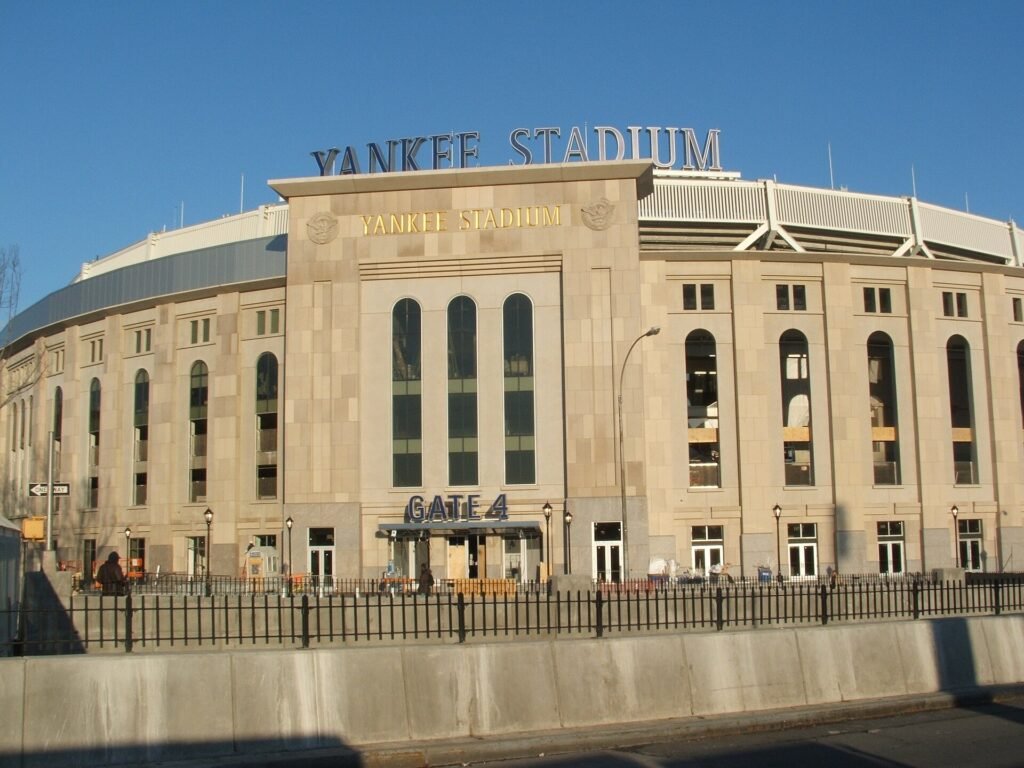
Photo: BuickCenturyDriver at English Wikipedia · Public domain · via Wikimedia Commons