
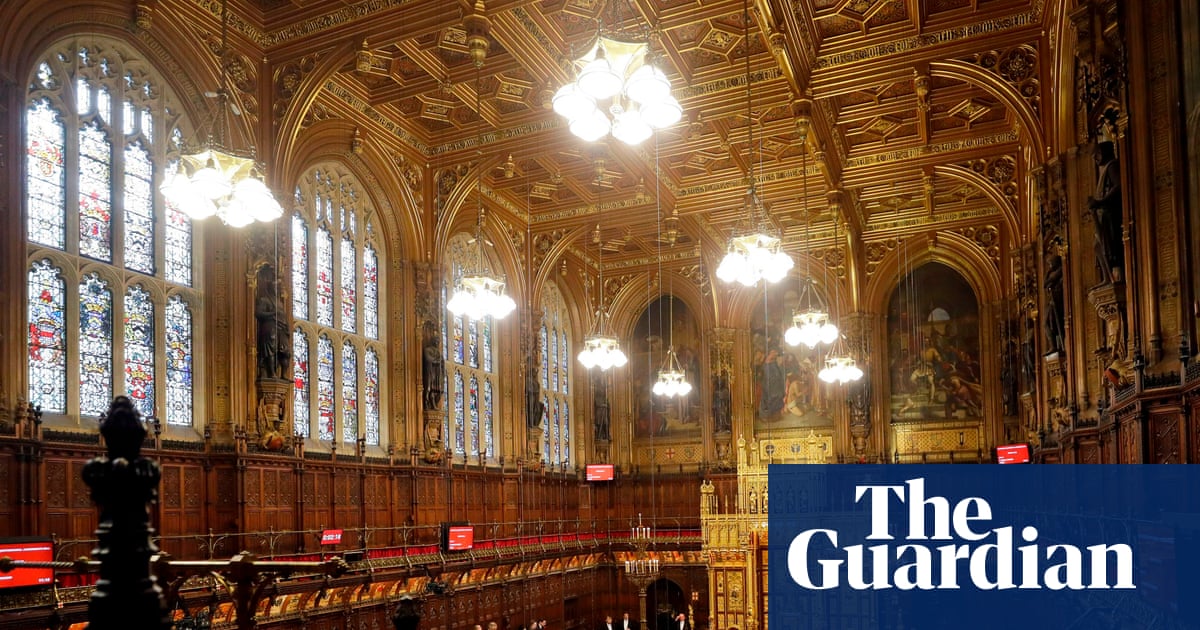
Here’s what a reformed House of Lords could look like | Letters
A reformed Lords could give us the best of all worlds: a chamber that connects and legitimises the disparate parts of our higgledy-piggledy devolved constitution without challenging the primacy of the directly elected Commons (So long, hereditary peers – but the Lords is still full of absurd anachronisms, 13 March).
Three-quarters of its members could be indirectly elected by local councillors, with temporary seats reserved for the heads of the national governments and regional mayors. Party leaders not yet in the Commons – such as Zack Polanski – could also sit there. The remaining seats could be time‑limited appointments for experts such as retired civil servants and former ministers, perhaps with different voting rights. An independent commission could oversee appointments, vet eligibility and weed out dodgy donors.
Such a chamber would empower the regions, give popular leaders such as Andy Burnham a route into parliament (while still serving Manchester) and give us one more reason to turn out in local elections.
Timothy Bailey
Oxford
I note that hereditary peers will soon disappear completely. However, for some strange reason, 26 bishops will remain in the House of Lords. Admittedly, there are still a number of theocracies in the world, but why are we still one of them? I can see no particular justification for this. We are increasingly a secular country and the relevance of the established church becomes weaker by the year. It saddens me, but that is the reality. Let us have an upper house that truly reflects the UK.
Ian Duckworth
Billington, Lancashire
Reduce the Lords to 400 members, with 300 appointed on merit by an independent committee, not because they are party donors or long-serving civil servants. They should be contracted to attend a minimum number of days a year at a modest day rate. And 100 could be separately elected at the same time as a general election. No bishops unless they make it into the group of 300. No patronage by prime ministers. No hereditary peers.
Kath Howard
Wellington, Shropshire
Polly Toynbee argues that we should move to an elected upper chamber, saying “all of Europe manages second chambers of different hues, none unelected”. Actually, Norway, Sweden, Denmark and Iceland have all abandoned their upper chambers as they found a second elected chamber superfluous.
So while we undoubtedly need to reform the House of Lords, an elected upper chamber is not a panacea.
Tony Voss
Emsworth, Hampshire
The hereditary peers have been expelled from the House of Lords supposedly in the name of democracy. The irony is that hereditary peers are elected while life peers are appointed, so the government has just removed the only members of the house with any electoral legitimacy.
Robert Frazer
Salford, Lancashire
If the current earl of Devon thinks that his family links to the Crusades 800 years ago give him special insights into either current events in the Middle East or contemporary domestic issues, he is not just mistaken but seriously deluded – while remaining a member of our legislative machinery.
Les Bright
Exeter
