
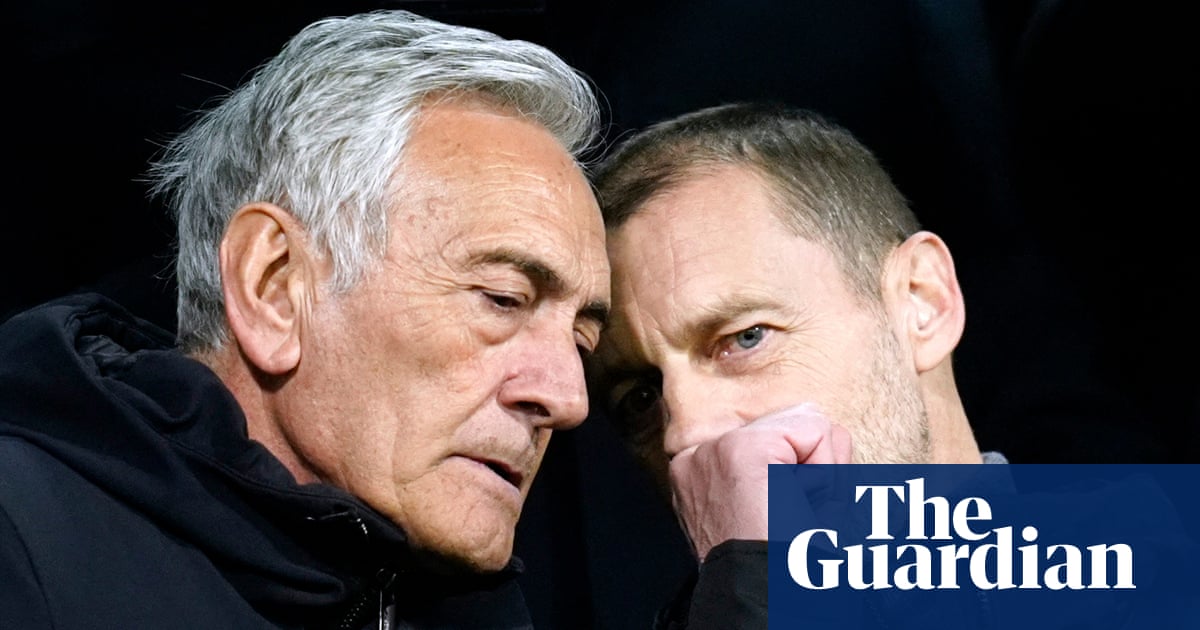
Italian football in crisis as FA chief resigns and Ceferin issues Euro 2032 warning
The crisis engulfing Italian football has deepened with the country’s football federation president, Gabriele Gravina, resigning and the Uefa president, Aleksander Ceferin, warning that it risks losing its co-hosting rights for Euro 2032.
Gravina announced his resignation at an emergency meeting of the Italian Football Federation (FIGC) general council two days after Italy failed to reach a World Cup finals for the third successive time, losing on penalties to the outsiders Bosnia & Herzegovina. He had come under heavy scrutiny since their exit in Zenica, the country’s minister for sport, Andrea Abodi, intensifying the pressure by calling for “a renewal of the FIGC leadership”.
The 72-year-old was followed out of the door by Gianluigi Buffon, the national team delegation head, who also announced his resignation on Thursday. Next could be the head coach, Gennaro Gattuso, whose 10-month reign in charge of the Azzurri appears to have ended ignominiously. Gattuso replaced Luciano Spalletti in June 2025 but may pay for failing to deliver the short-term target of World Cup qualification.
A new leader will be elected in June and they will have to deal with problems affecting Italy’s longer-term status. They are due to host the European Championship alongside Turkey in six years’ time but there have been deepening concerns within Uefa about the state of the country’s stadiums. That was articulated by an interview given to Gazzetta dello Sport by Ceferin on Thursday, who did not hold back about Italy’s need to shape up quickly.
Quick Guide
FA warns fixture pile-up could devalue cup competitions and hurt national teams
Show
Fixture congestion risks harming England’s future World Cup chances and devaluing the FA Cup, the Football Association has warned.
The expansion of Uefa club competitions and the introduction of a 32-team Club World Cup has placed further demands on elite players.
The FA has already scrapped cup replays in a bid to alleviate the packed schedule, but admits there is a risk of domestic competitions being further devalued by the addition of extra international club tournaments.
“A significant challenge each season is to balance the development of the global competition calendar with the imperative of protecting player welfare,” the FA stated in its 2024-25 annual report, published on Thursday. “This task is complicated by the ambitions of competition owners to expand their events within an already crowded schedule.
“The ongoing discussions regarding future structural changes to the game, such as the introduction of new tournaments (eg FIFA Club World Cup), further intensify this challenge.
“These changes have the potential to significantly reduce the downtime available to elite players, affecting their recovery and overall well-being.
“Additionally, the introduction of more global competitions risks devaluing traditional domestic tournaments, such as the FA Cup, and may affect the performance of our national teams due to increased player fatigue and reduced time for international squad training. These factors could have financial implications for us.” PA Media
“Euro 2032 is scheduled and will take place, of that there is no doubt,” he said. “I just hope that the infrastructure [in Italy] will be ready. If that’s not the case, the tournament will not be held in Italy. Maybe Italy’s politicians should ask themselves why the football infrastructure is among the worst in Europe.”
Italy must name its five stadiums for the tournament in October from its current shortlist of 11 cities but only Juventus’s Allianz Stadium currently meets the requirements. While there are plans for significant redevelopments of San Siro, in Milan, and Napoli’s Stadio Diego Armando Maradona, along with a new stadium in Rome, the clock is ticking given work has to have begun on any new or upgraded host venues by March 2027. Fiorentina’s Stadio Artemio Franchi is currently being redeveloped.
There has long been frustration inside Italy and externally about the country’s sluggish speed in modernising its football facilities. “The biggest problem in Italian football is the relationship between football politics and ‘normal’ politics,” Ceferin said.
Ceferin was speaking shortly before Gravina’s resignation. The pair are close allies, Gravina currently serving as first vice-president of Uefa, and Ceferin warned Italy’s problems extend beyond one man. “The greatest loss would be to the FIGC,” he said. “It won’t be easy to find a gentleman who loves football and Italy so much.”
Gravina, who assumed his role as president in 2018, was in situ for Italy’s Euro 2021 triumph but saw the four-times World Cup winners beaten at home by North Macedonia in the playoffs for Qatar 2022. They were also beaten comfortably by Switzerland in the last 16 at Euro 2024. He publicly took responsibility after the defeat to Bosnia & Herzegovina but warned of far deeper problems, saying: “The crisis is deep, [Italian] football needs to be redesigned.”
