NASA Jet Chases Total Solar Eclipse From 50,000 Feet
NASA's high-altitude WB-57F aircraft tracked the Moon's shadow over Iceland, capturing rare above-the-clouds views of a total solar eclipse.
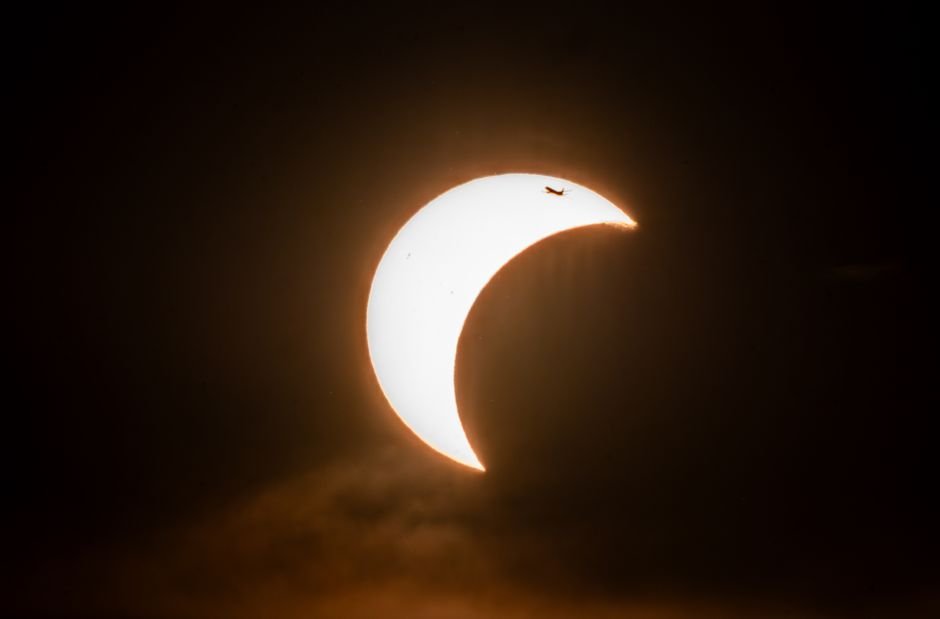
NASA’s Astronomy Picture of the Day feature has spotlighted a striking image captured from the cockpit of a specialized research aircraft as it chased the Moon’s shadow across the sky during a total solar eclipse earlier this year. The photograph, published September 5, 2026, shows the solar corona emerging at the start of totality, framed against a darkened sky with Venus, Jupiter, and Mercury visible nearby.
The image was recorded on August 12 when NASA’s WB-57F high-altitude research aircraft flew off the coast of Iceland, following the precisely calculated path of totality. Flying at roughly 50,000 feet, the aircraft was positioned to maximize the amount of time it spent within the Moon’s shadow, allowing onboard instruments to gather data unobstructed by weather or atmospheric interference. A suite of high-resolution cameras aboard the plane recorded the eclipse from above the clouds, dust, and water vapor that typically limit ground-based observations.
According to the description accompanying the image, the cockpit view was pulled from inflight video footage showing the moment totality began, with the corona becoming visible as sunlight was fully blocked by the Moon. The sky within the shadow appeared dark, while the horizon remained bright in the distance, outside the reach of the eclipse path. The image credits NASA and lists Jerry Bonnell, Cecilia Chirenti, Robert Nemiroff, and Keighley Rockcliffe as the authors and editors behind the daily feature, which is produced through NASA’s Goddard Space Flight Center in partnership with NASA Science Activation and Michigan Technological University.
High-altitude aircraft have long served as valuable platforms for eclipse science, offering researchers a way to observe solar phenomena without the disruptions caused by ground weather conditions. Flying above the bulk of Earth’s atmosphere allows instruments to capture sharper images of the solar corona, the faint outer atmosphere of the Sun that becomes visible only during totality. Because eclipses last only a few minutes at any single ground location, aircraft capable of tracking the Moon’s shadow can extend observation windows, giving scientists more data to study solar activity, coronal structure, and atmospheric effects tied to the sudden loss of sunlight.
The WB-57F program, operated out of NASA’s Johnson Space Center, has historically supported a range of atmospheric and astronomical research missions, given its ability to fly well above commercial aircraft altitudes for extended periods. Eclipse-chasing missions like the one over Iceland fit into a broader pattern of using specialized aircraft to complement ground-based observatories and satellite instruments, particularly when the path of totality crosses remote or hard-to-access regions such as the North Atlantic.
NASA also noted in the release that its Astronomy Picture of the Day service is in the process of migrating its primary web presence from the longstanding apod.nasa.gov domain to science.nasa.gov/apod, a transition intended to consolidate the daily feature within the agency’s broader science communications platform. The daily image series has run for decades, pairing a single photograph or illustration with a short explanation written by professional astronomers for a general audience.
The next installment in the series is set to focus on enhanced imagery of Pluto, continuing the program’s rotation through solar system subjects, deep-sky objects, and now, aircraft-based eclipse photography.
This report is based on details from a NASA press release, available via science.nasa.gov.