
Super League’s rousing Rivals Round offers timely boost for takeover talks
Super League’s possible takeover by the National Rugby League could gather pace in the coming weeks as executives head to the UK for talks to thrash out a deal. Had the NRL’s chief executive, Andrew Abdo, or anyone associated with the game in Australia watched the past few days, they would have been mightily impressed with matters both on and off the field.
The overriding mood in recent months as speculation rises over a partnership between rugby league’s two premier competitions has been that Super League is in desperate need of help. A league in crisis, sinking without a trace unless the sprinkling of magic that follows the NRL at every turn steps in and saves the day.
Financially, that may be true. There is no doubting that club owners are investing more than ever before as revenue streams diminish. However, on the field there is a salient argument to suggest that Super League is in the best position it has ever been in. Unsure? Take a look at the top of the competition after Easter as the season passes through the quarter-way mark.
Super League has provided compelling title races in recent years but not quite as widespread as this. Seven rounds feels an appropriate sample size to judge the table and with that in mind, the fact that there are five teams level on points at the summit – with at least one of them representing a major surprise – means there is plenty for the NRL to be excited about.
The devil will be in the detail with any agreement between the two competitions, but the Guardian has learned that the NRL is considering covering the cost of the Super League salary cap – roughly £2.1m – for all teams as part of a package. That would immediately prick up the ears of club owners who are losing millions, though they would have to relinquish control of the game.
It is also understood that talks have taken place in Australia about identifying a candidate who could potentially handle the NRL’s interests in the UK. That could be a chief executive operating in a club or even a high-profile former player, though it has been stressed to the Guardian any decision is some way away yet.
Few are better placed to underline the positives right now than Super League’s longest-serving coach and the man in charge of the surprise package within the leading quintet, Wakefield’s Daryl Powell. “It’s more open than I’ve seen in a very long time,” he said after watching his side join Warrington, Leeds, Wigan and St Helens at the summit following the Easter fixtures.
Having been shared between Saints, the Rhinos, the Warriors and – in Super League’s early years – Bradford Bulls for the first 29 years of its existence, Hull KR’s historic treble last year smashed not only the longstanding status quo, but also offered others a path to follow suit. That is something the NRL has always had over its English counterpart; genuine unpredictability and lots of title contenders.
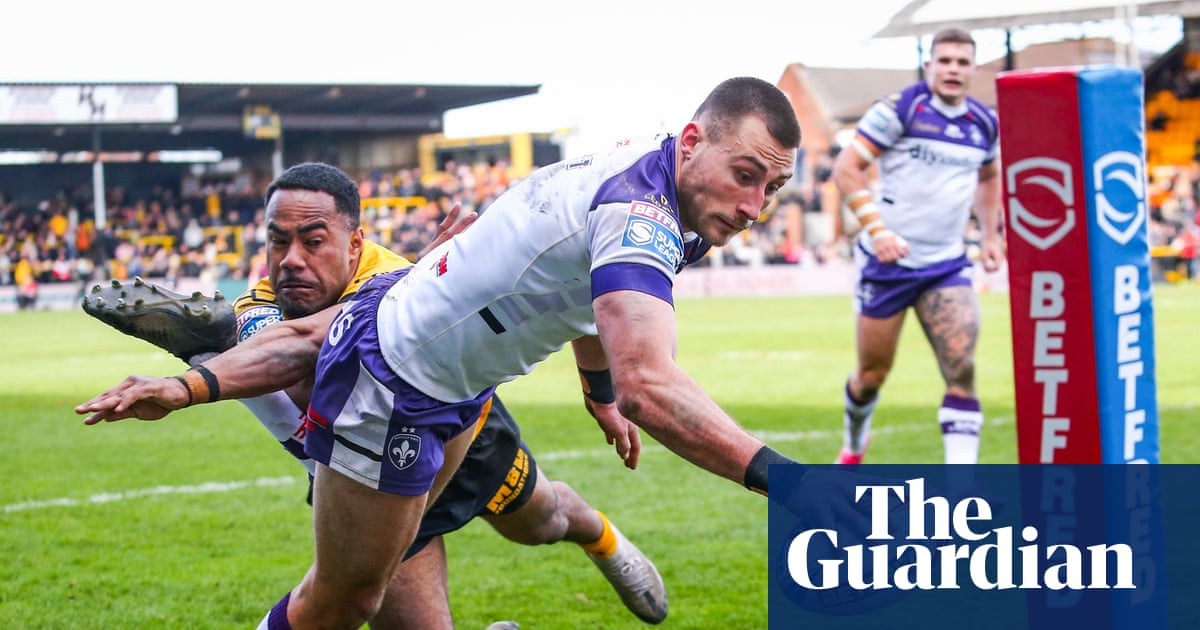
Wakefield, a Championship club 18 months ago, are now showing signs they could be next. Without a major trophy since 1968, they have been revolutionised under the ownership of Matt Ellis and the coaching of Powell. Their 34‑0 demolition on the road at local rivals Castleford Tigers on Sunday afternoon, the final game of Rivals Round, was further evidence of that.
That game was played in front of the third sellout crowd of the weekend, with full houses at the Hull derby and St Helens’ win against Wigan on Good Friday too. Bradford, themselves promoted last season, attracting a crowd of almost 15,000 for their derby with Leeds also shows there is now another club back in the big time that can offer plenty of scope for growth.
In total, more than 80,000 fans were at the seven games, with Super League crowds up 13 percentage points on this time last year. The longer the title race remains so open and compelling, the more those numbers will rise. You could not fail to be entertained by Saints’ stunning comeback on Good Friday, nor the manner of Warrington’s fifth win in six against Leigh on Saturday afternoon.
There are still problems, of course. The prospect of the NRL pumping money into a financial black hole will be appealing for club owners, but they will have to likely give up their considerable voting power and agree to be governed by an autonomous body. That will not be an easy sell for a group of individuals who have thrived in making the decisions internally in recent history.
Money alone does not solve a shrinking player pool either, nor does it truly address expansion. But what the NRL can offer is the scope to take the game to new heights. What the past few days have shown is that Super League is ready for its big breakthrough. It just needs a helping hand that, at long last, may not be far away from materialising.
