What the Oval Office National Monument Covers: Four Rooms, Interior Oversight, Preserved Exemptions
A proclamation dated November 5, 2026 makes the Oval Office, Outer Oval Office and Cabinet Room a national monument under the Antiquities Act.
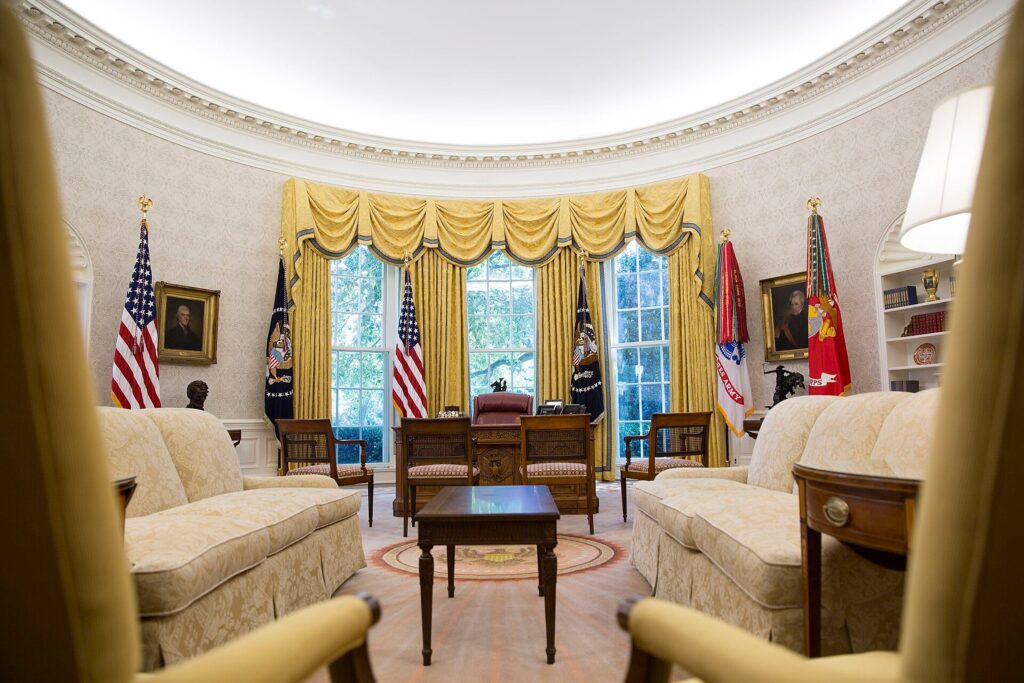
On November 5, 2026, President Donald Trump signed a proclamation establishing the Oval Office National Monument. The monument covers the Oval Office and its associated rooms in the White House. The proclamation was issued under the Antiquities Act and is listed on the White House website among presidential actions dated that day.
The proclamation sets the monument’s boundaries, assigns management duties to the Interior Department, and states what the president may still change inside the rooms. It also keeps existing exemptions under the National Historic Preservation Act for the White House in place.
Four Numbered Rooms Make Up the Boundaries
The boundaries list three named spaces. The Oval Office is Room 110. The Outer Oval Office covers Rooms 106 and 108. The Cabinet Room is Room 105. Together, they make up four rooms in the White House.
The proclamation describes these boundaries as the smallest area compatible with the proper care and management of the objects it protects. That limit follows the Antiquities Act, which the proclamation cites as its authority.
The statute allows parcels of land to be reserved as part of a monument. The limits of those parcels must be confined to the smallest area compatible with the proper care and management of the objects to be protected.
The monument includes no other rooms.
The proclamation puts four numbered White House rooms under a federal management framework.
Legal Basis
The Antiquities Act, codified at 54 U.S.C. 320301, lets the president declare national monuments by public proclamation on federally owned or controlled land.
Management Duties Fall to the Interior Department
The Secretary of the Interior, acting through the National Park Service, must manage the monument. The proclamation says that management must protect the monument’s historic character, its architectural integrity, and its association with the Presidency. The National Park Service manages the monument under the Secretary’s direction.
The proclamation notes that the White House grounds are already federal property administered by the National Park Service as part of the President’s Park. It also notes that the grounds are already a National Historic Landmark.
The Secretary must develop and implement a management plan in consultation with the White House Office of Administration and other relevant executive departments, agencies, and offices. The plan must prioritize preserving structural and significant architectural features. The proclamation sets no deadline for completing that plan.
Before any action that would substantially alter or demolish the monument or its essential architectural elements, the Secretary must require documentation, review and consideration of alternatives. The Secretary must also evaluate proposed changes that affect the monument’s historic character for consistency with its national significance. The Secretary must coordinate with the Committee for the Preservation of the White House and other appropriate advisory bodies. The proclamation gives no further details about the Committee.
The duties apply to the monument as a whole, so the Secretary’s role covers the three named spaces, not only the Oval Office.
What the President Keeps, and What Requires Review
The proclamation does not restrict the president’s authority to redecorate the monument or to select furnishings. It also allows ordinary operational and security modifications, as long as they do not substantially impair the monument’s historic structure or architectural character.
The proclamation states that it does not change existing National Historic Preservation Act exemptions that apply to the White House. It also states that it does not diminish Congress’s authority over federal property.
The proclamation separates two kinds of change. Under the text, the president’s authority over redecorating and furnishing is not restricted. Architectural alteration or demolition of essential elements requires documented review by the Interior Secretary, including consideration of alternatives.
The proclamation puts four numbered White House rooms under a federal management framework.
Statutory Basis and Other Presidential Actions
The Antiquities Act, codified at 54 U.S.C. 320301, lets the president declare national monuments by public proclamation. Eligible objects include historic landmarks, historic and prehistoric structures, and other objects of historic or scientific interest, on land the federal government owns or controls.
The statute gives the president discretion to make the declaration by public proclamation. It limits parcels of land reserved as part of a monument to the smallest area compatible with the proper care and management of the objects to be protected. The Oval Office boundary text follows that limit.
Other proclamations dated November 3, 2026 include Anti-Communism Week, 2026, and The American Declaration of Freedom in Space. The Oval Office proclamation is dated two days later, on November 5.