What Alibaba’s Zhenwu V900 chip claims, and what remains unverified
Alibaba's chip unit says the V900 triples its predecessor's performance. No benchmarks, process node or fabrication site have been published, and mass production is set for early 2027.
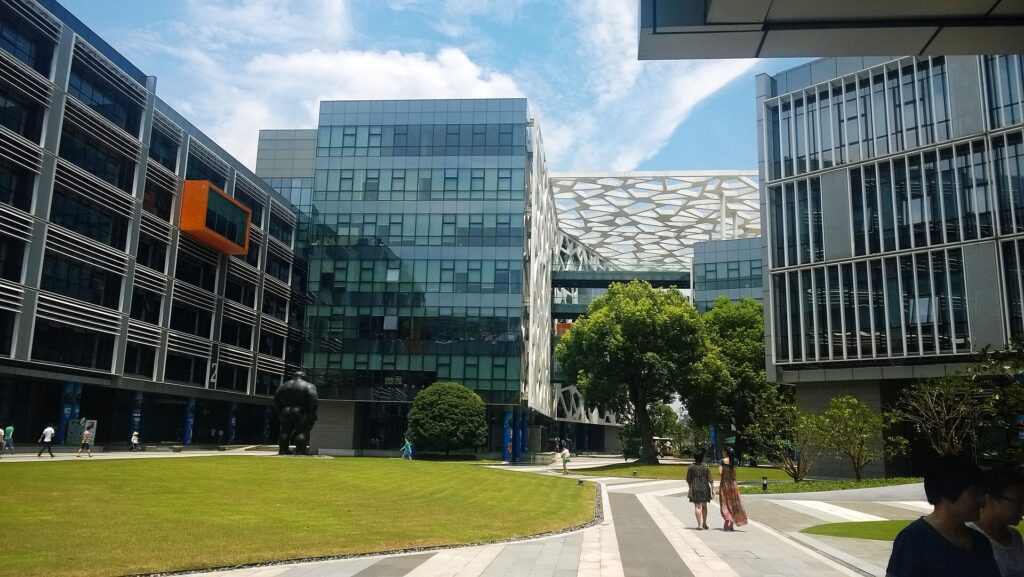
Alibaba’s chip unit, T-Head, unveiled the Zhenwu V900 AI accelerator on September 22, 2026, at the company’s Apsara Conference in Hangzhou. Chief executive Eddie Wu described it as the most powerful AI chip in China today.
The announcement came with a model roadmap, a set of self-improvement results and a data-centre target. Much of it is a company claim or a plan, and the public record so far does not allow independent checks of the headline performance figure.
What Alibaba says the V900 delivers
Alibaba says the V900 has three times the performance of its predecessor, the Zhenwu M890. Khaleej Times, reporting on the launch, says the M890 itself arrived in May. CRN Asia also dates the M890 release to May.
A write-up of the keynote by NYU Shanghai’s research site lists memory rising from 144 GB to 216 GB and chip-to-chip bandwidth rising from 800 to 1,200 GB/s. It describes the M890 memory as HBM. The chip natively supports the low-precision FP8 and FP4 number formats, which CRN Asia describes as meant to speed up inference and lower its cost.
The chip is paired with Alibaba’s own networking and storage components, including the ICN Switch, the Panmai SmartNIC and the Zhenyue SSD controller. CRN Asia describes the result as an upgraded supernode server. Alibaba says a single cluster built this way can scale to as many as 500,000 cards, for training and running frontier models.
Wu also said he expects significant growth in annual AI chip shipments, according to both CRN Asia and Khaleej Times. No shipment figures were given in either report.
The company plans mass production and commercial release in the first quarter of 2027.
V900 at a glance
Alibaba says the Zhenwu V900 has 216 GB of memory and 1,200 GB/s of chip-to-chip bandwidth, with mass production planned for the first quarter of 2027. No benchmarks, process node or fabrication site have been disclosed.
What is still unverified
The three-times figure is a comparison with Alibaba’s own earlier chip. The NYU Shanghai summary notes that no absolute compute numbers were published, such as FLOPS at a stated precision, so the claim can only be read against the M890. CRN Asia likewise says Alibaba did not publish benchmark details.
CRN Asia also reports that the company did not say where the chip will be manufactured or on which process node. Nor did the article it published make any direct comparison with Nvidia hardware.
The 500,000-card cluster is also a design figure. The sources describe it as a capability Alibaba says the system can reach, and none reports a cluster of that size in operation.
According to the Let’s Data Science summary of Reuters and Bloomberg coverage, public reporting did not give pricing or software compatibility information. That summary also lists memory specifications as undisclosed, while CRN Asia and the NYU Shanghai summary both give a figure of 216 GB. The sources do not explain the difference.
The V900 has not yet entered mass production, so the specifications reported so far are those announced by the company.
The model roadmap behind the chip
Alongside the hardware, Alibaba’s Qwen team outlined larger models. Qwen 4 is described as currently in training, with no release date, sizes or licensing terms announced. Qwen 4.5 and Qwen 5 are projected at 5 trillion to 10 trillion parameters, aimed at longer and more complex tasks.
Khaleej Times gives the current flagship, Qwen 3.8 Max, as 2.4 trillion parameters. Reuters, as summarised by Let’s Data Science, says the planned model is up to four times larger than the current flagship. The NYU Shanghai summary puts it at roughly two to four times larger.
Reuters is also cited as noting that parameter count alone does not measure model quality. The Let’s Data Science summary lists training data, architecture, post-training methods, inference efficiency and benchmarks as other factors. The NYU Shanghai summary adds that the plan is at least one generation away and that Alibaba did not say whether future Qwen models will remain open-weight.
The same summary says Wu praised the open 27B model and said Alibaba will keep improving models for local deployment. It also lists other releases, including a simultaneous-interpretation model, an audio model family and an agent platform for smartphone makers, with an image model due later in 2026.
A widely shared social media post listed names for Qwen 4 variants. The NYU Shanghai summary says Alibaba’s materials do not confirm them.
Self-improvement results Alibaba reported
The Qwen team also reported what Khaleej Times calls “meaningful” progress toward models that improve themselves with limited human input. In that approach, according to the NYU Shanghai summary, a model designs experiments, generates data and evaluates the results.
That summary lists two results. In one month of automated runs, Qwen 3.8 Max completed 33 iteration cycles, and its Artificial Analysis score rose from 40 to 45.
In the second, more than 60 hours of self-improvement and over 10,000 EDA tool calls produced chip bus modules that Alibaba calls production-grade. They were 42% smaller in chip area.
The NYU Shanghai summary says these results are company-reported, with no technical report or methodology published.
The three-times figure is a comparison with Alibaba’s own earlier chip.
Where it sits in China’s push beyond Nvidia
Reuters, as summarised by Let’s Data Science, says Chinese technology companies are seeking domestic alternatives to Nvidia’s AI processors as US export restrictions tighten. Khaleej Times and CRN Asia carry the same context.
Khaleej Times describes Alibaba as building out every layer of its AI business, from foundation models and semiconductors to the data centres used to train and deploy them. The Let’s Data Science summary says Wu named AI models, AI chips and AI cloud as three foundational areas.
None of the pages reviewed gives details of the specific restrictions, and none compares the V900 with an Nvidia product. The sources therefore establish the setting for the launch, but not how the chip performs against Nvidia’s processors.
CRN Asia notes that T-Head’s existing Zhenwu chips serve more than 650 customers in sectors including automotive, finance, energy and manufacturing. That figure refers to the current chips, not the V900. The NYU Shanghai summary adds that the M890 AI Supernode already runs inference for models above 2 trillion parameters.
Capacity target and what it means outside China
Alibaba said it aims to exceed 20 gigawatts of data-centre capacity by 2032. The South China Morning Post, as cited by Let’s Data Science, says this concerns Alibaba Cloud’s global capacity. The NYU Shanghai summary says the keynote slide showed it as a tenfold rise from 2022.
Wu acknowledged that global shortages across the AI data-centre supply chain limit how fast compute can scale. Khaleej Times reports he said demand is “exceptionally robust” and is accelerating cloud revenue growth, and that mid-to-long-term industry demand far exceeds the company’s supply capacity. It adds that AI supernodes are due to begin coming online at commercial scale in the third quarter of 2026.
Khaleej Times also reports Wu’s longer view. He said the truly groundbreaking products of the machine intelligence era have not yet arrived, and compared AI coding to the light bulb of the electrical age. He predicted machines would eventually produce more than 1,000 times the thinking of all humanity, and put today’s figure at less than 3%.
For cloud customers outside China, the sources offer little that is concrete. The target is described as global, but the pages reviewed give no regional breakdown, no named overseas customers and no timetable for offering V900-based capacity abroad.
Investors reacted to the day’s announcements. Khaleej Times reports Alibaba’s Hong Kong-listed shares rose 5.1% on Tuesday, their highest level in a month. Reuters is cited as reporting a gain of about 5%.
Photo: Danielinblue , designed by HASSELL (architects) [ 1 ] · CC BY-SA 4.0 · via Wikimedia Commons