
A blueprint for Latin America’s strongman
Nayib Bukele of El Salvador, Javier Milei of Argentina, and Daniel Noboa of Ecuador, have formed a new ‘axis of power’ in the continent
Article content
A century ago, the term strongman referred to towering circus figures who bent iron bars and hoisted horses onto their shoulders to the crowd’s astonishment. The iconic showmen were addicted to applause. Over time, the word shifted from spectacle to power. No longer confined to the circus tent, it now echoes through presidential palaces, where strongmen no longer twist metal beams but laws and political opponents. Yet, at their core, they still seek the same thing: the deafening roar of the crowd.
Advertisement 2

Article content
To find a strongman, you don’t have to look far. Latin America has been mass-producing them for years. Of course, they have evolved. The days of old military uniforms — which used to end their days in courtrooms — are now long gone. And leftist autocrats have descended into outdated authoritarianism, like that of Venezuela’s Nicolás Maduro or Nicaraguan dictator Daniel Ortega, whose only option is to avoid falling to evade prison. So, the region has renewed its contribution to iron-fisted politics with presidents who, instead of seeking refuge in rifles, wrap themselves in votes and social media likes.
The most recent and successful examples might even be endorsed by U.S. President Donald Trump, who broke 200 years of tradition by holding an inauguration with foreign leaders. He invited only three from Latin America: Nayib Bukele of El Salvador, Javier Milei of Argentina and Daniel Noboa of Ecuador. Three countries, three contexts, but all of them strongmen.
They all made it to Washington, but not on the same path. The way to power in the history of these three figures looks like a minefield of shortcuts. Although they share the youthful image of leather jackets, social media as their office, and astonishing approval ratings that place them among the most popular presidents in the Americas, they come from diverse backgrounds.
Advertisement 3
Article content

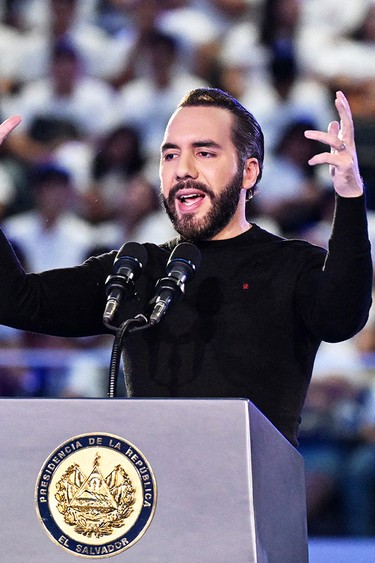
Bukele, 43, is the son of immigration. Baseball cap, meticulously trimmed beard, preacher-like rhetoric. The president of El Salvador is the son of a Palestinian who defied xenophobic laws that prevented Arabs from engaging in business and passed down a major business group that included a marketing agency to his children. That is Bukele’s background — the world of marketing, where form is as important as substance. He reached the presidency after a brief tenure as mayor of Nuevo Cuscatlán, a wealthy and small municipality, and then of San Salvador, the capital.
As soon as he arrived, he made headlines worldwide for a peculiar gesture: a selfie from the United Nations General Assembly podium. There, he accurately prophesied that his photo would get more attention than the speeches of his counterparts. For the past few years, he has held the unofficial title of the most popular president in the world, with an unshakable 92 per cent approval rating. He won his re-election effortlessly and now governs without opposition or critical media, with one per cent of his country’s population imprisoned.
Milei, 54, is the son of exhaustion. Messy hair, prime-time insults, an encyclopedic memory. The president of Argentina abandoned a little-known career as an economics professor and TV pundit to found the libertarian party, quickly leaped to the position of congressman, and used it as a springboard to the presidency just two years later. The son of a bus driver, he grew up in humble conditions alongside his sister, Karina — his most unbreakable bond and now his top adviser.
Advertisement 4
Article content
Article content

He has confessed that the most important things in his personal life are his dogs: Milton, Murray, Robert and Lucas, named after his favourite economists — Milton Friedman, Murray Rothbard and Robert Lucas. He captured the attention of the conservative world with a provocative speech: libertarianism had to come out of the closet. So, while others avoided the word “cuts” at all costs, he embraced it with such pride that it became his promise: “I’m not going to cut with scissors, I’m going to do it with a chainsaw.” That is his symbol: the downsizing of the state. Today, against all odds, he is considered the most popular president in South America, governing without resistance from the weakened historical forces. He even serves as inspiration for Elon Musk’s DOGE experiment.
Noboa, 37, is the son of privilege. Sharp suits, enviable resumé, bulletproof vests. The president of Ecuador is the son of Alvaro Noboa, the country’s richest man, a billionaire who ran for the presidency five times. He grew up surrounded by political power, studied at Ivy League universities, and his godfather is Robert Kennedy Jr., U.S. Secretary of Health under Donald Trump.
I’m not going to cut with scissors, I’m going to do it with a chainsaw
Javier Milei
Noboa jumped from an insignificant and fleeting legislative career to an unprecedented election in Ecuador, in the middle of a political and security crisis. He started his campaign with less than one per cent of voter intention. Brief in words, his inaugural speech lasted less than nine minutes. Radical in his actions, when he got angry with his vice-president, he indefinitely reassigned her to diplomatic service in Israel — right after the war with Hamas broke out. Uninterested in old protocols, he does not grant long interviews, wears shorts to presidential meetings, and has appointed 26-year-old women to his cabinet, for whom being a minister was their first job. Today, elected for a 15-month transition period, he seeks re-election in a tight run-off, where he starts with a slight advantage. If he wins on April 13, he will have retired the political class that has ruled his country.
Advertisement 5
Article content
But what matters is that things get done. So take note. This is how it gets done: A strongman blueprint for modern times drawn from these successful examples.
Chaos: A starting point
To begin, a strongman needs a broken country. A country where “liberties can be traded for results,” summarized Pedro Donoso, director of Icare, a reputation management firm in Ecuador that advises politicians on how to craft a public image. In his view, what works for strongmen in Latin America is that people seem willing to sacrifice the principles of freedom and rights in exchange for solving real-life problems.

Pre-Bukele, El Salvador was the most violent country in the world. The bipartisan political class had surrendered power to the gangs and made pacts with them, while the streets were under curfews imposed by criminals. Pre-Milei Argentina had the second-highest inflation rate on the planet — 211 per cent annually — an unmanageable debt amounting to 80 per cent of GDP, and a dreadful record: consecutively, each of the last four governments had left behind more poverty than the previous one. And as for pre-Noboa Ecuador, there’s almost no need to explain: this small South American country was facing multisystem failures — a recessionary economy, an energy crisis causing long and unpredictable blackouts and an unprecedented surge in violence that placed many of its cities among the 50 most violent in the world. Even Noboa’s election was marked by bloodshed: “Noboa was born by tragedy,” says Donoso. “Without the assassination of Fernando Villavicencio (one of the presidential candidates) just days before the election, there would be no Noboa. Rather than rising, he simply witnessed the collapse of the entire political class.”
Advertisement 6
Article content
Chaos, Donoso said, is the starting point for what he calls “a new axis of power.” He referred to the alliance between Trump and these leaders. “It’s too early to know where it will end, but everything suggests they seek to recognize each other as part of what seems to be a new axis of power in the continent.”
A government mission
Before aiming for anything, strongmen need to prove they serve a purpose. Antonio Sola is one of the most respected political consultants in the Spanish-speaking world. He has guided 19 candidates to the presidency across America, Europe and Africa, and when reflecting on the protagonists of this blueprint, he has no doubt: “They are the consequence of the exhaustion of democracies, which fail to address the major demands of the populations in our countries.”
Sola believes the reason these leaders have gained popularity is that they dedicated themselves to solving the cause their voters entrusted them with. “Bukele and Milei, above all. Noboa, I would put to the side,” he said.
The figures and facts support this. The moment he took office, Bukele understood there could be no prosperity in a country far more concerned with homicide rates than stock markets. He concentrated his efforts on trying to control insecurity. The first thing he did was militarize the nation and suspend constitutional rights through Emergency Decrees. He ordered law enforcement to arrest all individuals linked to the powerful Salvadoran maras — gangs that were bordering on becoming full-fledged drug cartels. In two years, Bukele’s police force captured 78,000 people and prosecuted them in summary trials under new, streamlined procedures. The scale of this figure amounts to one per cent of El Salvador’s population. At this pace, Bukele ordered the construction of CECOT, the largest prison in Latin America, a facility specifically designed for those sentenced to serve life sentences with no contact with the outside world, capable of housing at least 40,000 gang members.
Advertisement 7
Article content
Article content

When the gangs attempted to retaliate from prison by inciting violence outside, in 2022, Bukele did not hesitate to use the podium to deliver a speech that transcended his borders: “If you do that, I swear you won’t eat a single grain of rice. Let’s see how long you last inside. And I don’t care what international organizations say: If they want to help our people, let them come. If they want to help our gang members, we’ll hand them over — all of them. Two for one.”
The purge, as many called Bukele’s war on gangs, gave his government its worst reputation before ultimately giving him his best image. Today, El Salvador is the safest country in the Western Hemisphere, surpassing even Canada. It is the fastest-growing tourist destination in the world, and the nation that has reclaimed its public spaces.
Now, everyone wants to be Bukele, and Bukele-style figures have emerged around Latin America: in Ecuador (Jan Topic), in Peru (Rafael López), and in Argentina (Patricia Bullrich).
“They’re just trends,” Sola dismissed as he downplayed their significance. “Look, I’ve been doing this for 30 years. At one point, everyone wanted to be Felipe Calderón (México), and at another time, everyone wanted to be Álvaro Uribe (Colombia). But in the end, these things pass because these are transition leaders of a democracy that is agonizing.”
Advertisement 8
Article content
The Ford formula
It’s not about offering people what they want but making them want what you have to offer. Henry Ford was reputed to have said: “If I had asked people what they wanted, they would have said faster horses.” He never actually said that, but it would have suited him well.
The point is, people don’t necessarily ask for what they need. That was precisely what created the phenomenon of Javier Milei. From his role as an outspoken TV panellist, he began insulting politicians from a bipartisan system that has lasted almost a century in Argentina: the left-wing Peronists and their conservative opponents. Milei demanded a third way, telling people what they didn’t want to hear:
“There-is-no-money.” That was the headline of his inauguration speech.
Milei campaigned on a plan: “I want to make Argentina a global powerhouse,” he said. To do that, he needed to shrink the state. He called his plan the “chainsaw plan” and targeted everything that was considered taboo in one of the most state-controlled economies in the region: selling off public enterprises, laying off tens of thousands of bureaucrats and eliminating political perks. “We’re going to run a chainsaw over it,” he promised. And he wasn’t just talking about bureaucracy and salaries — he included pensions, public works, arts and everything he considered excessive government spending.
Advertisement 9
Article content

People voted for him. And in return, Milei has delivered results that seemed as improbable as his election.
“As successful as Bukele has been in his fight against crime, Milei has been against inflation,” said Juan Maiqueyra, former director of the Vatican’s Fratelli Tutti Political School and adviser to one of Milei’s defeated presidential opponents in 2023. “Inflation is a big issue for us. Milei brought it down from 30 per cent to two per cent per month. That may seem high for the rest of the world, but in this country, people used to rush to buy groceries in the morning because prices would go up by the afternoon.”
Milei loves his numbers. He repeats them whenever he can. At Davos, at CPAC with U.S. conservatives, in Buenos Aires. It doesn’t matter where. What matters is that everyone hears them: the Argentine peso has appreciated by 44 per cent in a year. The World Bank forecasts five per cent economic growth this year. And an astonishing fiscal turnaround — erasing a six per cent deficit and achieving the first surplus in 14 years.
These numbers, according to Maiqueyra, allow Milei to establish the friend-enemy logic, with one major caveat: “If you’re not with him, you’re against him.” And that applies to journalists, politicians and activists alike.
Advertisement 10
Article content
They are the enemy
“Even my harshest critics admit that I am a terrible, truly terrible enemy to have,” Daniel Noboa said six months into his presidency. His soft-spoken tone might make him seem hesitant to those hearing him for the first time. But Noboa takes pride in being feared. And with good reason. Despite being elected for a transitional term of just 14 months, having zero political experience, being the youngest president in Ecuador’s democratic history, and coming to power without a political party, he quickly took control of a country with a political class that devoured its own.

Many people could testify to the wrath of Ecuador’s president. But one particularly symbolic case is that of Cuban journalist Alondra Santiago. Having spent more than half her life in Ecuador, in 2024 she hosted a fiercely critical show against the government — one that included a satirical take on the national anthem. Shortly after, she was expelled from the country. Santiago sums up her case like this: “This was an attack on press freedom, meant to channel public hatred against my show. It wasn’t just about silencing me as a critical voice — he also needed to hand his followers a trophy.”
It’s no coincidence that Santiago exiled herself to Mexico, another witness to the president’s fury. In April 2024, after the Mexican government granted asylum to former Ecuadorean vice-president Jorge Glas, despite his multiple corruption convictions, Noboa decided to break with decades of international diplomatic norms. On live TV, he ordered the first military raid on an embassy in modern Latin American history. Glas was dragged out and taken to La Roca, Ecuador’s highest-security prison.
Advertisement 11
Article content
Outside of Ecuador: global outrage. Nearly every country condemned the violation of diplomatic immunity.
Inside Ecuador: a different reaction. Something unexpected happened — 66 per cent of Ecuadoreans felt their president had made the country “respected again,” according to local polling firm Comunicaliza.
But Noboa’s fury isn’t always a bad thing.
Even my harshest critics admit that I am a terrible, truly terrible enemy to have
Daniel Noboa
On Jan. 9, 2024, Ecuador woke up under siege. Dozens of terrorist attacks, bomb threats everywhere, and an armed gang taking over a national TV station live on air sent the country into full-blown panic.
That’s when Noboa declared war. Instead of using the usual state of emergency decrees, he took a step further: he declared Ecuador in a state of Internal Armed Conflict — essentially, a war footing, placing the country under permanent militarization.
The result? Noboa enters his reelection campaign with crime rates that would terrify voters in any country, but with one undeniable achievement: an 18 per cent drop in violent deaths during his first year. That is something Ecuador hasn’t seen since 2017 — violence numbers going down. Whether that will be enough to keep him in power remains to be seen.
Get rid of journalism
Independent journalism can be a real pain for any government — accountability here, opinions there, fact-checking everywhere. Of course, jailing and persecuting journalists is not only outdated but poorly regarded. Gets bad press. So our leaders have understood that instead of fighting the press, they must ignore it.
Advertisement 12
Article content
Article content

That’s why Bukele governs through X, issuing decrees, orders and judgments in just a few characters. Milei is known for his Instagram Live streams. A few weeks ago, he was delivering a speech at the Inter-American Development Bank when a call interrupted his broadcast. He flew into a rage: “Excuse me. The idiot bastard calling me right now knows exactly what he’s doing. He knows because I’m live (on Instagram),” he snapped, drawing nervous laughter from the audience. And Noboa, perhaps because he is the youngest, prefers TikTok — using the platform for announcements, dance videos, even dressing up as Ken alongside his wife as Barbie.
There are journalists around them, but not necessarily journalism.
Milei believes in militant journalism — hand-picked reporters to whom he grants frequent interviews as long as they are not inconvenient. Just a few weeks ago, a scandal broke when Argentina’s most famous journalist, Jonathan Viale, was caught on camera in an unedited clip uploaded by mistake. The video showed a presidential adviser halting the interview, scolding the journalist, and forcing him to rephrase a question in a way that fit the official narrative. Argentina has no exiled journalists and no shuttered newsrooms, but Argentine journalists consulted for this blueprint refused to speak on the record.
Advertisement 13
Article content
The key, according to our strongmen, is bypassing the press. Speaking directly to the people. Bukele knows this well. He rarely grants interviews within El Salvador. And his hostility toward El Faro, the country’s leading investigative media outlet, is well known. “Sellouts, corrupt, liars,” Bukele has called them.
One of El Faro’s most visible journalists, Gabriel Labrador, summed it up: “Bukele used to like El Faro’s work.” To be fair, most did. El Faro was one of the first digital news outlets to gain international recognition. Founded 26 years ago, long before most social media platforms, it specializes in investigative journalism.
Then Bukele came to power. In 2019, El Faro started questioning contract opacity. In 2020, they investigated alleged corruption in pandemic contracts. And then came the total war.
“I believe our freedom of expression is seriously wounded,” Labrador said. He’s not exaggerating. Under Bukele, El Salvador has fallen 80 places in the Reporters Without Borders ranking, which compares freedom of the press, and is now sitting at 131st out of 180 countries.
Then came 2023, when the government announced money-laundering investigations against El Faro. Fearing what was to come, the newsroom moved its headquarters to Costa Rica, where the team can operate safely.
Advertisement 14
Article content
Ecuador, for its part, has 16 journalists in exile since 2023, most due to threats from drug-trafficking groups or corrupt police forces.
The options for dealing with the media are varied: from ignoring journalists to forcing them into exile to funding a friendlier media network that aligns with those in power.
Learn to negotiate
The hardest part of being a strongman is remembering that, no matter how often you are called that, you are not a dictator. Leadership depends on the ballot box, and at any moment, a majority can vote you out of power. So it’s best to learn to negotiate — and the sooner, the better.
All our examples came to power without a legislative majority. Negotiation was essential for all three.
Perhaps the most extreme case is Noboa, who took office without even having a political party. Backed by a rented political force, with only 12 legislators — less than 10 per cent of the parliament — it took him just five months to build a coalition of 40 votes, and even fewer days to strike a deal with his worst enemies: the Social Christian Party and the Citizen Revolution, with whom he governed for half his term in an unprecedented political honeymoon. It lasted only a few months, but it allowed him to pass half a dozen laws to jump-start his government’s agenda.
Advertisement 15
Article content

Milei, on the other hand, who has spent his entire political career insulting what he calls “the caste” — his term for Argentina’s traditional parties — came to power by negotiating a deal with them. He secured the presidency by handing over control of Security and Foreign Affairs to the PRO, a mainstream conservative party. And, with no majority in Congress, he learned to negotiate through the sheer force of his popularity, securing approval for many of his proposals.
Bukele, in contrast, learned to negotiate before going on the offensive. In politics, he co-opted lawmakers to build a fragile majority, but once he secured it, he led legislative elections that gave him the broadest control in the country’s history. Once his absolute majority in Congress was indisputable, he launched a purge of the judiciary, removing all top judges and the attorney general. Now, he has the luxury of negotiating only with himself.
Sometimes there will be boos
For a true strongman, not everything is applause. Like any other ruler, sometimes they stumble. And when they fall, they bleed. However, criticism will likely come from abroad, from those who least understand the importance of their legacy.
Advertisement 16
Article content
Noboa not only got used to the complaints of his peers over the embassy invasion, but by the end of 2024, he found himself at the centre of an embarrassing Ibero-American presidential summit — without any presidents. His only companion that day was Felipe VI, the King of Spain. Many critics believe it was a snub in response to controversial remarks Noboa had made about his fellow presidents in The New Yorker a few months earlier: Bukele “is arrogant,” Milei came across to him as “conceited,” and Colombia’s Gustavo Petro was “a leftist snob.”

The criticism of Milei, beyond that slip by his Ecuadorean counterpart, stems from a scandal involving cryptocurrency. The Argentine president promoted a meme coin on his X account. Just a few hours later, tens of thousands of people found themselves scammed in a scheme that moved at least $200 million. The New York Times recently suggested that members of Milei’s inner circle might be tied to the project’s developers.
Bukele, on the other hand, has found himself under fire due to a report by El País, which linked him to the purchase of at least 34 properties worth $9 million during his first five years in office. The Salvadoran president responded briefly to reporters: “Imbeciles.”
Advertisement 17
Article content
Despite these setbacks, all three presidents continue to enjoy strong approval ratings and, as has been shown, hold a significant place in Latin American and U.S. politics.
Carolina Sandoval, president of the Washington Office on Latin America (WOLA), an NGO founded 50 years ago to explain how authoritarian regimes operate in Latin America, said that given the fact we are living in a second Trump era, “it is very likely that we will see U.S. officials praising these leaders. Trumpism has chosen to align itself in the region with right-wing undemocratic governments.”
It is striking, Sandoval noted, especially since Trump has become increasingly less hostile toward figures such as Russia’s Vladimir Putin, who could be considered the godfather of the strongman model, remarkably managing to be idolized both by Latin American conservatives and leftist regimes such as Cuba, Nicaragua and Venezuela.
It is striking only because analysts continue searching for ideological commonalities among those who, in reality, share only one ideology: a love for power. After all, that is what a strongman is — an addict of power.
What comes next will depend on the strongman. It could be lifelong rule, early retirement or being replaced by a younger, more ruthless strongman who follows this blueprint closely.
Advertisement 18
Article content
Article content

The strongman rises in a world where democracy is increasingly worn down. As Sandoval argued, “it is difficult to ask Latin Americans to continue defending a system that does not provide them with job opportunities, health care or quality education.”
She is referring to an undeniable reality. Since the beginning of the century, Latinobarómetro — a survey that studies political trends in the region annually — has consistently found the same results: only half of Latin Americans believe democracy is the best system of government.
That is why this blueprint remains relevant. In the end, a strongman is not defined by ideology, policy or even success. He is defined by the ovation — by the thousands who chant his name, the millions who hit “like” and the certainty that the louder the applause, the stronger he becomes.
Until, of course, the audience gets tired. The show loses its thrill. The tricks no longer dazzle. And the strongman learns the one truth his predecessors discovered before him: No applause lasts forever.
Andersson Boscán is an Ecuadorean journalist based in Toronto.
Article content
