How The Astor Revives Supper-Club Dining Inside the Public Theater
Chef Andrew Carmellini and designer Serge Becker's new restaurant reopens the Public Theater's dining program with midcentury Manhattan classics and theatrical memorabilia.
The Astor, a new supper-club-style restaurant designed by Serge Becker, opened September 15 inside The Public Theater at 425 Lafayette Street in NoHo. The 70-seat dining room, 20-seat bar, 12-seat lounge, and 52-seat mezzanine occupy the space formerly held by The Library, the theater’s previous restaurant. The partnership reunites NoHo Hospitality Group—led by chef Andrew Carmellini, alongside Luke Ostrom and Josh Pickard—with The Public Theater, continuing a collaboration that began in 1998 with Joe’s Pub.
Jersey Katz and Michelle Cunha serve as managing partners, with chef Angel Monge running the kitchen alongside Carmellini. The restaurant was designed to evoke an old-fashioned New York tavern or supper club, featuring red banquettes, white tablecloths, and wood paneling throughout. A mural by artist André Carrilho encircles the island bar, depicting 32 figures associated with The Public, including Lin-Manuel Miranda, Alicia Keys, and Tony Kushner. Theatrical memorabilia from the theater’s archives—including photographs, letters, and playbills—line the walls, with pieces such as a photograph of Meryl Streep with founder Joseph Papp and correspondence from Samuel Beckett on display.
The Public Theater’s Legacy in American Theater
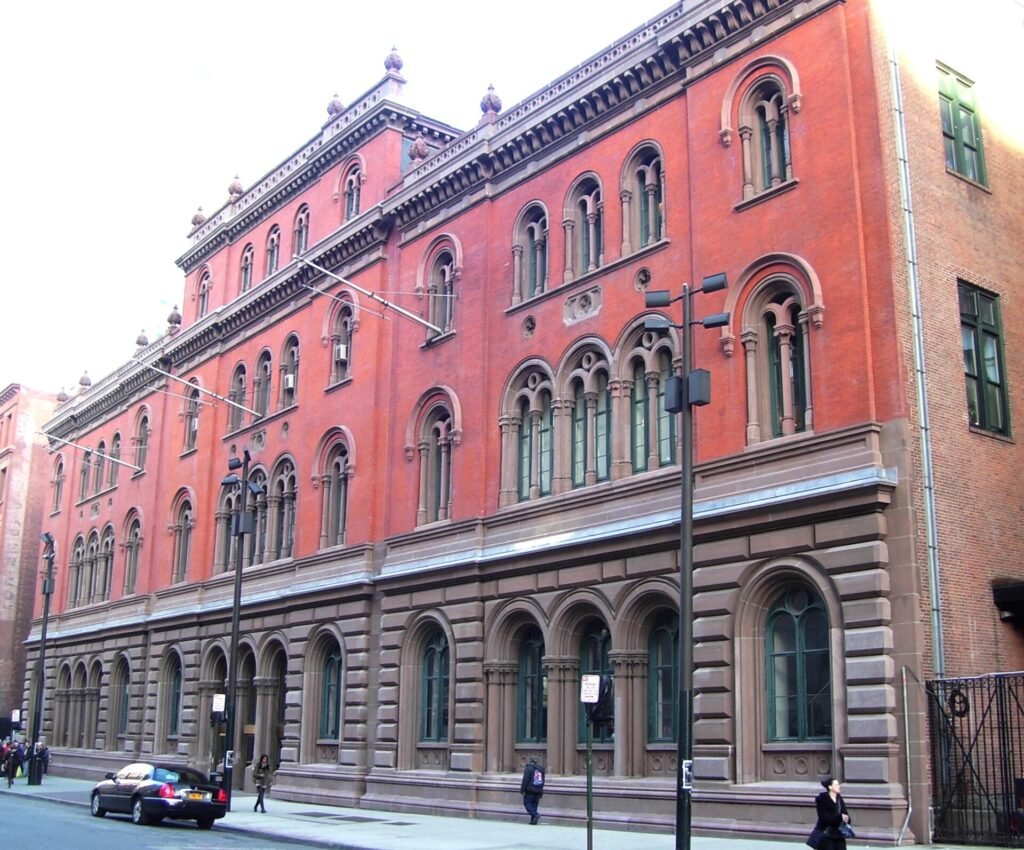
The Public Theater was founded by Joseph Papp as the Shakespeare Workshop in 1954 to support emerging playwrights and performers. In 1967, Papp moved the operation to the dilapidated former Astor Library, a Romanesque revival building constructed between 1853 and 1881. The location embodied Papp’s philosophy: if cities maintained public libraries for free access to knowledge, why not public theaters for free access to performance? The Public Theater became a year-round producing home dedicated to new American plays and musicals, establishing a foundation for the institution’s outsized influence on the American stage.
The theater’s cultural reach remains extensive. Fifty-five Public Theater productions have transferred to Broadway, with major successes including Hair, A Chorus Line, and Hamilton. The organization has accumulated 54 Tony Awards, 152 Obie Awards, 42 Drama Desk Awards, and five Pulitzer Prizes throughout its history. The theater also operates the free Shakespeare in the Park program at the Delacorte Theater in Central Park, continuing Papp’s vision of accessible theater for all New Yorkers. The Public’s mission expanded to educational initiatives, developmental programs for new playwrights, and the Mobile Unit, which brings performances to underserved communities across New York City’s five boroughs.
The Public Theater by the Numbers
Since its founding in 1954, The Public Theater has launched 55 Broadway productions, accumulated 54 Tony Awards, 152 Obie Awards, 42 Drama Desk Awards, and five Pulitzer Prizes. The institution operates five theater spaces at 425 Lafayette Street, the site of the former Astor Library Building built between 1853 and 1881.
The Hospitality Partnership: From Joe’s Pub to The Astor
The relationship between The Public Theater and professional hospitality operators began in 1998 with the opening of Joe’s Pub. The $2.35 million venue was carved from ground-floor back-office space at the theater, funded in part by a city capital grant that also refurbished the Delacorte Theater in Central Park. Named after Joseph Papp, Joe’s Pub opened October 16, 1998, with an inaugural concert by Carl Hancock Rux and was designed with 184-seat capacity, superior acoustics, and theater-quality technical systems. The venue hosted early U.S. headlining debuts by Amy Winehouse and Adele, and received recognition from Rolling Stone Magazine in 2013 as one of America’s 10 best clubs.
Joe’s Pub’s programming reflected The Public Theater’s commitment to emerging artists, spanning from ethnic music ensembles to spoken-word artists to young musical-theater composers. A major 2011 renovation improved sight lines and expanded seating capacity. The success of Joe’s Pub established a model in which performance venues and dining experiences were integrated with cultural institutions’ missions, leading to a partnership that expanded to include The Library and now The Astor. NoHo Hospitality Group—which joined the Joe’s Pub partnership in 2012—now operates 15 restaurants, bars, and food stands.
Serge Becker’s Design Philosophy and Nightlife Legacy
Serge Becker, born in Paris in 1961 and raised in Zurich from age eight, studied graphic design while working nights as a DJ. He began his hospitality career in New York’s nightlife scene, serving as art director at the legendary AREA nightclub from 1983 to 1987. André Balazs characterized Becker in the New York Times as a “Cultural Engineer,” reflecting his distinctive approach. Rather than treating nightclubs and restaurants as separate from entertainment and performance, Becker integrated theatrical elements, immersive visual design, and cultural programming into each space. He became known for transforming neglected locations through expert curation of design, staff casting, music selection, and programming.
Becker’s major projects include MK, Time Café, Club USA, and the neo-burlesque theater The Box, which opened in 2007. He co-created La Esquina, a Mexican restaurant and bar that opened in 2005. In 2016, Becker was appointed creative and artistic director of the Museum of Sex in New York. For The Astor, Becker designed the interior to evoke an old-fashioned New York tavern, with red banquettes, white tablecloths, and wood paneling creating an atmosphere rooted in classic supper club aesthetics.
Andrew Carmellini’s Culinary Portfolio
Andrew Carmellini has established himself as a chef known for elevating American and Italian cooking while maintaining accessibility. He studied at L’Arpège and San Domenico before serving as opening Chef de Cuisine at Café Boulud, where he earned three stars from The New York Times. He later achieved three-star New York Times reviews and a Michelin star at A Voce before co-founding Locanda Verde with Luke Ostrom and Josh Pickard in 2009. Locanda Verde, housed at Robert De Niro’s Greenwich Hotel in Tribeca, describes itself as serving “soul-satisfying urban Italian cuisine” and features “a seasonal, urban Italian menu of antipasti, housemade pastas and secondi.” The restaurant emphasizes warmth and “leisurely Italian spirit” rather than formal fine dining conventions. A second Locanda Verde location opened at 50 Hudson Yards in 2024.
Carmellini and his partners also co-founded The Dutch, which the team describes as “an American joint that serves nice food, wine, and spirits.” The menu features seasonal salads, steaks with shellfish towers, sandwiches, curries, chilis, fried chicken, and fresh pie. The kitchen creates its own hot sauce in-house and occasionally sources locally and organically. The Dutch was designed by Roman + Williams and reflects Carmellini’s approach to accessible American fare. Through NoHo Hospitality, Carmellini oversees food and beverage at 15 restaurants, bars, and food stands, making his culinary vision one of the most influential in contemporary New York hospitality.
Rather than treating nightclubs and restaurants as separate from entertainment and performance, Serge Becker integrated theatrical elements, immersive visual design, and cultural programming into each space.
Menu, Cocktails, and the Supper Club Revival
The Astor’s menu draws from what the team calls the “golden age” of New York dining. Appetizers include chips and dip, deviled eggs (“Devilish” eggs), clams casino, and a French mushroom dip finished with au jus. Main courses feature steak Diane and pigs in Wellington with bourbon mustard. The cocktail program emphasizes classic New York drinks, with a dedicated “From the Ice Box” section highlighting cold versions of martinis, Manhattans, and Bijous—drinks that evoke Manhattan’s midcentury cocktail culture.
This menu reflects a broader trend toward classic midcentury cuisine and nostalgic supper club atmospheres. Establishments like The Odeon, Keens, and The Oyster Bar have long maintained this aesthetic, preserving red leather banquettes, wood paneling, and vintage cocktails. The Astor arrives as part of a supper club revival spanning New York—from underground dinner parties in Brooklyn apartments like Burrow, run by former Eleven Madison Park chef Sammy Koolik, to more formal establishments offering curated menus and intentional community dining.
Integration of Dining, Theater, and Community
The Astor functions both as a pre- and post-show destination for theater patrons and as a standalone neighborhood dining venue. The mezzanine seating overlooks The Public’s lobby, creating visual connections between restaurant and theater. Diners observe the venue’s activity below while maintaining an elevated dining experience. A ground-floor café and aperitivo bar called Bar Torino accompanies The Astor, serving pastries and panini during morning hours before transitioning to Italian aperitifs later in the day. It is NoHo Hospitality’s second Bar Torino location, following the original at Hudson Yards.
The Astor’s opening in September positions it within New York’s fall dining calendar. The restaurant represents both a continuation of The Public Theater’s hospitality partnership dating back to 1998 and a reinvention of the theater’s dining program. The space now functions as a modern supper club rooted in classic New York hospitality, with theatrical memorabilia serving as reminders of the institution’s cultural legacy. The integration of the restaurant with the theater’s ongoing programming creates a unique venue where dining and performance coexist within an institution dedicated to public access and cultural engagement.
Photo: Beyond My Ken · CC BY-SA 4.0 · via Wikimedia Commons