
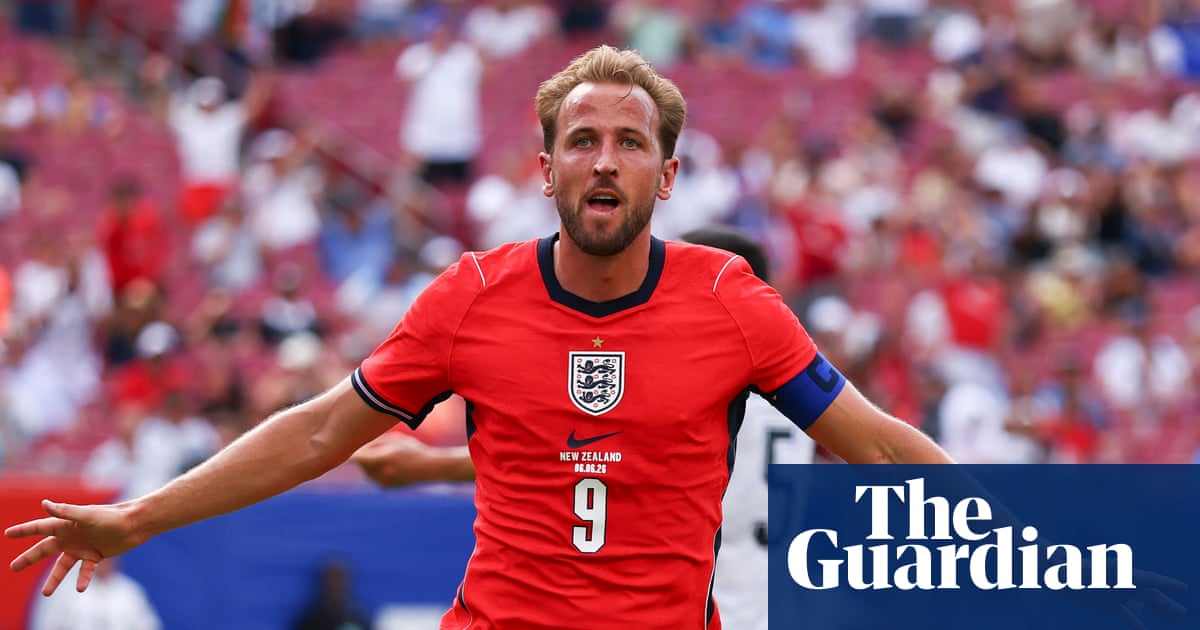
Bayern’s best ever? Kane in Ballon d’Or conversation but World Cup is pivotal
The Bayern Munich president, Uli Hoeness, has a propensity for hyperbole, so when he labelled Harry Kane as the best transfer the club has ever made in the wake of the DFB-Pokal cup final, which Bayern won 3-0 thanks to a Kane hat-trick, you wondered whether he was simply dialling up the rhetoric. A month on, emotion subsided, it appears not. “He absolutely is the best we’ve had,” another Bayern insider confirms.
It’s impossible to overstate the unfussy way Kane has won over not just Bayern Munich but, perhaps, global football opinion. Kane’s travails through Euro 2024, when he still had yet to win a trophy, suggested a player on the downslide. Combined with the scepticism that met his Golden Boot at Russia 2018 among foreign observers – “top goalscorer despite not having scored from the quarter-finals on,” sniffed Le Journal du Dimanche – indicated that his six most productive years as a pro might have been regarded a tireless yet vain effort.
When Time chose the iconic faces of the game for this World Cup, Lionel Messi, Cristiano Ronaldo, Neymar, Kylian Mbappé, Lamine Yamal and Jude Bellingham were perhaps predictable. Yet there also stood Kane, finally having earned himself a place at football’s top table. “When we bought him for more than €100m, that was new territory for us and a crazy risk,” said Hoeness. “But he’s paid back every single euro. Not just because he scores so many goals, but because he is a role model in the dressing room.”
Hoeness relays stories of Kane encouraging younger players, putting an arm around the less experienced. It doesn’t matter he isn’t fluent in German – Kane still takes lessons, as stipulated by his contract – because so many of Bayern’s key figures are effectively native English speakers and Vincent Kompany runs the dressing room mainly in English. Hoeness, a World Cup winner in 1974, also offered an ex-pro’s perspective, citing how much and how hard defenders kick Kane in the Bundesliga and how he never wavers. “I think you’d have to cut off his head or his arm to stop him playing,” said Hoeness.
Those observing the dressing room say that only Manuel Neuer and Thomas Müller in his later years have had such an impact, and both are bona fide Bayern legends, with Müller born and bred at the club. When the Kane family initially delayed moving wholesale to Munich, some might have thought that Kane was the typical British player abroad. Ian Rush never actually said being at Juventus was “like living in a foreign country” – he has Kenny Dalglish to thank for that attribution – but it summed up the archetype. Yet Kane and his wife, Kate, have settled in a beautiful rural home, inherited from the former Bayern defender Lucas Hernández, near the plush suburb of Grünwald. Talking to Kane about family life, it is noticeable how Kate and the children – Ivy, 9, Vivienne, 7, Louis, 5, and Henry, 4 – embrace Bavarian pursuits, such as skiing in the winter. Kane himself is naturally barred from partaking but enjoys Alpine trips to Garmisch.
Kane’s trip to a fan day at Kirchweidach, a village of 2,000 people deep in rural Bavaria by the Austrian border, saw him seasoning the soup as Bavarian wedding couples traditionally do (the symbolism was that he was now united with Bavaria), as well as playing a form of skittles but with litre beer steins rather than bowling balls. With British understatement, Kane labelled it all “a bit crazy” but fully embraced the day.
While Bayern knew they were signing a world-class player even they have been surprised by how dominant Kane is and the range of technical brilliance he brings to the team. Since finally breaking the trophy drought with the Bundesliga title in 2025 – he has added another league title and DFB-Pokal since – Kane has emerged over the subsequent two years as a player who looks leaner, fitter, sharper and better than ever. His goal against Atalanta in the Champions League perhaps tops the list, a drag-back and turn eliminating two defenders before a characteristic crisp finish. Yet the goal that effectively won the cup final, his second on 80 minutes, perhaps illustrates Kane’s growth beyond the six-yard-box finisher. Initially his fearsome curling strike from outside the box rebounded off the bar; when the ball fell back to Kane, he executed a drag-back and turn to create his own space before finishing.
With 61 goals for Bayern he is the only player in Europe’s major leagues replicating Messi and Ronaldo’s extraordinary scoring numbers, with only Erling Haaland, also alongside him on the Time photoshoot, coming close. Ronaldo once scored 66 goals in a season, admittedly in a year without a tournament, and Messi 73. Kane, after Saturday’s game against New Zealand in Tampa, has 67. At Bayern, though, he also regularly drops deep into a No 6 position to pick up the ball when out of possession. His passing range is almost as good as his goalscoring, as his assist for Luis Díaz in the Champions League semi-final first leg against Paris Saint-Germain demonstrated. It seems certain Thomas Tuchel will persist with the Bayern plan at the World Cup.
Kane was never in the Ballon d’Or conversation while at Tottenham. Now, as a regular in the latter stages of the Champions League and finally winning trophies, he is among the contenders, though clearly pretty much everything depends on this World Cup. Yet if you wanted to project a meta narrative on to the 32-year-old’s career, you might suggest this summer is building towards a moment of destiny, the slow starter who finally assumes his place at the pinnacle of the game. He is definitely tortoise rather than hare in football’s game of life.
Spurs youth coaches remember a young teenager who, by elite sport’s standards, was slightly overweight, lacked speed and wasn’t the best technically. “You would never have thought that he would be what he is now,” said one. “But at 14 he had a growth spurt and started to show technical improvements, and the quality of his striking stood out. Any message you relayed to him, he only needed telling once, whether that was gym work or finishing practice.”
An unhappy loan spell at Norwich was defined by an awful, high-profile miss on his debut against West Ham and being hauled off at half-time during an inglorious FA Cup exit to non-league Luton in his last game for the club. Inbetween those landmarks, he ended up being dropped to play with Norwich’s under-21s, where they wouldn’t let him take penalties because he wasn’t considered good enough. During his loan spell at Leicester he started on the bench with Jamie Vardy for both legs of their 2013 Championship playoff semi-final with Watford.
Even at Spurs, Maurico Pochettino did not initially rate him after an unimpressive pre-season in 2014. “We had our body fat test done and I was the highest in the team, something like 18%” recalls Kane. “I went to see him [Pochettino] and he explained to me that my body fat was high, that I wasn’t trying as hard as I could. He was just straight up [but] he told me: ‘You can be the best striker in the world.’”
Pochettino, like Hoeness, was perhaps employing a little hyperbole and, back then, needed to boost the confidence of a struggling young player. But, as with Hoeness, what seemed like magnification has turned out to be uncannily accurate.
