
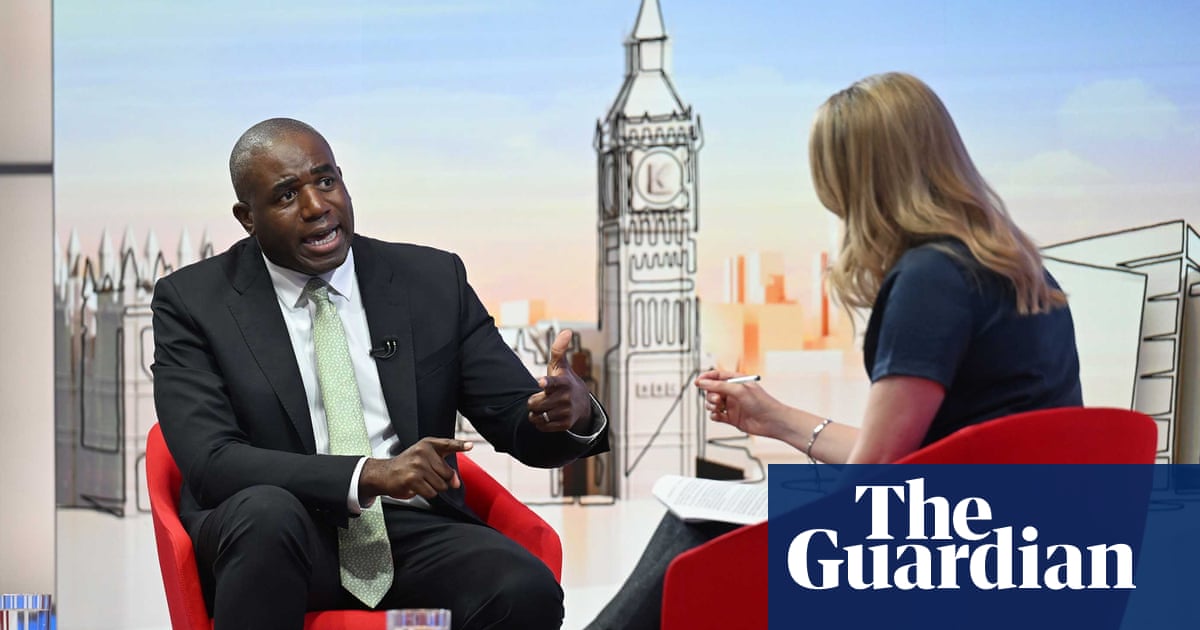
David Lammy: I told JD Vance he was wrong about Henry Nowak murder
David Lammy has said he told the US vice-president, JD Vance, he was “wrong” to blame the murder of the British teenager Henry Nowak on mass migration.
The deputy prime minister said he spoke to Vance in a phone call on Saturday to tell him “our democratic process is working well” and that he was wrong in his commentary about the murder.
Keir Starmer suggested this week that the US was trying to interfere in British democracy after the senior Republican politician claimed in a post on X that Nowak would be alive “if the last few generations of European elites had stood their ground against the politics of self-hatred and the mass invasion of migrants, many of whom despise the West and the people who love it”.
Lammy told Sunday Morning With Trevor Phillips on Sky News that he told the vice-president that his post was “not helpful”.
Lammy said: “This young man has been convicted. There is an investigation into the police by the independent police complaints authority. There is an investigation into Hampshire police by the inspectorate. The AG [attorney general] is looking at the sentencing in relation to this.
“This has got nothing to do with mass migration. This young man was a Brit … I said, ‘Look, Mr Vice-President, you’re wrong about this,’ and it’s also the case that actually murder is coming down in the United Kingdom.”
His comments come after it was reported that Hampshire police, the force at the centre of the controversy, sought to release a statement to address what it described as “disinformation” circulating online while court proceedings were at a critical point against Vickrum Digwa, the 23-year-old who was sentenced to life imprisonment for the murder of 18-year-old Nowak in December. The Sunday Times reported that the Crown Prosecution Service had stepped in to prevent the move, and said Nowak’s family had disagreed with the wording in an early police press release about the case, which was changed.
Three more people have been charged with violent disorder after protests in Southampton earlier this week over the teenager’s murder, bringing the number of people charged after disorder in the city to 14.
Darren Medhurst, 36, from Southampton; Jordan Hambleton, 19, also from Southampton; and Callum Darch, 27, of Romsey, were charged with violent disorder, Hampshire police said. They will appear at Southampton magistrates court on Monday.
On Saturday the US defence secretary, Pete Hegseth, also criticised European countries over migration, for allowing what he described as an “invasion”, during a D-day anniversary speech in France.
On the 82nd anniversary of the day that allied forces stormed French beaches to liberate Nazi-occupied Europe in 1944, he said: “Sadly, today, different European beaches are stormed by different dangerous ideologies … Beaches in Spain, in Italy, in Greece and Bulgaria. Boats and men arrive. When will European capitals do something about that invasion?”
Lammy was challenged about his own response after Black Lives Matter protests sparked by the death of George Floyd, when he said: “We have to find a way to transform this righteous anger into meaningful reform.”
Lammy rejected the idea that anger was the right response for one death, but not another. “Of course, I’m angry, upset, deeply troubled that this young man has lost his life as a human being. That’s got nothing to do with the colour of his skin. He died horrendously.” But he added that the “right response” was to look at “the action that flows from that”.
Addressing a possible ban on the carrying of the kirpan, a knife which can be lawfully carried by Sikhs for religious, ceremonial, sporting or historical reasons, Lammy said it was a “privilege” to carry a blade as part of their faith – but this could be taken away if necessary for public safety.
Mark Nowak, Henry’s father, has said that “people should not be able to walk openly through the streets of Britain carrying a 21cm blade”. The Sikh Federation has said that the weapon Digwa was carrying was not a kirpan.
Asked by the BBC’s Laura Kuenssberg if he thought Vance was being racist, Lammy said: “I reminded him that the family have called for calm, they don’t want division … I reminded him also of the online space, and how toxic that can become, so that we had a robust conversation, a respectful conversation. We remain colleagues and friends.”
Asked if he believed the police were institutionally racist, he said that he believed the UK had “moved on from that period of institutional racism that was very real in the Stephen Lawrence era”, adding: “I don’t personally recognise that is the appropriate description today.”
Reform UK’s home affairs spokesperson, Zia Yusuf, said UK police were “institutionally racist”, claiming there was “structural anti-white prejudice”.
Lammy said it was right that police guidance on race was reviewed. “When we look carefully at arrest data, prosecution data, conviction data we do see examples of disproportionality, not just in relation to black communities, Muslim communities, Gypsy Roma, Traveller communities,” he said. “That is not all about racism, some of it can be about socioeconomic background and other factors … There’s a level of complexity here, which is why the proper way to deal with this is a considered, measured, careful review.”
