
External review finds antisemitism, harassment and fear at TMU
Jewish students, faculty and staff at Toronto Metropolitan University (TMU) say they have stopped wearing religious symbols, changed their routines, avoided campus events and, in some cases, concealed their identities because they fear harassment or assault.
Those accounts are among the findings in a new external review of the TMU’s campus environment, which paints a picture of a “fractured campus environment” where the climate for its Jewish community has drastically worsened since Oct. 7, 2023, and Israel’s subsequent war with Hamas in Gaza.
Before Hamas’ terrorist attack on Israel, most of the Jewish community interviewed for retired Justice Mary Lou Benotto’s review felt the school was a safe and inclusive space where they were free to express their identity without fear of reprisal.
“Many Jewish students, faculty, and staff described October 7 as a turning point in their experience of campus life,” the former Ontario Court of Appeal and Superior Court judge wrote in her 192-page report. “Activities and expressions that were previously unremarkable became sources of discomfort or concern.”
One Jewish staff member said they “just stopped talking about anything Jewish.”
Another described a university where they had once felt able to “bring your whole self to work,” but said the same confidence no longer extended to being Jewish.
A Jewish lecturer who normally wore a Star of David necklace said they no longer do. (The report doesn’t use gender-specific pronouns when talking about participants’ experiences.)
“I will not wear it at TMU,” they said, explaining that doing so would “feel incredibly unsafe” because they fear being physically or verbally assaulted.
Jewish students and faculty said they had become more guarded about what they said, how they dressed and where they went. Some described calculating how much information could be safely disclosed about Jewish events.
One participant said even organizing a Shabbat dinner — a “simple dinner, nothing political” — requires a security assessment of the guest list and advance information about the event.
Some Jewish students felt unsafe attending Hillel or Students Supporting Israel (SSI-TMU) events when anti-Israel demonstrations were taking place nearby. They described aggressive filming, megaphones directed at Jewish tables, demonstrations outside private Jewish gatherings and vandalism as part of a pattern that made Jewish campus life feel increasingly fraught with danger.
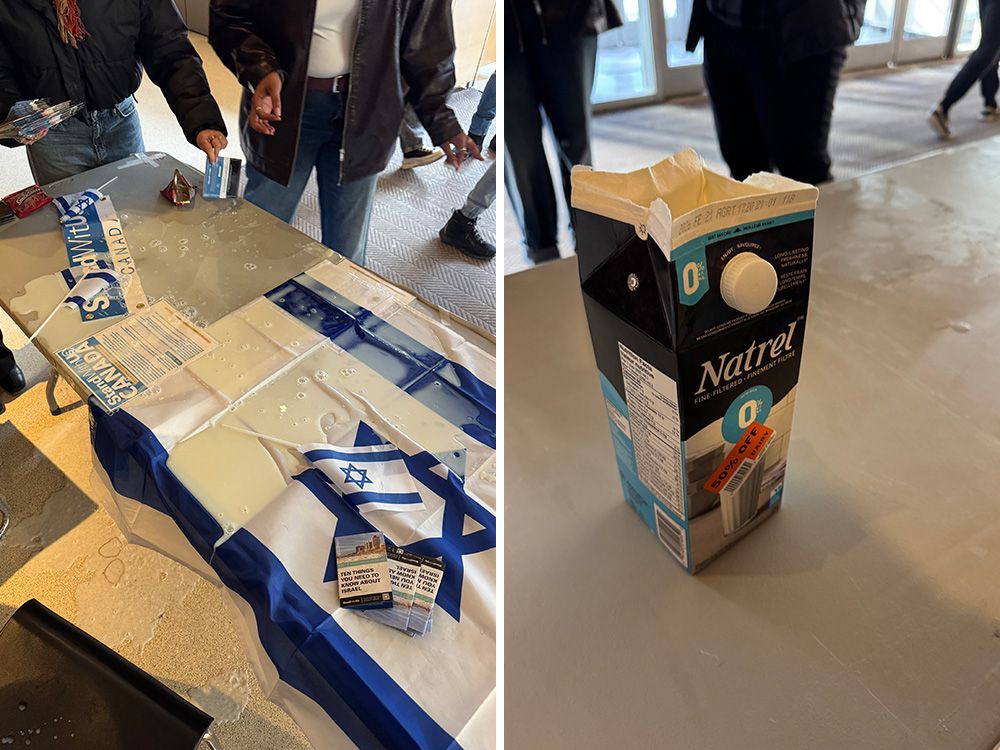
In addition to witnessing a marked increase in antisemitic graffiti in washrooms and common areas, participants reported being spat on, verbally harassed, and having objects thrown at them. In one incident, a masked individual threw spoiled milk at visibly Jewish students who were set up on campus.
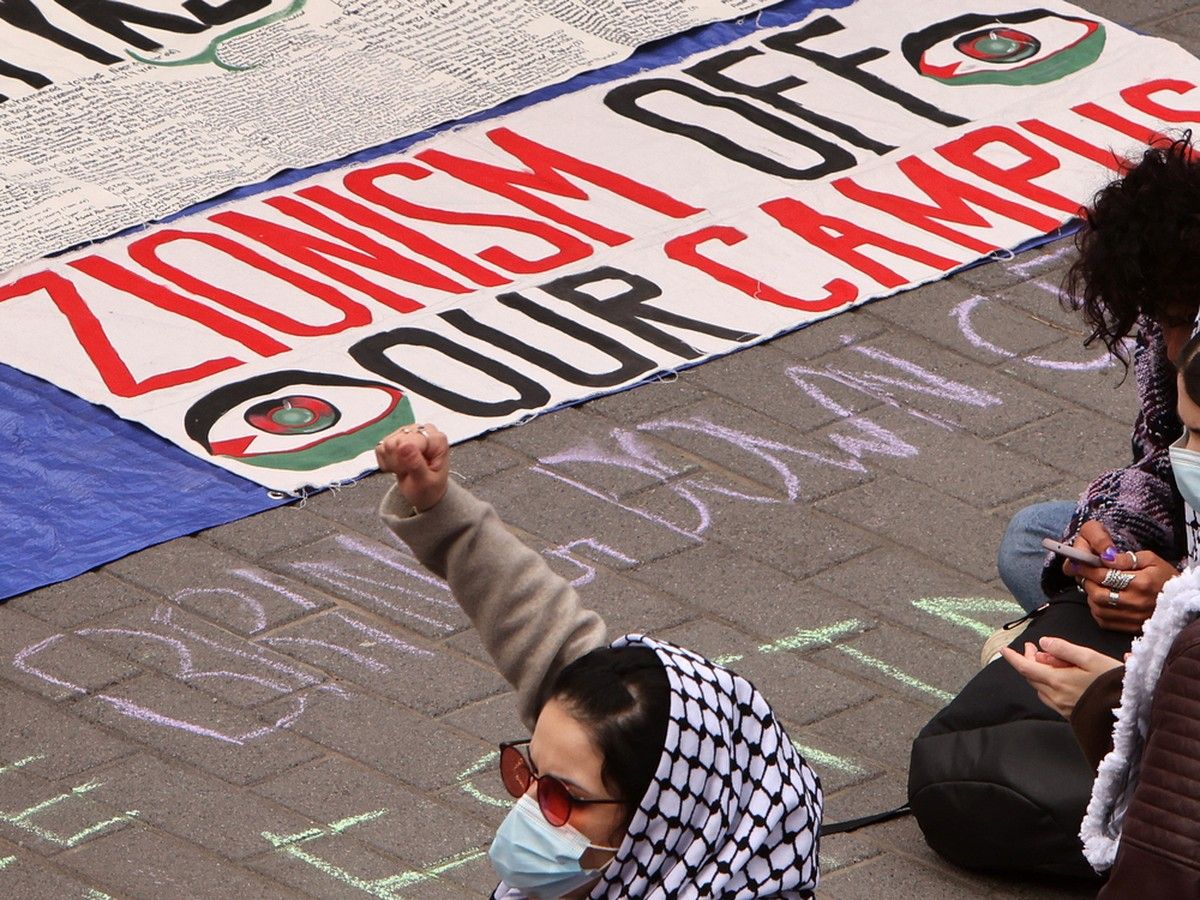
Other examples included individuals wearing Hamas-style headbands or combat clothing, and campus materials featuring automatic weapons, paraglider imagery they believed to be associated with the Oct. 7 attacks, and slogans such as “SMASH ZIONISM.”
One Jewish professor said that after objecting to students wearing Hamas badges for a planned photo they were told by an undisclosed person, “‘Well, then, you’re not going to be able to participate.’”
The review also found that social media was used to identify and publicly shame Jewish students.
“Examples described included posters, pamphlets, and online postings of Jewish student leaders with inverted red triangles over their heads, manipulated videos of confrontations posted publicly after encounters, and calls for removal of SSI-TMU as a student organization for hosting ‘war criminals.’”
Faculty members described classroom environments where statements were made that were regarded as antisemitic or dehumanizing.
Among the examples were Holocaust denial or minimization, the assertion that “academic power is rooted in Jewish supremacism” and should be “rooted out of academia,” that violence against Jews might be justified to support activism, and statements suggesting violence against Jewish children could be acceptable when their parents were perceived to support Israel.
“Several participants described these statements as particularly troubling because they were reported to have occurred in educational settings led by faculty or within spaces intended to foster learning, contributing to diminished trust in classroom neutrality and concerns regarding the safety and inclusion of Jewish students,” Benotto wrote.
She also drew a distinction between criticism of Israel and antisemitism. While the former is legitimate expression protected under the charter, she said, many Jewish participants experienced the word “Zionist” as an alternative to “Jewish,” and usually in a pejorative manner.
She and the reviewers heard and saw examples of calls for Zionists to be removed from campus and descriptions of them as “baby-killers” and “murderers.” Although some people using those terms maintained they were referring to political ideology or alleged support for Israel government actions, Jewish participants said the rhetoric was often indistinguishable from antisemitism.
“The redefinition of Zionism to incorporate genocide and the insistence that anyone who fails to actively support anti-Zionism is likewise culpable have contributed to an environment that has enabled antisemitism to flourish,” Benotto wrote.
The review was commissioned after two events were disrupted by Students for Justice in Palestine at TMU (SJP-TMU), with both incidents leading to arrests and charges.
In September, a forum with Minister of Artificial Intelligence and Digital Innovation Evan Solomon was cancelled after SJP-TMU protesters shouted “war criminal,” “baby killer,” and “murderer” at specific members of the audience. One woman was arrested after allegedly assaulting a security guard while being escorted out of the building.
The second was an SSI-TMU speaking event — held just off campus because the school denied the group space over safety concerns — featuring speakers with ties to the Israel Defense Forces.
SJP-TMU protesters mobilized at the location, which led to a confrontation during which a glass door was shattered and injuries were sustained. Several protesters were arrested when police arrived.
By not allowing the event to happen on campus with “stronger security, clearer conduct expectations, and enforcement of rules,” Benotto said “TMU effectively permitted a ‘heckler’s veto.’”
“Allowing the prospect of disruption to determine whether a lawful event may proceed risks undermining viewpoint neutrality and the University’s obligation to protect the expressive rights of all members of its community.”
Benotto said the two incidents “were symptoms of a deteriorating campus climate that, absent decisive institutional action, are likely to recur.”
The review of the incidents determined the university already has policies in place to address the conduct, but hasn’t applied them consistently. The lack of enforcement and ambiguity around freedom of expression and protest has fueled the conflicts and leads many to think there are few consequences, she said.
“The University cannot resolve the conflict in the Middle East or eliminate disagreement, grief, anger, or competing historical narratives,” Benotto concluded. “It can, however, establish clear behavioural expectations, protect the rights of all members of the community, and enforce its policies consistently, transparently, and predictably.”
The review includes a series of recommendations, the most consequential of which is that the school adopt the International Holocaust Remembrance Alliance working definition of antisemitism to provide a clearer framework for distinguishing between protected political expression and discriminatory conduct.
“Without the guidance of IHRA, Jewish people at TMU have less protection from antisemitism than the rest of Canada,” she wrote.
It also calls for faster responses to misconduct, a simpler complaints process, stronger enforcement of university rules, regulation of online harassment and targeted filming, and mandatory education for incoming students on respectful conduct and the boundary between protest and harassment.
“Freedom of expression, safety, inclusion, and institutional neutrality are not competing objectives; the success of each depends on the protection of the others,” the report reads.
“Maintaining that balance requires clear expectations, consistent enforcement of the university’s policies, and a shared commitment to ensuring that disagreement does not give way to intimidation or the silencing of others.”
TMU, in response, announced Friday that it was creating a task force on campus expression, antisemitism and community to “carefully consider and respond to every recommendation … as well as provide an implementation blueprint to the university by March 2027.”
“Many of the issues the report identifies are complex, but it is our responsibility to carefully review each of the recommendations. We know we have work to do and we accept this responsibility,” TMU president and vice-chancellor Mohamed Lachemi said in a news release.
Noah Shack, CEO of the Centre of Israel and Jewish Affairs, urged the school to fully and immediately implement the Benotto report’s recommendations.
“With classes set to resume next month, it is chilling that TMU announced a ‘Task Force’ to ‘consider and respond’ to Justice Benotto’s recommendations with an ‘implementation blueprint’ by March 2027,” he wrote on X.
“Students should not be expected to wait for another school year to pass without change.”
Our website is the place for the latest breaking news, exclusive scoops, longreads and provocative commentary. Please bookmark nationalpost.com and sign up for our daily newsletter, Posted, here.
