
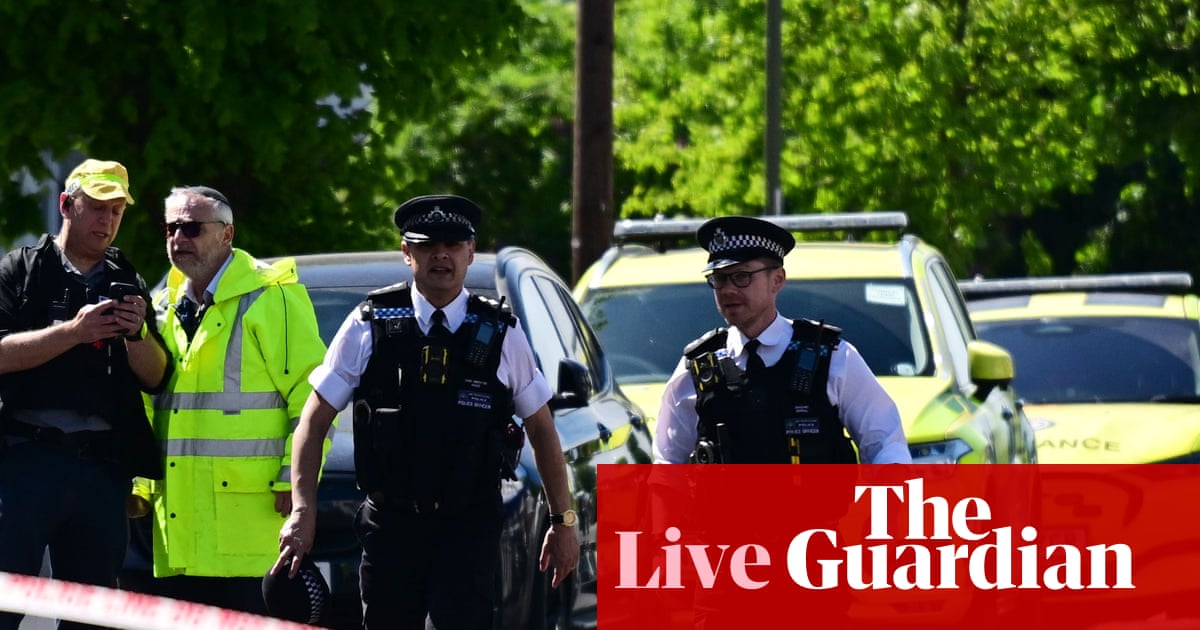
Golders Green attack suspect was previously referred to Prevent – live updates
Suspect was referred to Prevent in 2020
Vikram Dodd
The Metropolitan police has now confirmed the suspect in the Golders Green double stabbing was referred to Prevent, the official scheme trying to stop people becoming terrorists, in 2020.
The Guardian understands his case was closed within six weeks by the deradicalisation scheme, which has faced previous criticism.
The attack on Wednesday is being treated as terrorism by police who are investigating whether the suspect who is in custody was targeting people who were Jewish, in the north London area.
Police say a 45-year-old man was arrested at the scene, on suspicion of attempted murder.
In a statement counter-terrorism police said: “We can confirm the suspect was known to the Prevent programme and was subject to a Prevent referral in 2020, which was closed in the same year.
“Given the investigation remains ongoing, we will not be providing any further information in respect of this matter at this time and we remain focused on securing justice for the victims of this attack.”
The Met commissioner Sir Mark Rowley has said the suspect had a history of violence and mental health issues.
Key events

Dan Sabbagh
Jonathan Hall, the independent reviewer of terrorism legislation, has called for a pause in pro-Palestinian protests where “public demonisation and hatred is incubated” in response to the Golders Green stabbings, arguing that “demonisation of Jews and Israels and Zionists will lead to a terrorist attack”.
The barrister acknowledged that the motivation of the 45-year-old suspect had yet to be established, but said that he believed there was a “social responsibility” to reduce the risk of attacks on the Jewish community, and said that antisemitism represented “a national security emergency”.
In a statement, he said:
The starting point is the perpetrator, and to imagine what would have happened if the attack had been fatal (as it could have been), and how an inquest or public inquiry would approach the matter with the benefit of hindsight.
What was there in his profile that made the attack more likely? Was all relevant information shared between the relevant agencies? Were opportunities missed?
We wait an assessment to whether Iran commissioned or inspired this attack – but ultimately it takes a UK resident to carry out an attack, so this is a social responsibility too. How do we reduce the risk that such individuals will carry out attacks?
This is where antisemitism in the public and private domain comes in. I have spoken about a national security emergency and the risk, as I have warned about repeatedly, that demonisation of Jews and Israels and Zionists will lead to a terrorist attack.
Since the right to life is more important than the right to protest, it makes sense to consider a pause or moratorium of protests where public demonisation and hatred is incubated. We are talking about protecting British lives, and the life of the community.
Suspect was referred to Prevent in 2020

Vikram Dodd
The Metropolitan police has now confirmed the suspect in the Golders Green double stabbing was referred to Prevent, the official scheme trying to stop people becoming terrorists, in 2020.
The Guardian understands his case was closed within six weeks by the deradicalisation scheme, which has faced previous criticism.
The attack on Wednesday is being treated as terrorism by police who are investigating whether the suspect who is in custody was targeting people who were Jewish, in the north London area.
Police say a 45-year-old man was arrested at the scene, on suspicion of attempted murder.
In a statement counter-terrorism police said: “We can confirm the suspect was known to the Prevent programme and was subject to a Prevent referral in 2020, which was closed in the same year.
“Given the investigation remains ongoing, we will not be providing any further information in respect of this matter at this time and we remain focused on securing justice for the victims of this attack.”
The Met commissioner Sir Mark Rowley has said the suspect had a history of violence and mental health issues.
Suspect previously referred to Prevent counter-terrorism programme
The BBC has reported that the suspect in the Golders Green attack had been previously referred to the Prevent counter-terrorism programme.
The Guardian approached the Metropolitan police about the BBC’s report, but a spokesperson said it would not be commenting at this time.
The Met said yesterday that a 45-year-old man British national, who was born in Somalia, was arrested on suspicion of attempted murder. Met commissioner Mark Rowley said the suspect has a history of mental health issues, drug use and convictions for violence.
Police officers are carrying out a search at an address in south east London, the Met said.
Conservative leader Kemi Badenoch, who visited Golders Green after the attack yesterday, said the community there does not feel the government is doing enough to protect Jewish people.
“You could feel the fear that was on the streets,” she told BBC Radio London.
Commenting on the government’s plans to invest a further £25m in extra policing and security for Jewish communities, Badenoch said: “We do need to see an increased police presence. The government has said it’s giving money – I don’t know exactly what the money is for, I don’t know if that money is enough.”
She added that the voluntary Jewish security group Shomrim has said “they have never had any money from government”. She said the volunteers are “having to look after themselves” and that it was “very lucky” that police officers were close to the attack.
Starmer: Golders Green attack was ‘not a one-off’
Keir Starmer said an attack on the Jewish community “is an attack on all of us”.
“What we saw last night was people being targeted because they are Jewish, I’m absolutely clear about that,” the prime minister said.
“There’s no getting away from the fact that this was not a one-off.
“This has been a series of attacks on our Jewish community, particularly in recent weeks, and there is a very deep sense of anxiety, of concern about security, about safety, about identity frankly.”
Describing the “visceral feeling” among many British Jews, he added: “We have to be really clear that an attack on our Jewish community is an attack on all of us and we have to approach it in that way.”
Starmer: Criminal justice response to Golders Green attack must be ‘swift, agile and visible’
Keir Starmer said the government and criminal justice system must respond to the suspected terrorist attack in Golders Green in “a swift, agile and visible way”, as he convened a meeting in Downing Street, PA reports.
Speaking ahead of the private meeting in Downing Street, the prime minister said:
Today is about part of the response which is really important, which is the criminal justice response, because a number of people have been arrested, a number of them go through the criminal justice system, and it’s really important that we are able collectively to demonstrate that the response will be swift and visible.
And that’s why I wanted to get you around the table today.
He continued:
I do think there’s a wider duty on all of us in terms of confidence in the criminal justice system to be able to deal with appalling attacks like this, to show that it can act in a swift, agile and visible way.
And I look forward to a discussion with you as to how we make that happen.
Attending the meeting are:
-
Metropolitan police commissioner Sir Mark Rowley
-
Home secretary Shabana Mahmood
-
Deputy prime minister David Lammy
-
Attorney general Richard Hermer
-
Security minister Dan Jarvis
-
Justice minister and Finchley and Golders Green MP, Sarah Sackman
Here are some of the latest images from the newswires in Golders Green this morning:
What we know about the alleged attacker
-
A 45-year-old man, who is a British national, born in Somalia, was arrested on suspicion of attempted murder.
-
The home secretary, Shabana Mahmood, said he came to the UK lawfully as a child.
-
The Metropolitan police said he was initially taken to hospital after being arrested but has since been discharged. He was taken to a London police station where he remains in custody.
-
The Met commissioner, Mark Rowley, said the suspect has a history of mental health issues, drug use and convictions for violence.
The Press Association has been speaking to people in Golders Green this morning following yesterday’s attack.
Danny Grunfeld, 75, said he felt “just terrible” when he found out a man had been stabbed outside his house on Highbury Avenue.
“It’s very frightening,” he added. “It’s not a pleasant situation when you feel any minute you’re getting out, your life is in danger.”
He added: “We look around all the time. It’s horrible. That’s the best word. It’s just a horrible situation. I go to synagogue. I’m frightened.”
Joseph Deutsch, 80, who said he has always lived in Golders Green, said he will not allow himself to be frightened by the attack.
“I’m not going to give into it,” he added. “That’s exactly what they want us to feel: frightened.”

Aamna Mohdin
‘Do we need to think about moving away?’: Jewish community fears for safety after Golders Green stabbings
People in Golders Green and members of the wider Jewish community in Britain have expressed shock and grief after two men were stabbed in north London in an apparent antisemitic attack. Some have been left questioning whether it is still safe to remain in the UK.
“People feel scared, people feel unsafe,” said Baruch Stern, of Gross Butchers near the scene of the attack. “People think, is it really the place for me to be here? Is the UK safe for Jewish people, or is it something we need to think about, moving away?”
It is feared the stabbings in Golders Green are the latest in a string of incidents that have targeted Jewish schools, synagogues and charities over the last few months.
“I would say the community is always getting messages from Westminster, encouraging messages, they’ll do this and we’ll do that,” Stern said. “But at the end of the day, it would be much more encouraging if they would take the words into action and do something about it.”
You can read the full report here:
British Jews at ‘breaking point’ and could leave UK, says government adviser on antisemitism
John Mann, the government’s independent adviser on antisemitism, said British Jews are at “breaking point” and feel they can no longer live safely in the UK.
“Don’t forget, everyone in the Jewish community is fleeing from somewhere,” the Labour peer told Sky News.
“Jewish people in this country have always had to flee from somewhere to get here.
The home secretary said that while protecting the Jewish community was a priority, she rejected the characterisation by Jonathan Hall, the UK’s independent reviewer of terrorism legislation, that attacks on Jewish people was a “national emergency”.
“I think the phrase ‘national emergency’ has particular connotations,” Shabana Mahmood told BBC Breakfast.
“It means that for a period, you change your democracy, and you disapply some elements of our democratic society. I don’t believe this is where we are today.
“But for me this is an absolutely pressing priority. It is an emergency for me as home secretary to respond to.”
Several of the UK’s leading imams have come together to “utterly condemn” the Golders Green attack.
The leaders, including the chief Iman of Scotland, Sayed Razawi, alongside Jewish leaders signed the Drumlanrig Accords last year, which aims to strengthen Jewish-Muslim relationships in the UK.
In a statement, they said:
We note with grave concern the violent attack on two Jewish men in Golders Green, London. We extend our thoughts and solidarity to those injured, their families and the wider Jewish community.
Any act of violence or intimidation directed at individuals because of their faith or identity is utterly unacceptable. Incidents which create fear within communities, particularly near places of worship or religious gathering, undermine the safety and cohesion of our shared society.
As Muslim leaders and signatories to the Drumlanrig Accords, we stand firmly against antisemitism, Islamophobia and all forms of hatred and extremism.
We reaffirm our shared commitment to protecting the dignity, safety and religious freedom of every community.
It is important that communities respond with unity, responsibility, and a shared commitment to mutual respect and social cohesion.
The Press Association has reported that the police cordon surrounding the scene of the stabbings in Golders Green has been lifted.
Parts of Highfield Avenue, Beverley Gardens and Golders Green Road in north-west London had been sealed off following the attack yesterday, but the roads were opened again by 7am this morning.
Jonathan Hall, the UK’s independent reviewer of terrorism legislation, said attacks on Jewish people have become “the biggest national security emergency” since 2017.
“There are Brits in London in particular, Manchester, but probably all around the country, who are now thinking they cannot live a normal life. And it’s not one attack, it’s multiple attacks,” he told the BBC.
He also called for a “moratorium” on pro-Palestinian marches, telling Times Radio it was currently “impossible” for such demonstrations not to “incubate” antisemitism.
Government announces extra £25m to protect Jewish communities
Morning. The home secretary, Shabana Mahmood, said she understands the fears faced by the Jewish community in the UK as the government announced extra funding to boost police patrols and protections around synagogues, schools and community centres.
Speaking on BBC Breakfast, she was pressed on comments made by the chief rabbi, Ephraim Mirvis, that people in the UK who are visibly Jewish are no longer safe, after two Jewish men were stabbed in an attack in Golders Green in north-west London.
“I, of course, can understand why people who are both visibly and not visibly Jewish are feeling a huge amount of pressure and fear at the moment,” Mahmood said.
She continued: “The question for me is, what am I going to do to ensure that people are able to go about their business safely, just like their fellow citizens, and that they also feel safe as well?
“And that is the action that I am taking, practical action, in order to put in the enhanced policing, the higher spending on security so that people can go about their business.”
She said the government will invest a further £25m to increase security for Jewish communities, and that it will also fast-track new legislation in order to tackle state threats.
The victims who were stabbed in the attack yesterday, which has been declared a terrorist incident by police, have been named locally as Nachman Moshe ben Chaya Sarah and Moshe Ben Baila, who are in hospital in a stable condition.
The Metropolitan police said a 45-year-old man, a British national born in Somalia, is in custody after being Tasered by police and arrested on suspicion of attempted murder. Mahmoud told BBC Breakfast that he came to the UK lawfully as a child. The Met commissioner, Mark Rowley, said the suspect has a history of mental health issues, drug use and convictions for violence.
The stabbings follow a series of arson attacks on Jewish targets in London since March, including two previous incidents in Golders Green.
