
‘In the heatwaves, it’s crucial’: the fight to save France’s rural swimming pools
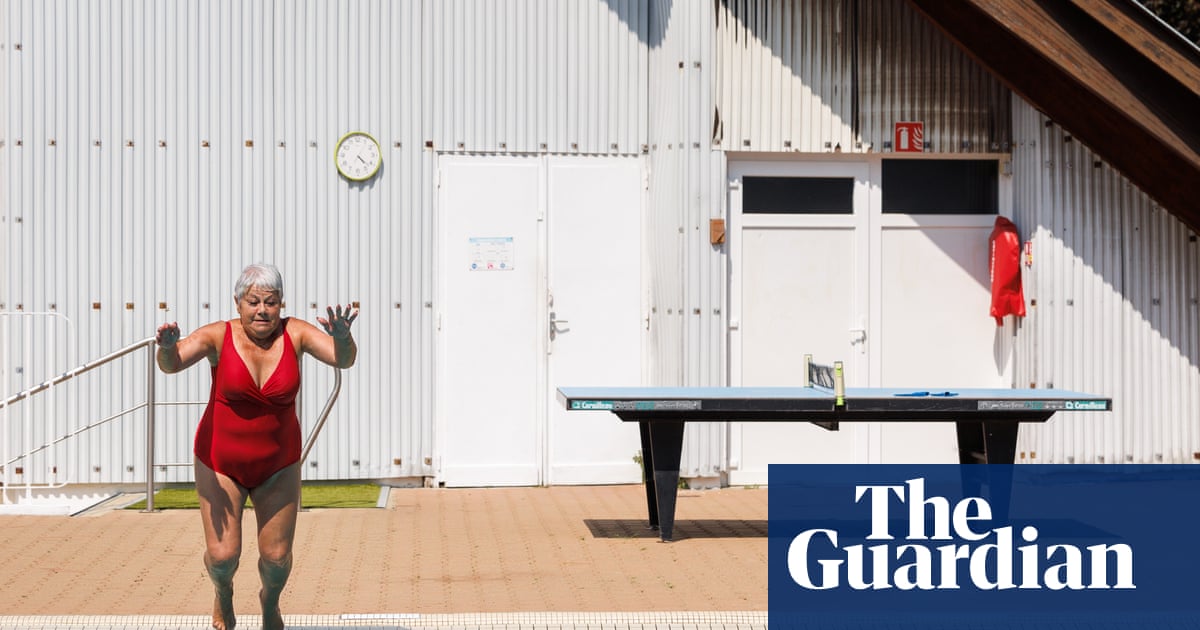
Suzy Bernard took a breath and jumped into the deep end of her village swimming pool with a splash.
“There’s a wonderful feeling of wellbeing in the water,” said the former hospital healthcare assistant, who recently learned to swim aged 75 and was now gliding along with her daughter and grandson.
The municipal swimming pool, bordered by shady oak trees in the village of Châteauneuf-sur-Sarthe, in western France, has been the Bernard family’s daily refuge from the sweltering heatwaves this summer. Bernard is a member of the village collective, Touche Pas à Ma Piscine (Hands Off My Pool), campaigning to defend the Châteauneuf-sur-Sarthe facility and calling for more government support for rural swimming pools. “We’ll fight to make sure this pool survives and stays open,” she said.
As a summer of record temperatures parched much of the French countryside, local village swimming pools, with cheap entry tickets, have often been the only shelter from the heatwaves for rural families on low incomes who cannot afford to go on holiday or who live in heat-trap homes. The pools are also crucial for teaching rural communities to swim. A total of 274 people died from drowning in France between 1 May and 15 July this year, with most deaths occurring when people jumped into rivers and waterways to cool down.
But France’s ageing rural swimming pools, many of which were built in 1970s, are in crisis as village mayors with shrinking budgets struggle to pay the high running costs and some pools are forced to close owing to lack of funds.
In Châteauneuf-sur-Sarthe, a village of 3,200 people in Les Hauts-d’Anjou, a farming area of the Pays de la Loire, the new mayor, Véronique Langlais, said she was determined to keep running the village pool that opened in 1973, despite an annual cost of at least €100,000 (£85,000) to the town hall’s modest budget. Three other rural pools had closed in the surrounding countryside, making this the only pool in a radius of about 20 miles.
“This pool is a treasure that we have to protect,” Langlais said. But any sudden need for a costly new part or major repair could force the pool’s closure owing to lack of funds. “There’s a sword of Damocles hanging over our head.”
In 1969, after France’s poor swimming performance at the 1968 Mexico City Olympics, and a series of tragic drownings across the country, the government under Georges Pompidou launched a plan to build 1,000 pools in mainly rural areas to encourage swimming. Over 600 were built, but those still in use – as well as later 1980s pools – are in urgent need of costly renovation.
François Gernigon, a centre-right lawmaker for the Maine-et-Loire, has petitioned the government for a funding plan. He recently surveyed rural mayors, finding more than 75% feared their village pools risked closure in the short-term. He said the heatwaves made it essential to protect pools as “the only place of leisure to relax in rural areas”. He said village pool closures “make residents feel abandoned”.
Emma-Özlem Kaya, 45, is a printmaker whose Turkish father moved to Châteauneuf-sur-Sarthe in 1972 when the local tannery recruited artisan leather-workers from Istanbul. “We didn’t go on holiday because my parents didn’t have the budget,” she said. “So every day in summer, I’d grab my swimming bag and walk to the pool with my siblings and friends and we’d spend the afternoons there with our towels laid out.” She now attends water aerobics classes there and campaigns to protect the pool.
Nadine Lemonnier, a local teacher who is also part of the collective, remembered childhood summers at another local village pool: “whole days spent diving for objects and having deep teenage conversations at the edge”. For her, protecting rural pools that offered children swimming lessons was crucial because her three-year-old cousin died from drowning in a private pool.
Across France, there are dozens of rural village collectives mobilising to protect local pools: campaigning, volunteering to help run them and even painting and carrying out maintenance work.
In Rochefort-sur-Loire, a village of 2,400 people near Angers, members of the local pool support group gathered at the water’s edge. In recent years, they had decorated the village with flippers and rubber rings to convince a visiting government minister to secure funds for reopening the indoor teaching pool. They hosted a poet in residence at the pool and run theatre performances there.
“It’s about making our village pool the focus of life in the community,” said Nicolas Robin, a sociologist.
On 18 July 1969, at nearby Juigné-sur-Loire, 19 children drowned in the River Loire on an outing from a school holiday club – one of many tragedies that led the government to improve swimming teaching facilities. Swimming lessons remain key. There are three rivers in the area and the village is often hit by flooding in winter.
“People need to know how to swim to protect themselves in the flooding season too,” said Guillaume Lusteau, the pool’s lifeguard and swim coach.
The pool sits beside the River Louet, a branch of the Loire that is usually a paddling spot. But the summer heatwaves have left the river level too low for a dip, increasing the number of swimmers at the pool.
The mayor, Didier Le Gall, said that in this area, with a large proportion of organic farming, health was a priority and the pool was essential, particularly for families on low incomes. “It’s important for children learning to swim, but also for the social lives of people who don’t go away on holiday,” he said. “The pool is part of our village’s identity, and in the heatwaves it has become a crucial place to cool down. The pool’s impact on mental health and physical health is considerable.”
Le Gall said the town hall wanted to keep the pool open, despite the €100,000 basic running cost. “But we need help in the long-term,” he said.
Bruno Cheminat, 73, a former special educational needs teacher and one-time competitive swimmer, clocks up 2,000 metres every day, and has also helped with painting and maintenance work as a volunteer. “It’s beautiful to be the first in the water in the morning,” he said.
Estelle, a former flight attendant who works on the pool reception, said it boosted her mood to be in the water, looking out at trees towards the church: “It’s like swimming in a picture postcard.”
