
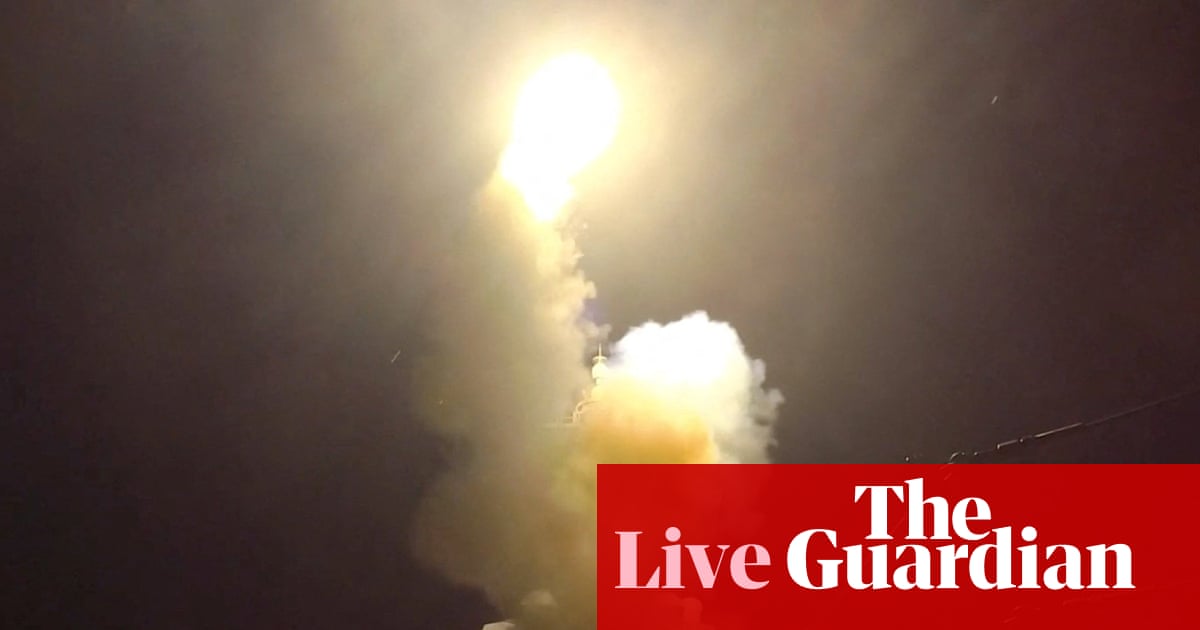
Iran launches attacks on American military facilities in Bahrain and Kuwait after fresh US strikes – Middle East crisis live
Iran launches attacks on American military facilities in Bahrain and Kuwait after fresh US strikes
Iran’s Revolutionary Guards said this morning they targeted American military facilities in Bahrain and Kuwait, destroyed radar systems in Oman and struck fuel tanks and ammunition depots at Prince Hassan air base in Jordan as part of its retaliatory strikes against the US.
Jordan said a few hours ago that it intercepted and downed four missiles fired from Iranian territory, while Kuwait’s military said it was intercepting “hostile aerial targets” in the country’s airspace.
The strikes marked an escalation in the recent tit-for-tat attacks between the US and Iran as Tehran seeks to assert sovereignty over the strategic strait of Hormuz, which it sees as its biggest leverage in negotiations with Washington.
The Iranian attacks on US-allied countries across the region came in retaliation to overnight US strikes on “dozens” of Iranian sites, including air defence systems, radar sites, missile and drone equipment and small boats.
“The strait of Hormuz is a vital maritime corridor for global trade,” the US military’s Central Command said. “Iran does not control it.”
But Iran’s Revolutionary Guards, which controls the country’s ballistic missile arsenal, rejected the US statement, saying the strait “is our territory” and it would not allow Washington’s “illegal interference in it”.
Iran and the US are nearly midway through the 60-day period of an interim deal that was supposed to set-up talks for a permanent end to the war launched by the US and Israel in late February.
Instead, it has devolved into a series of attacks over the strait, through which one fifth of the world’s oil and gas usually flows, and its future.
The US president, Donald Trump, suggested last week that the interim deal in the war was “over”. But mediators – including Pakistan, Qatar and Egypt – have continued efforts to reach a final agreement.

In other key developments:
-
The US said it had struck Iran early on Sunday after the IRGC fired on a Cyprus-registered container ship they claimed was sailing an “unauthorised route” through the strait of Hormuz.
-
According to state media, the IRGC then said they had hit a second vessel, accusing it of “violating regulations”.
-
A short time later, US Central Command said its forces had carried out a round of strikes against Iran, attacking at least 140 targets.
-
Iran launched missiles and drones at its Gulf neighbours yesterday in retaliation to US strikes and announced the closure of the strategic strait of Hormuz until further notice.
-
Donald Trump later rejected Iranian claims to have closed off the strait, insisting it was open to commercial traffic even though the US-run Joint Maritime Information Center said traffic was transiting the narrow waterway at “reduced levels”. Trump said US forces were keeping the strait open by force.
-
Iranian state media reported on Sunday that a telecommunications company employee had been killed and two others injured in attacks in the southern province of Hormozgan on the Gulf. Iranian media earlier said overnight strikes had killed an Iranian navy lieutenant in the southern port of Jask.
Key events
Esmail Baghaei also told the media briefing that Iran is trying to agree a joint mechanism with Oman for the management of the strait of Hormuz but claimed that US pressure on Oman has hindered efforts. He did not say how exactly the US is pressuring Oman.
During talks on Saturday aimed at resolving the standoff over the strait, Oman proposed a plan to fully reopen both shipping lanes through the waterway, according to US outlet Axios, citing a diplomat briefed on the negotiations.
The report said that under the proposal the southern route through Omani waters would reopen without the need for prior approval, reverting back to the position in place pre-war.
The Iranian delegation, however, was unable to gain approval for the plan in Oman and took it back to Tehran for internal deliberations, the diplomat told Axios.
The US is demanding that Iran publicly state it will stop attacks on ships in the strait – and that all lanes will be open with no tolls through the waterway.
Iran has laid out a system of lanes through the north of the strait close to the Iranian coast, where Tehran can try to justify charging tolls or fees, and has insisted that all vessels use this route (or face consequences).
Iran says it won’t honour memorandum of understanding as long as US fails to – spokesperson
Iran’s foreign ministry spokesperson, Esmail Baghaei, has been speaking at a press conference in Tehran, the Iranian capital.
He suggested that Iran would not abide by the memorandum of understanding signed with the US last month if Washington failed to uphold its commitments to end the war.
“Each time that the other party has failed to meet its obligations, we did not uphold ours… We will continue to act in this manner,” Baghaei said.
“No one can accuse the Islamic Republic of Iran of violating its promises,” he was quoted as having said by Al Jazeera.
“In all cases, our obligations and those of the other party are clear, and it can be proven in a documented manner that the other party has violated various parts of this memorandum of understanding under various pretexts.”
Iran has accused the US of violating the agreement by attacking Iran’s transportation infrastructure and cargo vessels, among other things, and has also accused the US of using territory and facilities in Gulf countries to prepare attacks against it.
Baghaei said Iran’s “defensive strikes” were only targeted at bases and facilities used by the US to attack the country. “We will not hesitate in our self-defence,” he was quoted as having said.
Oil prices jumped again on Monday as the US and Iran traded their latest attacks, with Brent crude, the global benchmark wholesale oil price, rising 4.2% to $79.18 a barrel in early London trading.
Jefferies analyst Mohit Kumar said:
For now, we remain hopeful that both parties would return to the negotiating table and traffic would start to flow through the strait. We are not looking for oil prices to go back to the March highs.
You can keep up with all the latest market reaction in our business live blog here:
What are the state of US-Iran talks?

Julian Borger
A US-Iranian memorandum of understanding (MoU) signed on 17 June extended a ceasefire in the war by 60 days to allow the restoration of trade through the strait of Hormuz and create breathing space for talks on Tehran’s nuclear programme and sanctions relief, the main points of contention between Iran and the west.
Apart from some indirect technical talks, those negotiations have failed to materialise, and fighting has continued between Israel and Hezbollah in Lebanon, which was supposed to be covered by the agreement.
The MoU started to unravel when Iran attacked three commercial vessels last Monday as they were crossing the strait along a southern route next to the Omani coast that the Iranians said they had not approved. This drew US missile attacks in response, beginning almost a week of tit-for-tat exchanges.
Tehran is determined that any long-term settlement in the region recognises its control over the strait, which it seized soon after the US-Israel attack on Iran in February.
On Sunday, Mohsen Rezaee, a senior adviser to Iran’s supreme leader, Mojtaba Khamenei, was quoted in state media as saying: “This strategic passage is more important than dozens of atomic bombs, and the Islamic Republic of Iran will protect it.”
The deputy governor of Isfahan province said one person has been killed and seven others injured in a US attack on a military base in the Iranian city of Nain, according to a report in Iran’s Mehr news agency which we have not been able to independently verify.
In a series of social media posts this morning, Oman’s interior ministry said sirens were being activated and urged residents to head to the nearest safe place and await further instructions.
As we mentioned in the opening post, Iran’s Islamic Revolutionary Guard Corps said earlier that it had attacked radar systems in Oman as part of its counter strikes against the US.
Iran launches attacks on American military facilities in Bahrain and Kuwait after fresh US strikes
Iran’s Revolutionary Guards said this morning they targeted American military facilities in Bahrain and Kuwait, destroyed radar systems in Oman and struck fuel tanks and ammunition depots at Prince Hassan air base in Jordan as part of its retaliatory strikes against the US.
Jordan said a few hours ago that it intercepted and downed four missiles fired from Iranian territory, while Kuwait’s military said it was intercepting “hostile aerial targets” in the country’s airspace.
The strikes marked an escalation in the recent tit-for-tat attacks between the US and Iran as Tehran seeks to assert sovereignty over the strategic strait of Hormuz, which it sees as its biggest leverage in negotiations with Washington.
The Iranian attacks on US-allied countries across the region came in retaliation to overnight US strikes on “dozens” of Iranian sites, including air defence systems, radar sites, missile and drone equipment and small boats.
“The strait of Hormuz is a vital maritime corridor for global trade,” the US military’s Central Command said. “Iran does not control it.”
But Iran’s Revolutionary Guards, which controls the country’s ballistic missile arsenal, rejected the US statement, saying the strait “is our territory” and it would not allow Washington’s “illegal interference in it”.
Iran and the US are nearly midway through the 60-day period of an interim deal that was supposed to set-up talks for a permanent end to the war launched by the US and Israel in late February.
Instead, it has devolved into a series of attacks over the strait, through which one fifth of the world’s oil and gas usually flows, and its future.
The US president, Donald Trump, suggested last week that the interim deal in the war was “over”. But mediators – including Pakistan, Qatar and Egypt – have continued efforts to reach a final agreement.
In other key developments:
-
The US said it had struck Iran early on Sunday after the IRGC fired on a Cyprus-registered container ship they claimed was sailing an “unauthorised route” through the strait of Hormuz.
-
According to state media, the IRGC then said they had hit a second vessel, accusing it of “violating regulations”.
-
A short time later, US Central Command said its forces had carried out a round of strikes against Iran, attacking at least 140 targets.
-
Iran launched missiles and drones at its Gulf neighbours yesterday in retaliation to US strikes and announced the closure of the strategic strait of Hormuz until further notice.
-
Donald Trump later rejected Iranian claims to have closed off the strait, insisting it was open to commercial traffic even though the US-run Joint Maritime Information Center said traffic was transiting the narrow waterway at “reduced levels”. Trump said US forces were keeping the strait open by force.
-
Iranian state media reported on Sunday that a telecommunications company employee had been killed and two others injured in attacks in the southern province of Hormozgan on the Gulf. Iranian media earlier said overnight strikes had killed an Iranian navy lieutenant in the southern port of Jask.
