
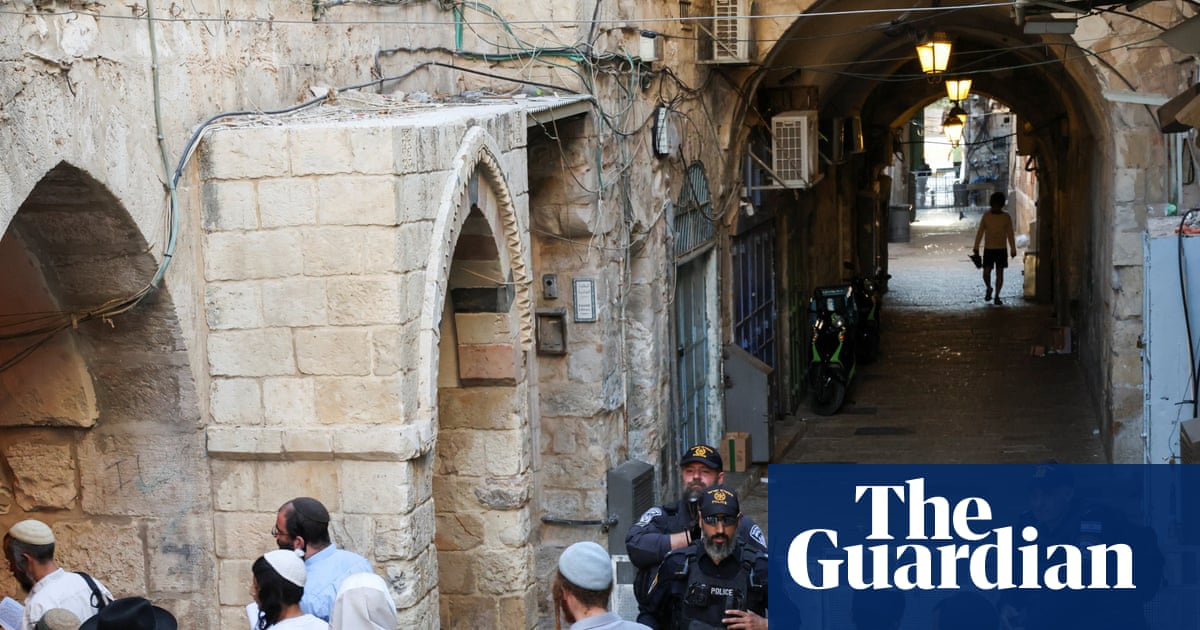
Jerusalem’s most important religious site facing ‘imminent’ threat of Israeli takeover, warns Jordan
Jordan is convening an emergency meeting of foreign ministers from the Arab and Islamic world over what it says is an “imminent” threat of an Israeli takeover of the most important religious site in Jerusalem, with the potential to “trigger a religious conflict”.
The meeting on Wednesday – and the Jordanian warning – follow an escalating pattern of government-backed incursions by Jewish religious extremists on the compound around the al-Aqsa mosque and Dome of the Rock, in violation of a status quo treaty overseen by Jordan’s Hashemite monarchy, by which only Muslims can pray at the site.
On 23 July, more than 2,000 Israelis from the religious right – mostly settlers led by the national security minister, Itamar Ben Gvir – stormed the area, known to Jews as the Temple Mount. They prayed and performed rituals all around the compound in what Jordanian officials said was the worst violation in modern history.
Amman has also been alarmed at a recent recruitment drive for religious Jews for a special Temple Mount police unit, and is braced for more direct challenges to traditional Jordanian custodianship by extremist Israeli leaders in the major Jewish holidays in September. This year, those holidays will come amid an intense election campaign, in which the far-right coalition of the prime minister, Benjamin Netanyahu, will be fighting for survival.
“This is a constant threat, a dangerous threat that we’re trying to counter in every tool that we have possible,” Jordan’s foreign minister, Ayman Safadi, told the Guardian. “We warn that tampering with the status quo … could trigger a religious conflict that will reverberate beyond Palestine and Jordan into the whole Muslim world.”
Safadi, who will host Wednesday’s emergency meeting, bringing together his counterparts from Arab League countries, as well as Turkey, Indonesia, Malaysia and Pakistan, said it was “something that the whole international community should be aware of. Jerusalem is a tinderbox.
“We’re trying to explain the danger. We’re protesting legally. We are trying to create awareness of the imminent danger in the continuation of those Israeli measures.”
Jordan’s custodianship of the al-Aqsa compound dates back to Ottoman times, and the status quo encompassing the city’s religious sites was enshrined in the 1878 Treaty of Berlin. The Hashemite kingdom’s oversight in Jerusalem was expanded to cover Christian holy sites in the 20th century, and its custodianship was reaffirmed after the 1967 war, and in the 1994 Israeli-Jordanian peace treaty.
Infringement by Jewish extremists triggered riots in the British Mandate period between the world wars, and a 2000 visit to the compound by the right-wing leader Ariel Sharon, soon to become the Israeli prime minister, ignited more than four years of violence in the second intifada.
Jordan is uniquely vulnerable to the impact of Israel’s broader ethnic cleansing campaign in the West Bank, which Amman fears may also escalate dramatically as the October elections loom. There is anxiety over what the Israeli government might do in the three months before the vote, as radical elements seek to change the geography of the region in ways which could be difficult to reverse.
For Jordan, the worst-case scenario is an attempt at the mass deportation of Palestinians from the West Bank, which would destabilise the country in several ways, including economic costs, the political impact of an influx of an angry, dispossessed population, and threats to the country’s delicate demographic balance.
“Our position that this is a red line that we will not allow to be crossed. We have made that known to everybody that we will do whatever it takes to prevent any attempt at Israeli displacement of Palestinians into Jordan,” Safadi said. “Not only will that be a violation of international law and of the right of the Palestinians to stay on their land, but that will also be a tremendous escalation.”
Jordanians descended from previous waves of Palestinian refugees already represent more than half of Jordan’s 11.5-million population, and the country’s original residents, the “East Bankers”, are wary of what they see as a further dilution of national identity.
Israel has already refused to renew a 2021 water agreement under which it shared 100m cubic metres a year to its parched neighbour, one of the most water-scarce countries in the world. It reverted to the 50m cubic metres originally agreed in the 1994 treaty, which falls far short of the needs of a much bigger population than the Jordan of 32 years ago.
The Israeli government reportedly halved the water supply in retaliation for criticism from the Jordanian government of the mass killing of Palestinian civilians by Israel in the Gaza war, and officials have hinted that the taps could be turned back on if the criticism ended.
The Israeli government’s provocative actions in Jerusalem and the West Bank and over water raise the political cost to the monarchy of maintaining normal relations with its western neighbour.
“Anti-normalisation sentiment here has grown even larger than before due to the Zionist state’s plans of annexation of the West Bank, the denial of Jordan’s share in the water agreement and also the daily challenges to the custodianship at the al-Aqsa mosque,” said Dima Tahboub, a member of parliament and spokesperson for Jordan’s Islamist Umma party. “Every day there is penetration by settlers into the al-Aqsa mosque and at the same time, [Palestinian] Jerusalemites are prevented from entering the mosque.”
Tahboub’s party is Jordan’s biggest political bloc, known as the Islamic Action Front (IAF) until earlier this year when it was ordered to adopt a less ideological name. Its rise has largely been driven by events on the other side of the River Jordan, and the Gaza war helped it win over 22% of the available seats.
The surge in political Islam came as a shock to the monarchy, which slowed down its plans for political reform and the transfer of more power to parliament as a result. The Muslim Brotherhood movement was outlawed last year and IAF, which operates as its political arm, had its offices raided. It has, however, been allowed to continue as a party, under the name of Umma, which means “community” or “nation”.
Tahboub said there was more the government could be doing to rally international support to resist Israel’s encroachments.
“I think more pressure can be exerted. The issue is not being put to the table with the force that it needs,” she said, while stressing that the Umma party stood together with the Jordanian government in the face of its adversaries, and that it understood the limitations imposed by geography and economics which have left it significantly dependent on the US for its economic and security needs.
Unlike other Gulf monarchies, Jordan has not allowed the US its own military bases on its territory, but there is a US presence on Jordanian bases, which has grown significantly since the start of the US war with Iran. Amman has sought to play down the presence of US forces, planes and other equipment, but that has been made harder by repeated successful Iranian airstrikes, which have killed three Americans and injured scores at the Muwaffaq Salti base in the eastern desert.
For decades the US military presence has been seen as a security guarantee for Jordan, but it has also proved to be a political liability, especially as the Jordanian air force has found itself serving as Israel’s first line of defence shooting down Iranian drones and missiles heading towards Tel Aviv.
Last month, several hundred prominent figures from politics, the law and Jordanian cultural life signed an open letter calling for the withdrawal of US forces, in a rare direct challenge to the government.
The letter said: “We maintain that their presence exposes Jordan to security, political, and economic risks that serve no national interest and increases the likelihood of our country being dragged into a regional conflict to which it is not a party.”
