
Katie Price: Nothing to Hide review – the bit about Hugh Hefner’s body is extremely candid
‘In 10 years’ time,” muses 30 Rock’s Jack Donaghy as he watches his employee Kenneth the page walk back to his desk, “we’ll either all be working for him or dead by his hand.” I have always felt much the same way about Katie Price, AKA Jordan, née Katrina Infield, the 90s glamour model turned celebrity turned businesswoman turned cultural behemoth who has dominated headlines, airwaves and, increasingly, television documentary slots over the last 30 years. Her ruthless commodification of herself and others around her, the vaulting ambition, the fortunes earned and spent, the battles fought, the sloughing off of abuse that would have broken any lesser being, the belligerence, the keen intelligence, the dead-eyed stare down any camera lens presented to her, the bizarre vulnerability when it comes to men, the flat monotone voice daring you to poke the basilisk … all of it together is as terrifying as it is fascinating. If she ever chooses to slip her tabloid bonds and turn her attention to wider world domination – well, I for one shall be the first to swear fealty and avoid a much more fatal kind of fate.
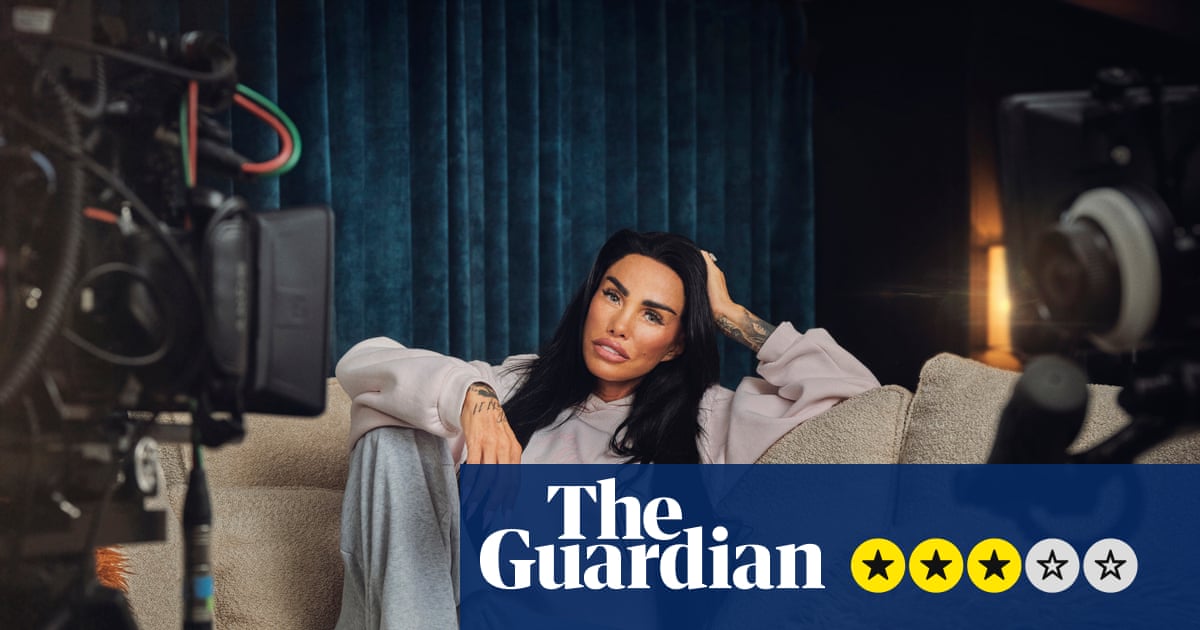
The latest documentary about the Price phenomenon is called Katie Price: Nothing to Hide. The Beckhams have done one each since Price’s last major outing, the Vardys have a reality show, Coleen Rooney is on the up and up – the correct pecking order must be restored. So here is Price again, on a giant sofa, vaping or chomping through snacks with her luminous giant veneers, swathed in a giant sweatshirt and pants, 10 days after her latest facial surgery and avowing honesty. “You can talk to whoever you like,” she tells the film-maker Paddy Wivell, who generally focuses on non-celebrity subjects (most recently, in Hell Jumper, on volunteers in the war in Ukraine).
Wivell duly interviews Price’s mother, Amy (a mesmerising mix of enduring love, utter bafflement and incandescent fury at some of her extraordinary daughter’s life decisions as she evolved from horse-mad prepubescent to attention-loving sex bomb), siblings and some exes. They include her first boyfriend, Gary Bolingbroke, a friend of her stepdad. That this point is not pressed suggests Price’s rather than Wivell’s hand remains most firmly on the tiller.
Price’s first famous boyfriend, Dane Bowers, gives his insights. “I was known as a bit of a boob man back then.” Then there’s Gareth Gates, who seems to still be reeling from the relationship (which blew up in the tabloids when Price, in what she admits was an act of revenge for him denying their time together to his management, said losing his virginity to her cured him of his then famous stutter), and Alex Reid. Neither Dwight Yorke, who left her when she was pregnant at 23 with their son Harvey, nor Peter Andre, perhaps her most famous relationship, appear.
Price is as candid as ever. She didn’t become Hugh Hefner’s girlfriend after her 2001 Playboy cover because she thought it would be like having sex with her grandad, though she was surprised as other girls “climbed aboard” in the bedroom “how young his willy looked”. She recounts going to the abortion clinic three times when pregnant but leaving each time, reasoning that just because Yorke didn’t want the baby was no reason she shouldn’t. She dispassionately acknowledges that some breakups or tabloid campaigns against her hurt, but “me being me I’ve always had an ability to just get on with it”.
But candour and confession are not insight. And it is not supplied elsewhere, either by Wivell contextualising her life, experiences and decisions within the unquestioned but now inescapably obvious misogyny of the day, or by any of her friends and family doing more than assuring us that Katie can be “hard as nails” but that a softer side exists too.
It’s as carefully manufactured and defiantly unreflective as any other product supplied by the Price brand. Does Price ever wonder what she might have done or been if she hadn’t been beautiful and/or sexy? If plastic surgery hadn’t been an option? How would she have channelled all that ambition? CEO of what? Despot where? Does she wish she’d let her intelligence temper her instinct more with men? Can she do it now? Does she think a life lived this way is sustainable for another 30 years? Answers come there none. It is not her way.
