
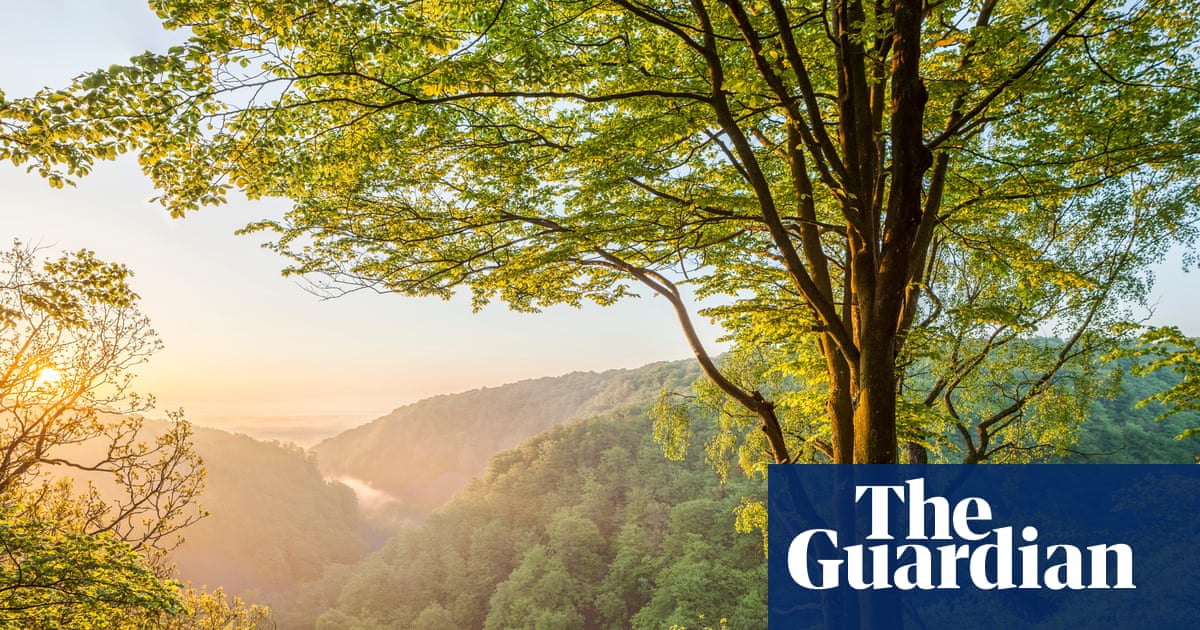
‘Living proof damaged landscapes can recover’: exploring a vast restored forest in southern Sweden
[ad_1]
From the bus window, the ridge looks like a giant slumbering beast stretched deep green across the flat farmland. “It feels alive,” I say to the woman beside me. “Yes,” she answers. “It is where you would run for safety, don’t you think?”
I am in southern Sweden to explore Söderåsen national park, established in 2001 to protect more than 1,600 hectares (4,000 acres) of the larger Söderåsen ridgeline. Shaped over millennia by immense geological collisions, fractures, volcanic eruptions and ice ages, today it is one of northern Europe’s largest continuous protected broadleaf forests, and only 90 minutes by car from Copenhagen or, in my case, two hours by public transport.
The little village of Röstånga at the gateway to the park is where travellers stop for supplies from the supermarket before disappearing into the forest on foot, bike or horseback, and people gather for food, live music and art.
My room for the first night is in Villa Söderåsen, a grand timber-framed yellow and white guesthouse, which has stood at the park’s entrance since 1904. It was built for tourists arriving via the new railway in search of connection to nature. Sebastian and Åsa, the owners, want to continue that tradition. “We humans are as loud as elephants in the wood,” says Sebastian. “Sit quietly for half an hour and see what happens.”
That evening, I eat with strangers at long wooden tables outside the hip restaurant and live music venue Stationen. Music drifts out of open doors, adults chat around the fire, children run circles around us.
The next morning, Åsa recommends I take a dip in Odensjön (Odin’s Eye) Lake. “Some say it is bottomless,” she says. It’s almost perfectly round, edged by steep beech-covered slopes, and fed by underground springs. Fifteen minutes into the forest and I am there.
A woman making her way back to the village says: “There is a rock in the water, heated by the sun, sit there, let your body adjust.”
Grasshoppers trill, spider silk trails from branches, noble chafer beetles glimmer like the aurora borealis, a dragonfly rests electric-blue on my now empty walking boots. I swim, the circle of blue sky rippling, and emerge ready for anything.
A few years ago, scientists obtained a sediment core from the bottom of the lake, providing detailed information from the past 600 years of land-use history. This showed that in the 18th and 19th centuries the plateau was largely deforested. I would have been walking across a heath, repeatedly burned to improve grazing grounds. It is difficult to imagine as I move through endless layers of beech, interspersed at times with birch, oak and rowan, mossy trunks, roots like octopuses.
Once I start searching, the signs of human history are everywhere too, from hollow ways to clearance cairns and dry-stone walls.
Two hours of hiking later, I arrive at the second entrance to the park: Skäralid, a rift valley. The visitor centre Naturum, packed with information and playful exhibits, shares its premises with Café Italia. Both look out onto a picturesque dam. A ranger explains that much of the initial conservation efforts since designation as a national park involved the felling of non-native Norway spruce and the planting of broadleaved trees in its stead.
In search of solitude, I choose the wilder three-hour Hjortsprångsrundan or Deer Leap circular, a trail named after a prehistoric hunting method where people drove game over a narrow cliff shelf. I pick my way along it, across heather and bilberry, to perch on the hard gneiss bedrock that blushes a startling mineral pink. A buzzard swoops down from the branch of a gnarled oak.
The descent is like scrambling and slipping back through time into an entirely other world. Many of these slopes managed to escape the historical land clearances and thus are the closest to ancient woodland. But all around this area, ferns, lichen, fungi, seeds and spores are recolonising the land.
after newsletter promotion
The scree slopes are dotted with springs pushed up from a subterranean lake and laced with streams that feed into the Skärån river. The scent in the bottom of the valley is heady, sweet and damp, bringing with it a keen awareness of how much is always happening just out of sight.
I rest on a wooden walkway, pop a wild raspberry in my mouth and watch a slowworm the length of my forearm slither past. Then, a sudden crashing through undergrowth. Wolf? Wild boar? Moose? A young stag steps from a pocket of alder trees, pawing the ground. We look at one another. The sun drops, and as it does its light rises up the walls of the ravine.
My room for the second night is in Söderåsens Skafferi, a vandrarhem, or wanderer’s home. The house glows like a lantern on the edge of the dark wood. The owner Elisabeth, who spent her childhood exploring Söderåsen on horseback, says the house was once the first nature school in Sweden.
On my final morning I climb to Kopparhatten, the park’s highest viewpoint at 212 metres, and hold up a booklet with an image of a painting from 1840 of this same vista, almost bare of trees. “We used to holiday in the south,” a couple tell me. “But we’re searching for cooler climates now.” I wonder what stories they will bring home.
Summer, all green infusion; autumn, rust and gold; winter, snow and stone; spring, wood anemones and paper-thin leaves. The national park feels like living proof that damaged landscapes can recover if nature, and humans, are given half a chance.
Accommodation was provided by Villa Söderåsen (doubles from 1,095 Swedish Kronor, about £85, B&B). Coco also stayed at Söderåsens Skafferi (doubles from around £78). Söderåsen national park has multiple wild campsites with wind shelters and barbecue areas. For information on public transport access, visit skanetrafiken.se
[ad_2]
Source link
