
Manchester Camerata review – mental torments build up to a royal meltdown
Shouts of “Rubbish!” famously greeted Peter Maxwell Davies’s Eight Songs for a Mad King at its 1969 Proms premiere. Over half a century later, the composer’s modernist monodrama – George III the “mad king” of the title – has lost none of its feral power. To be shocked is to be numbed; artistically it’s not actually very interesting. What Eight Songs achieves is far more insidious: it makes you feel. And in this fierce account from the Manchester Camerata, conductor John Andrews and soprano Rosie Middleton we felt it all: every desperate clutch for sanity, every hairpin bend of reason, every queasy realisation and glassy-eyed forgetting.
Clever programming let us build up to the Maxwell Davies – looming slowly towards us in a concert gradually losing its grip on reason and order. Ophelia railed and cringed in Errollyn Wallen’s Hamlet-setting By Gis and Saint Charity – a theatrical miniature that packs a punch in barely five minutes of music. Cries and whispers of “Shame” break through the text, uttered not just by the soprano (here the compelling Rebecca Hardwick, balancing hysteria with a horrible glee) but flung at her by the string quartet, who otherwise conspire and feed her delusional fantasies.
How neat to treat the two contemporary monologues as bookends for Schumann’s Kreisleriana – the manic product of the composer’s own mental illness and his love for Clara Wieck. “Sometimes your music actually frightens me,” Clara wrote to her soon-to-be-husband, and the music’s turbulent excesses were only amplified in Simon Parkin’s new arrangement for small ensemble, turning the unanimity of a solo piano into a fractious Babel of dissenting voices. The convulsive opening seized us by the throat, losing its grip only slightly in the awkwardness of more obviously pianistic movements II and VII.
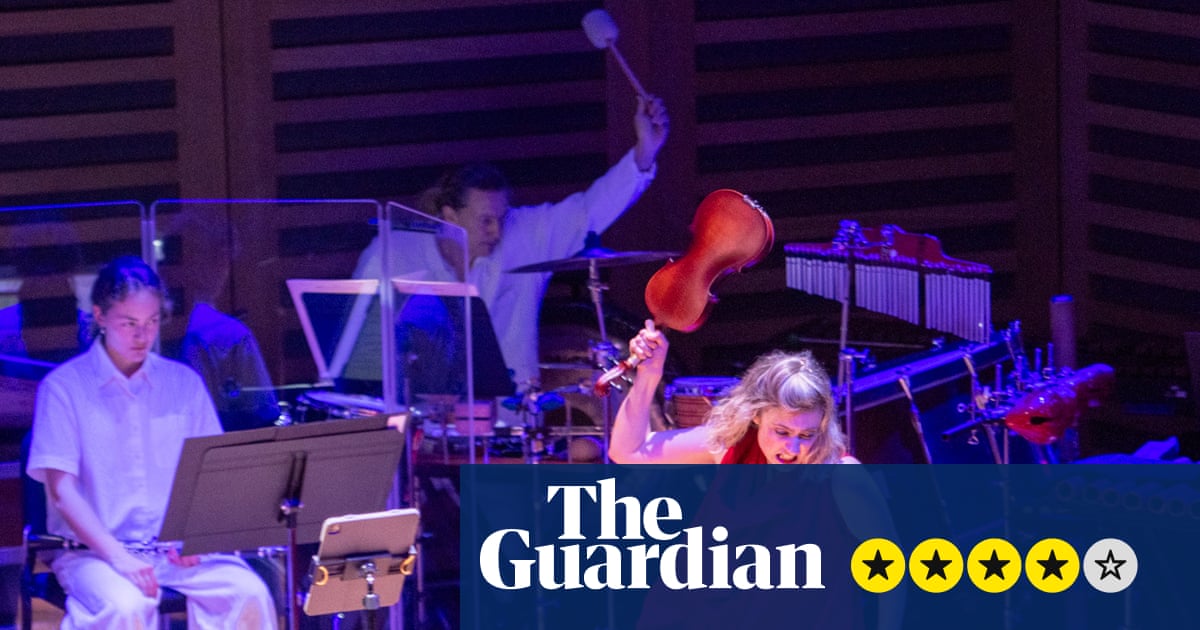
Swapping concert blacks for sanitorium whites and creams after the interval, the orchestra became the fantastical projections of King George’s besieged mind in Ruth Knight’s light-touch concert-staging of Eight Songs. No cages for the monarch’s instrumental “birds”, but fewer props meant more mind (and music)-forged manacles. Middleton flung herself bodily across the part’s four octaves, voice flayed of tone, shredded in howls and hoarse barks. Her perversion of Handel’s “Comfort ye”, suddenly sweet, was a dagger, but it was the sudden clarity and truth of the finale – “The king is dead … poor fellow he went mad” – that finished us off. Brutal, brilliant music-theatre.
