
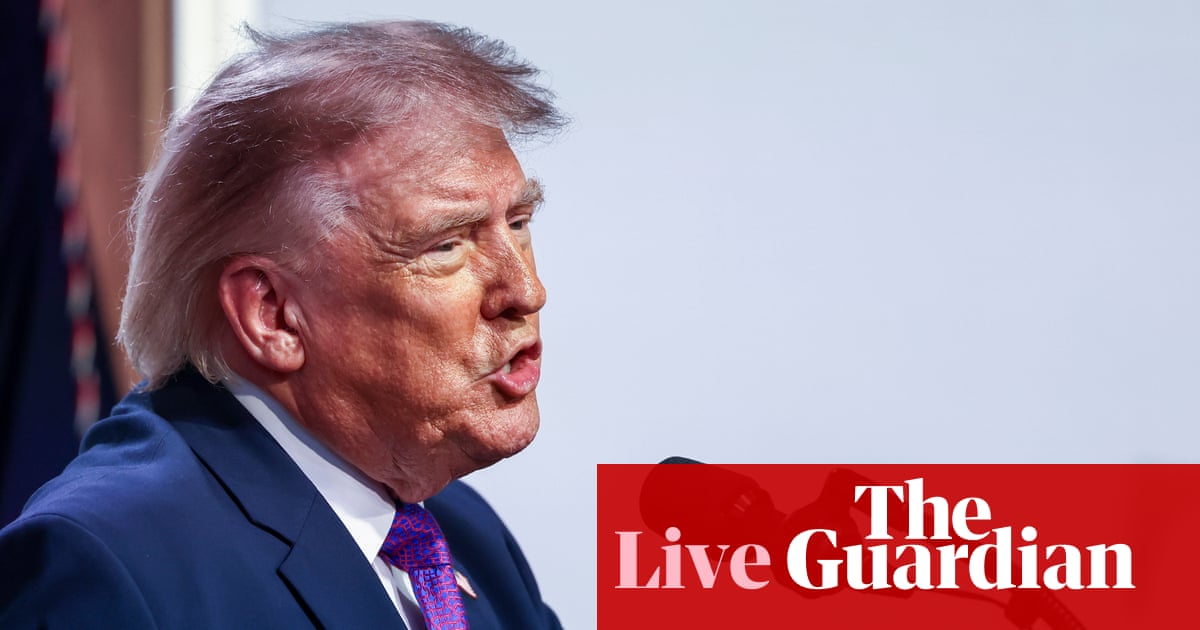
Middle East crisis live: Trump claims Iran attack ‘on hold’ due to request from Gulf allies
[ad_1]
Trump claims Iran attack ‘on hold’ due to request from Gulf countries
We are restarting our live coverage of the US-Israeli war on Iran and the other conflicts in the Middle East. Donald Trump says he has called off a planned attack on Iran on Tuesday at the request of Gulf states so peace talks could continue.
In a post on Truth Social on Monday, the US president said he had been asked to do so by the leaders of Qatar, Saudi Arabia and the United Arab Emirates.
Trump said he had been told a deal would be made that is “very acceptable” to the US, adding there would be “no nuclear weapons for Iran”.
He said, however, that he had informed his military leaders “to be prepared to go forward with a full, large scale assault of Iran, on a moment’s notice, in the event that an acceptable Deal is not reached”.

The announcement came as Iran’s foreign military spokesperson, Esmail Baghaei, claimed Pakistan has shared Tehran’s latest proposal with the US.
Trump has repeatedly threatened to launch new strikes on Iran, only to retreat at the last minute. The war on Iran is deeply unpopular with the American public and is hitting consumers hard with increased oil and fertiliser costs resulting from the reduced flow of vessels through the critical strait of Hormuz. ‘
Negotiations on Iran’s nuclear programme and the strait of Hormuz have reached a deadlock and the US’s blockade of Iranian ports is failing to force Tehran into making painful concessions even though Iran is suffering an escalating economic crisis.
Trump did not say what targets the US had planned to strike on Tuesday, but officials said the military could have targeted Iran’s ballistic missile sites, according to the New York Times.
Key events
G7 finance ministers are looking at ways to contain the economic fallout resulting from the war in Iran, which has sent global energy prices soaring and slowed down growth.
Finance ministers and central bank governors from G7 countries met in Paris for a second day of talks to discuss responses to the fallout amid continued volatility on global bond markets. Along with rising energy prices, policymakers are also expected to discuss sanctions policy and how to limit the economic impact the effective closure of the strait of Hormuz is having on poorer, import-reliant countries.
“We agree on the fact that the IMF and the World Bank have to step up their game for those countries (most vulnerable to the impact of the Middle East conflict) and make sure we help them,” French finance minister Roland Lescure told reporters.
The head of the International Monetary Fund, Kristalina Georgieva, warned last month that the US-Israeli war on Iran will permanently scar the global economy even if a durable peace deal can somehow be reached. You can keep up with the latest business news in our live blog here:
Lebanon’s state-run National News Agency (NNA) is reporting that Israeli artillery shelling has resumed in southern Lebanon’s Marjayoun district. We will bring you updates as we get them.
Death toll from Israeli attacks on Lebanon passes 3,000, health officials say
As we have been reporting, Tehran wants Washington to pressure Israel into stopping its war on Lebanon as part of a deal to end the US-Israeli war on Iran.
But the US has so far seemed reluctant to exert any real pressure on Israel to stop its continued attacks on southern Lebanon despite a recently extended ceasefire and with Lebanon and Israel set to resume diplomatic talks at the beginning of June.
Both Israel and Hezbollah, the Iranian-backed Lebanese militant group and political party, have continued with their attacks since the 17 April ceasefire agreement came into effect, accusing each other of violations.
More than one million people have already been displaced by the renewed Israeli war on Lebanon which started when Hezbollah launched missiles at Israel on 2 March after the US-Israeli bombing of Iran in late February.
Israeli strikes have now killed more than 3,000 people in Lebanon since 2 March, the health ministry said on Monday. “The total cumulative toll of the aggression from 2 March to 18 May is now as follows: 3,020 martyrs and 9,273 wounded,” the ministry said, with 211 people aged 18 and under and 116 healthcare workers among the dead.
Twenty IDF soldiers and one defence ministry civilian contractor have been killed in southern Lebanon during the fighting, according to officials, with at least four civilians also reported to have been killed.
Iran’s recent proposal to the US called for the lifting of sanctions on Tehran, the release of frozen Iranian funds and an end to the marine blockade on the country, Iran’s deputy foreign minister Kazem Gharibabadi was quoted by the IRNA news agency as saying this morning.
The Iranian proposal also includes ending the war on all fronts – including Israel’s assault on Lebanon – the withdrawal of US forces from areas close to Iran and war damage compensation costs, Gharibabadi added.
The US reportedly saw the updated peace proposal Iran sent on Sunday as insufficient, leading to expectations that the US would resume its attacks.
According to the US outlet Axios, Donald Trump is due to meet with his top national security team in the Situation Room later today to discuss possible military options.
But speaking at a White House event yesterday, Trump said there had been a “very positive development” and claimed a deal was near that would leave Iran without nuclear weapons, which Tehran denies pursuing.
Trump claims Iran attack ‘on hold’ due to request from Gulf countries
We are restarting our live coverage of the US-Israeli war on Iran and the other conflicts in the Middle East. Donald Trump says he has called off a planned attack on Iran on Tuesday at the request of Gulf states so peace talks could continue.
In a post on Truth Social on Monday, the US president said he had been asked to do so by the leaders of Qatar, Saudi Arabia and the United Arab Emirates.
Trump said he had been told a deal would be made that is “very acceptable” to the US, adding there would be “no nuclear weapons for Iran”.
He said, however, that he had informed his military leaders “to be prepared to go forward with a full, large scale assault of Iran, on a moment’s notice, in the event that an acceptable Deal is not reached”.
The announcement came as Iran’s foreign military spokesperson, Esmail Baghaei, claimed Pakistan has shared Tehran’s latest proposal with the US.
Trump has repeatedly threatened to launch new strikes on Iran, only to retreat at the last minute. The war on Iran is deeply unpopular with the American public and is hitting consumers hard with increased oil and fertiliser costs resulting from the reduced flow of vessels through the critical strait of Hormuz. ‘
Negotiations on Iran’s nuclear programme and the strait of Hormuz have reached a deadlock and the US’s blockade of Iranian ports is failing to force Tehran into making painful concessions even though Iran is suffering an escalating economic crisis.
Trump did not say what targets the US had planned to strike on Tuesday, but officials said the military could have targeted Iran’s ballistic missile sites, according to the New York Times.
[ad_2]
Source link
