
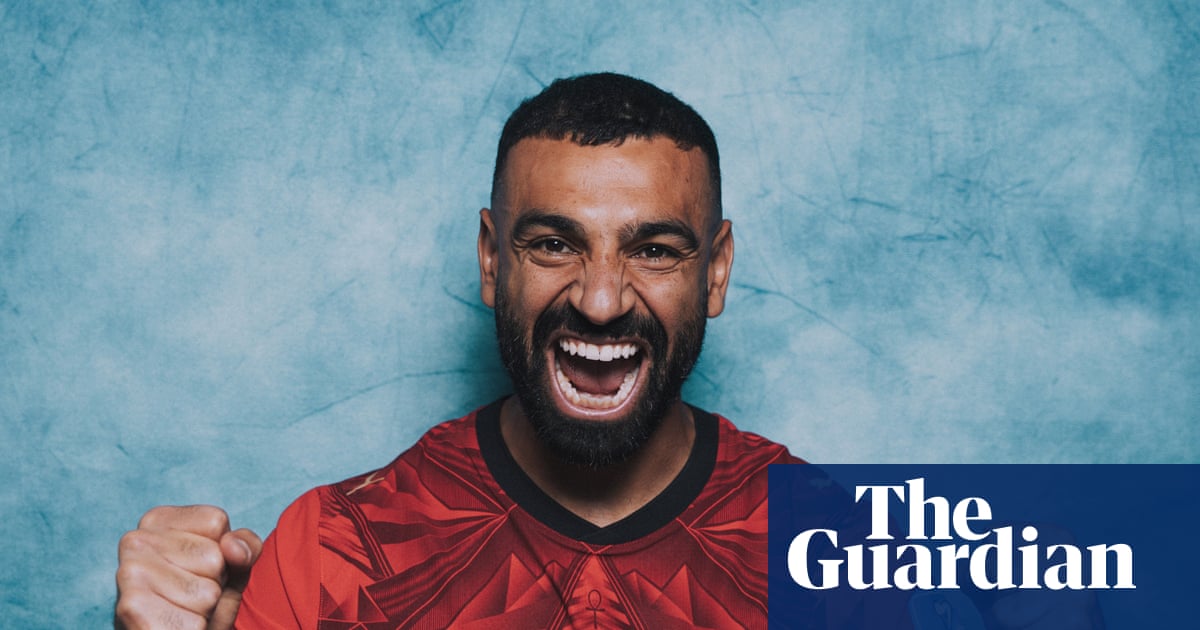
Mohamed Salah has eyes of a nation on him as Egypt look to end 92-year wait
Last week Orange, one of Egypt’s leading mobile network operators, released a series of humorous adverts starring Egypt’s Ahmed Fatouh, Rami Rabia and Hossam Abdelmaguid, where the trio’s optimism is met with scepticism as partners and family members struggle to take them seriously. Their crime? Daring to suggest Egypt might finally progress beyond the group stage of a World Cup.
If there is one thing Egyptians do particularly well, it is self-deprecation. Perhaps that comes from history. Despite winning the Africa Cup of Nations seven times, Egypt are still waiting for their first World Cup victory. The Pharaohs will kick off their fourth appearance at the tournament against Belgium on Monday knowing they failed to win any of their seven matches so far. That is the contradiction at the heart of Egyptian football. No African nation has won more continental titles, yet Egypt remain one of the continent’s World Cup underachievers. While other African nations aim to replicate Morocco’s 2022 semi-final success, many Egyptians would happily settle for something far more modest: a single group stage victory.
Qualification for the World Cup was remarkably straightforward by Egyptian standards. The Pharaohs topped their qualifying group unbeaten and – like many African nations – they benefited greatly from Fifa’s 48-team tournament expansion; the country’s golden generation of the 2000s never managed to reach the World Cup despite dominating the continent. This time, Mohamed Salah was Egypt’s main man during qualifying, scoring nine, assisting three goals and playing virtually every minute of the campaign.
However, the Egypt captain arrives at this World Cup in very different circumstances to the player at the 2018 edition. In Russia, Salah was still establishing himself after coming off a sensational first season at Liverpool; he had yet to build the trophy-laden résumé that would make him one of the greatest Premier League players. Egyptians adored him for ending the country’s 28-year World Cup exile with a dramatic stoppage-time penalty, while the wider football world was still unsure whether his 2017-18 form was just a flash in the pan.
Now, at 34, there is little left for Salah to prove. He won every major honour available at Liverpool and whether Egypt exit in the group stage or make the round of 32, few non-Egyptians will fundamentally alter their assessment of his career.
In Egypt, however, the stakes are different. If Salah manages to guide the nation to an elusive World Cup win, his international legacy in his country will soar. Salah remains the undisputed focal point of the national side and delivering an inaugural win – and perhaps even guiding Egypt into the knockout rounds – would surpass the feats of every Egyptian player who came before him. Salah is also closing in on Hossam Hassan’s record as Egypt’s all-time leading scorer, needing just two more goals to draw level despite having played 61 fewer matches than the man now patrolling the touchline.
“We have great players – I am very happy with my squad – but, of course, we depend on Salah in big moments,” said Hassan. “He scores goals, he creates chances. We need him to be at his best and he will be. I am confident he can guide us to victories.”
For the second World Cup running, Salah arrives carrying an injury. In 2018, it was the shoulder injury from the Champions League final that impeded him throughout the tournament. This time it is a hamstring problem that disrupted the closing weeks of his Liverpool career. It is frustrating for Egypt that Salah has maintained such a remarkable record of fitness throughout his club career only to arrive hampered at the World Cup again.
Encouragingly though, the situation appears less serious than eight years ago, when Salah was spotted before Egypt’s decisive match against Russia needing the help of three teammates to put on his shirt during a training session. When asked about his fitness after Egypt arrived in the United States, Salah sidestepped the question, simply saying: “We need to focus on our camp and just train hard and we will see. We want to make the people proud and we will do our best. It is a tough group. Everyone has a chance so we will give it our best and we will see. Hopefully we can go far.”
There is a reason Egyptians approach World Cups with equal parts hope and humour. History has taught them to expect disappointment. But history has never given them a player quite like Salah. The irony is Egypt’s captain arrives at what may be the most important World Cup of his career with the least left to prove. Long before Salah, Egypt were the first African nation to play at a World Cup in 1934. The self-deprecating jokes, the adverts and the gallows humour are all part of the national character, but even the best punchlines wear thin. And most Egyptians would agree that after 92 years, one World Cup win would do just fine.
