
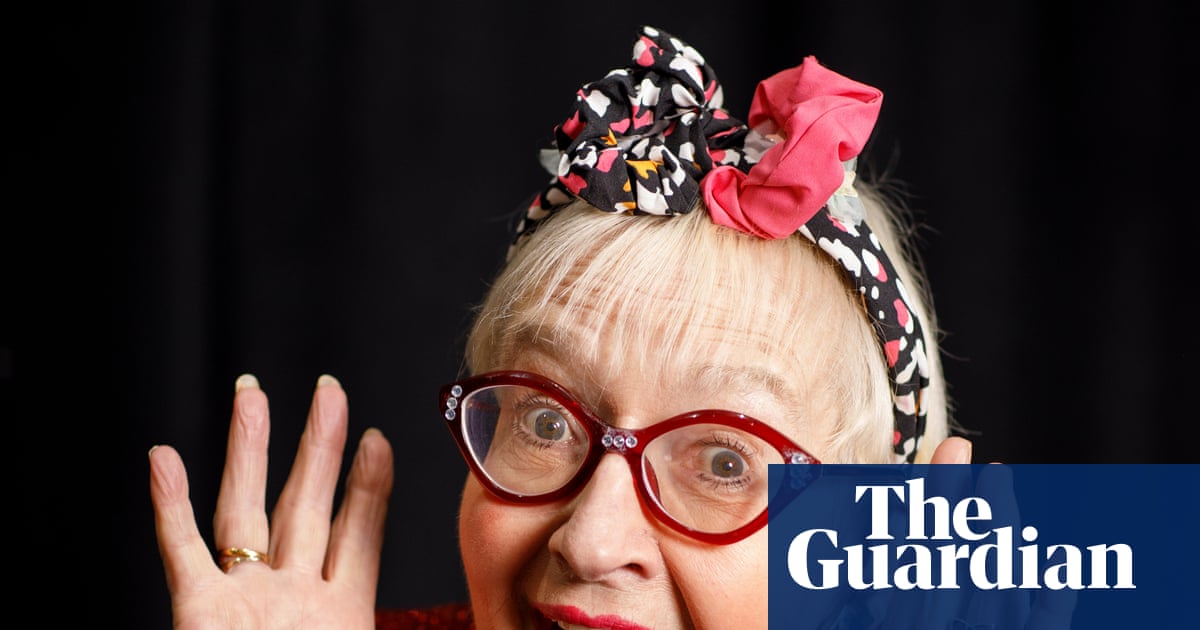
‘Paul McCartney asked for my autograph!’ Su Pollard on Hi-de-Hi! and her amazing celebrity encounters
A quick run-through of some of the 20th-century icons that Su Pollard has met. Paul McCartney? “Absolutely fabulous,” Pollard says. “He was sat leaning against a wall, next to Linda.” She does a great impression of McCartney’s accent. “‘Hey Su, how are you? Love the show. Can I have your autograph? For my mother.’” The show was, of course, the hugely successful BBC sitcom Hi-de-Hi!, set on an Essex holiday camp and for which Pollard, playing chalet maid Peggy, will for ever be best known.
Queen Elizabeth, after a Royal Variety Performance? “She was absolutely marvellous. What struck me – I’ve always said this – was her skin. I was drawn to her skin. It was all peachified. And beautiful smile, her own teeth. Very regal, very straight-backed, not very tall, and quite a voluptuous bosom.”
Diana, Princess of Wales, did a little tap-dance with Pollard at a function. “I found her very charming. Although she was classed as quite shy, I don’t think she was. She was very open to meeting people, but perhaps it was a slow burn with her.”
At a club in Earl’s Court in London, Pollard was “having it large”, she says, when a man approached her and asked if he could join in. “I went: ‘Stop! It’s never you, is it?’” It was – Queen singer Freddie Mercury. She does an impression of him too, overbite protruding. “He went: ‘I could be anybody, dear.’ His teeth were fantastic. Another wonderful smile. His friend took a picture of us.”
At various Downing Street functions, Pollard met Margaret Thatcher – “marvellous, but it was very fleeting” – and Theresa May. “She went: ‘Hi de hi.’ I said: ‘Ho de ho.’ She was fabulous – I liked her. She was very warm. Getting on with the job the best she could.” Tony Blair? Gordon Brown? No, she says. “But I did see Tony and Gordon in … what’s that lovely restaurant?” Might it have been Granita? (Blair was a near-neighbour at the time in north London.) Pollard looks astonished. “That’s it! How do you know that?”
Granita was, you may remember, the venue of the 1994 pact, where Brown agreed Blair would run for the Labour leadership. “That’s the first I’ve heard of that,” says Pollard. “God, I feel a shiver. That’s what they were talking about!” I mean, we don’t know that’s what they were discussing at that precise moment, but let’s go with it. “I gawked at them through the window and waved.”
Much has been written about that fateful night, and to it we can perhaps now add the mental image of Pollard – wearing, I like to think, bright owlish glasses, maybe a feather boa, and manic grin – excitedly waving at the two serious men, history in their hands, through the window. “They just kind of went” – she gives a harassed smile – “and then hurried back to talking. I bet they thought: ‘It’s that Hi-de-Hi! person.’”
We meet in London at the Club for Acts and Actors, the social and support organisation of which Pollard is president, in a room surrounded by old portraits of stars and posters for shows. Pollard, 76, has just written her memoir, Fully Charged, hoofing through her 52-year career, which has spanned theatre, musicals and TV. She is such funny company, and her book – which one can’t help reading in her throaty Nottingham accent – has some gems. On changing her name from Sue to Su: “I can’t prove it, but I maintain that losing that vowel gave me some kind of momentum.” And on spotting a pop superstar, not known for his sense of humour, at the infamous 1987 It’s a Royal Knockout TV event, which she co-hosted: “I saw a sight I never expected to witness – Cliff Richard dressed as a leek.”
It was “lovely”, she says, to write the book (with her friend and collaborator Paul Boyd), “because it reminded me, and gave me time to reflect, going: ‘God, that was funny.’ Then it makes you think, ‘I’ve had far more ups than downs’, and that’s what you’ve got to be in life, I think – positive.”
It has been an extraordinary life. Pollard grew up in Nottingham, an only child until she was eight. Her parents both worked in a cigarette factory, but Pollard discovered an interest in the stage while taking part in her school nativity. She was playing an “assistant” angel and when she stood to deliver her lines, on a cardboard box that had been taped together, she fell through it. The audience laughed and Pollard was hooked. When she was about 14, writing a school essay about where she hoped to be in 10 years, “I wrote: ‘I see myself at the Palladium.’ And funnily enough, I was.”
What did her parents make of her? She laughs and does an impression of her mother, Hilda (she started calling her by her name as a teenager, “because I was a hippy” and she thought her mother deserved more than to be identified only as “Mum”). “Su, if you don’t mind, do you think you could walk behind me?”
She thinks she was wearing a full-length fur coat that day, but it could have been any number of outlandish outfits. Clothes had become her costume, and gave her a sense of permission to be bold, visible and fun (today she’s wearing a black sequined dress, sparkly red waistcoat, maroon specs, beads and a portrait of Frida Kahlo around her neck, with a pair of miniature Ferrero Rocher chocolate packets for earrings). “I was creating my own style, albeit I looked like a morris dancer at one point because I had scarves round my knees and ankles. No wonder my poor mother …” She laughs. “It was fabulous. What I’m saying is, just be yourself in life.”
Sometimes people would stare at her so hard and so long they’d walk into a lamp-post. People would comment but it never bothered her. “You think: ‘Why are you so pathetically feeble-minded? Just because you’ve seen something different.’ And then you think: ‘Oh, it’s not their fault – forget it.’” Her headteacher reprimanded her for wearing her school coat “like an opera cape” but also, recognising her “theatrical leanings”, as Pollard puts it, introduced her to a friend who ran the local amateur dramatic group.
Pollard was off – in am-dram roles, and performing in local working men’s clubs. In 1974, she appeared on the TV talent show Opportunity Knocks, but came second to a “singing” jack russell (she alleges the owner would insert a finger into its bottom to make it howl on cue). “I’ve never liked jack russells ever since,” she says with a laugh. “I cross the road to avoid them.”
Her first big professional job was in a touring production of Godspell, produced by a young Cameron Mackintosh, who would go on to become a titan of theatre. Did she ever feel out of place as a working-class actor? “No, funnily enough, because I met several that were very similar to me.” Now, she says, “there’s more privately educated people, perhaps, than there are from comprehensives. But I didn’t feel out of place, whether I was with my peers or with people that had been to ‘radar’.” She hoots at herself. People would assume she was so uneducated that she didn’t know how to pronounce Rada, the acronym for the prestigious Royal Academy of Dramatic Art. “It used to make me laugh. I used to do it, just for fun. To me, it never matters where you come from, as long as you’re a good team player, you’ve got the discipline and the passion for it. And reliability – I always believed in a work ethic.”
Impostor syndrome never plagued her. She was lucky, she says, to have been supported by her parents and teachers. “You didn’t feel that you weren’t good enough. I tried never to get above myself, but I thought: ‘Su, you’ve got enough talent, just as much as anyone else.’”
Pollard had been working in theatre for five years and approaching 30 when she got the role in Hi-de-Hi! (She had appeared in another sitcom just before that, Two Up, Two Down.) “I was just beside myself. I was the luckiest person – we all were – in the world at that time.” Did they know it would become so big? “No, but we had an inkling that it was on the right track when we did the pilot and the whole crew were killing themselves laughing.” The humour, she says, hasn’t really dated. “It’s adults looking ridiculous and silly situations. Mostly slapstick stuff – that’s what I loved about it because I like physical humour.” (It remains big in Hungary.)
She still loves talking about the show, she says, and never feels resentful about being asked about it, especially by fans. “People have loved it and you have to respect that you were part of somebody’s life. I think it’s rotten to disrespect your audience.” The cast, or at least those that are still around, continue to get together. “We call ourselves “the Undead”, the ones that are still here. We go: ‘Weren’t we lucky to have brought people all that joy?’”
Boyd brings her a cup of tea and Pollard rummages through her handbag – it’s decorated with all the names of her shows on it – looking for something to fish the teabag out with. Has she got a tomato in there? (Appearing on the TV panel show Would I Lie to You?, Pollard revealed she never went anywhere without a tomato, to jazz up restaurant salads, and a party blower, to jazz up … life). No tomatoes today. “I don’t put them in there now because people started pinching them.” A party blower? Again she rummages in her bag, and brings one out and toots it. “Sometimes, suddenly on the train …” She blows it loudly and laughs. “Pathetic. Honestly! I’m in my 70s. It just makes me laugh.”
In 1984, Pollard married Peter Keogh, whom she met when he was working as a stagehand on the Hi-de-Hi! musical. She knew that he’d had boyfriends, but when the tabloids found out, it unleashed years of homophobic coverage. “It’s not a very nice thing [to be hounded by reporters], especially when you’ve got to work,” she says. There were constant stories alleging he had continued to have affairs with men.
It was also around the time of the HIV and Aids crisis, which made the tabloids even more rabid. Pollard, a longtime ally of the gay community, watched with horror as friends started becoming ill. She remembers doing an early fundraiser at the Royal Vauxhall Tavern, the iconic London LGBTQ+ venue. “I didn’t know enough about it at the time; I don’t think anyone did. People were great, giving money. But then, of course, people I knew started dying. One of the first was a friend from Godspell. That was a really tragic thing – he was amazing. Then a very close friend. It was devastating, really.” She would hear about friends of friends. “There was no real consolation.”
Pollard is still great friends with her ex-husband – they divorced in 1992 – and his husband. “You can’t regret things in your life. You might feel sad that things didn’t turn out the way you initially hoped, but no grudges, no regrets.” She had another long-term relationship. “But since then, I can’t be bothered. I’m more passionate about showbiz than a man.”
This was the reason she never wanted to have children. “Why would I want to be a mother? How can I learn my lines if I’m going: ‘Stop that, Carol – eat your dinner.’ I don’t know how people do it, darling.” It’s hard enough for women who choose to remain child-free now; was she judged for it in the 80s? “No, because I think people knew better than to actually be … And you know the greatest thing? Hilda and me dad never once said: ‘When are we going to be grandparents?’” Jean, her sister, also didn’t have children. “It was not at all because of bad parenting – they were marvellous – we just never thought to go down that route. No thank you.”
About 25 years ago, when Pollard had just turned 50, she had a bit of a career lull. “At the time, you think: ‘Oh, flippin’ ’eck, here I am, middle-aged.’ I thought: ‘I’ve got to make a concerted effort. I’m not going to be proud, waiting for the phone to ring.’” She wrote to writers and directors, reminding people she was around and wanting to work. “I wrote to Jonathan Harvey, who I liked.” The playwright had been writing the BBC comedy Gimme Gimme Gimme, and offered Pollard a guest spot. “That sort of kickstarted my career again, so I was really fortunate. Then I got offered more musicals.” She went into the touring production of Annie, and continued for many years. “I think a lot of producers, and even writers, probably think, ‘Well, they’ve had a good innings’, and it’s time for you to go. No! I’m too young. I never say the R-word.” Camply, she stage-whispers: “Retirement.”
This year, Pollard will do her 43rd panto, playing a fairy in Sleeping Beauty in Crewe, and she continues with her one-woman show. She has enviable energy – the work helps. “If you like the piece, you’re energised by it.” But she also does all the sensible things: walks a lot, sees friends, eats healthily, sleeps well. “My favourite sleep time is 2am till nine.” What does she do until 2am? Read mostly, she says. Gone are the days of dancing in clubs, but only because London nightlife is so “pathetic” (she almost spits the word). “Sadiq Khan [the London mayor], God love him, he’s doing his best trying to get the night-time economy back. Ever since Covid, it’s the saddest thing. I can’t believe, in a capital city of the world, there’s nowhere open at midnight. You must be having a laugh. I’ve been furious since then.”
She is so irrepressible; does she ever have down days? “I wouldn’t say down. I would describe it as dissatisfied. I’m more likely to get irritable. But then I go: ‘Oh, forget it, Su.’” She used to dwell on things, she says. “I’ve learned over the years you’re better not to. I get sad for other people sometimes. I get very sad about losing mates. But then again, I still talk to them and say, ‘just thinking of you, babe’, and then that moment passes.”
To use the theatre cliche, the show must go on, of course. And I think – as she reapplies lipstick, grins and adjusts her sequin minidress – that to be Su Pollard must be like being in one glorious, joyful show that runs and runs.
