
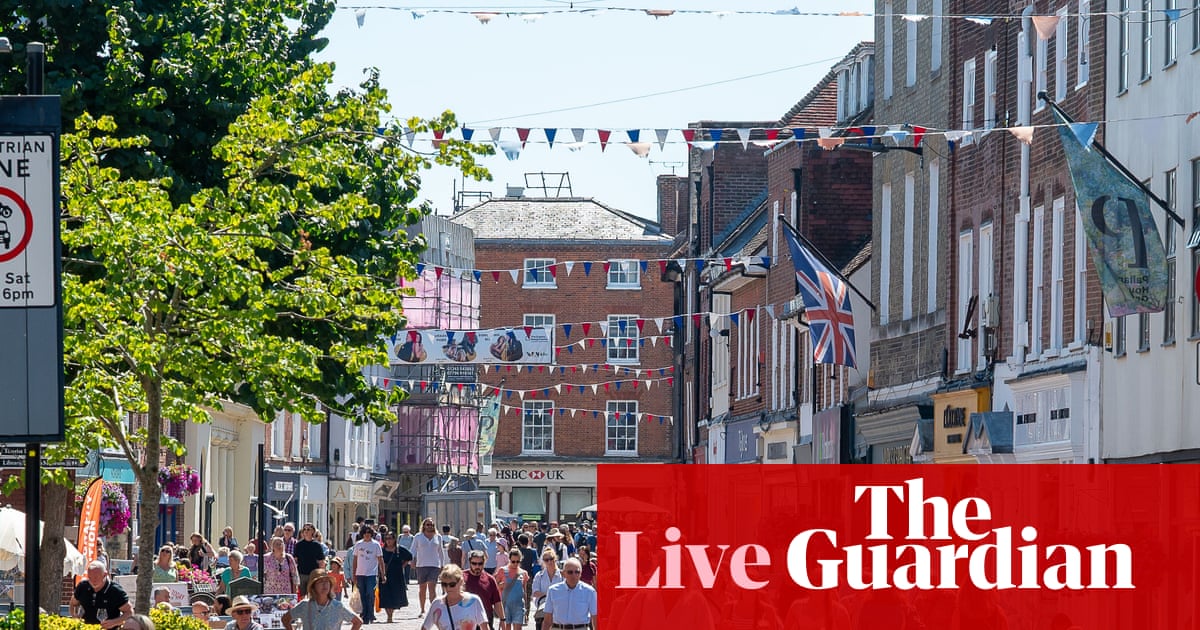
Retail sales fall despite World Cup and hot weather boosting alcohol and drinks trade – business live
Introduction: Retail sales fall despite World Cup and hot weather boosting drinks trade
Good morning, and welcome to our rolling coverage of business, the financial markets and the world economy.
Retail sales fell in July after a bumper period the previous month, despite the World Cup luring punters into pubs and the hot weather boosting alcoholic drink sales in supermarkets.
The total volume of goods sold in stores and online fell 0.5% in July, according to the Office for National Statistics (ONS), compared with a 1% rise in June.
The drop was partly down to non-food sales dropping back in July, after British retailers had brought promotions forward to June because of the hot weather. The ONS said there was “evidence of reduced promotions in July” among household goods and clothing retailers.
But shops selling alcoholic drinks and beverages “performed well, which they attributed to promotions, the hot weather, and the World Cup,” it said.
ONS chief economist Grant Fitzner said: “Retail sales increased in the latest three months, with all main sectors, apart from motor fuel, seeing growth.
“Some retailers told us that hot weather and promotions helped sales of outdoor products and items such as fans, with clothing and online sports merchandise also doing well.”
The figures come after UK consumer confidence jumped to a two-year high last month, according to a closely followed monitor. That is despite tensions in Iran flaring up again and a jump in energy bills last month making a dent in consumer finances.
GfK’s Consumer Confidence Index rose to -14 from -17 in July, but with inflation rising again and ongoing uncertainty in the Middle East, “there are still many challenges ahead that will test the mettle of UK consumers,” said Neil Bellamy, consumer insights director at GfK.
Elsewhere, oil prices were at one-month highs amid the ongoing deadlock between the US and Iran. Brent crude was at $93.42 a barrel, 0.38% down for the day but still trading higher than at the start of the week.
Asian share indices were mixed on Friday as stress in global bond markets showed little sign of abating. Japan’s Nikkei index was down 0.53%, although South Korea’s Kospi was up 0.87% and Hong Kong’s Hang Seng was up 0.92%.
The agenda
-
7am BST: ONS retail sales data
-
7am BST: ONS public finances
-
9am BST: Flash PMI eurozone
-
9.30am BST: UK flash PMI
-
2.45pm BST: US flash PMI
Key events
The retail sales data suggests that previous resilience among British consumers in the face of war and rising energy prices may be dropping off slightly, experts said.
Even with the World Cup boosting the early part of the month, some have suggested that the hot weather may have (understandably) deterred shoppers from venturing outside, despite earlier reports to the contrary…
Sandra Prince, head of consumer at Lloyds, said:
After an extended spell of warm weather across large parts of the UK, many households will already have bought what they need for the season, while lines of popular summer products come to an end.
The boost from the World Cup that came to an end in the first half of July also meant fewer opportunities to capitalise on the warmer conditions.
Even so, the picture is unlikely to be uniform. Hotter days could have shifted footfall and spending online or towards retail parks.
For retailers, as the summer peak slows down, attention is now turning to the opportunities the autumn could bring to keep consumers engaged.
Andrew Hunter, senior economist at Moody’s Analytics, added”
The 0.5% fall in U.K. retail sales in July suggests the resilience of consumer spending over the first half of the year is fading. The weakness may partly reflect a temporary drag from the exceptionally hot weather, which the ONS notes reduced footfall in many stores.
But alongside the continued boost from the World Cup, warm temperatures are also reported to have helped sales in other retailers, notably supermarkets.
The July fall follows a run of strong monthly gains and the sharp rise in consumer confidence suggests renewed strength could lie in store, with the GfK index surging again in August to its highest level in two years.
That said, the full impact of the jump in energy prices is only now feeding through to households and, with the labour market still struggling and rising inflation eroding real incomes, we expect retail sales growth to slow over the second half of 2026.
Introduction: Retail sales fall despite World Cup and hot weather boosting drinks trade
Good morning, and welcome to our rolling coverage of business, the financial markets and the world economy.
Retail sales fell in July after a bumper period the previous month, despite the World Cup luring punters into pubs and the hot weather boosting alcoholic drink sales in supermarkets.
The total volume of goods sold in stores and online fell 0.5% in July, according to the Office for National Statistics (ONS), compared with a 1% rise in June.
The drop was partly down to non-food sales dropping back in July, after British retailers had brought promotions forward to June because of the hot weather. The ONS said there was “evidence of reduced promotions in July” among household goods and clothing retailers.
But shops selling alcoholic drinks and beverages “performed well, which they attributed to promotions, the hot weather, and the World Cup,” it said.
ONS chief economist Grant Fitzner said: “Retail sales increased in the latest three months, with all main sectors, apart from motor fuel, seeing growth.
“Some retailers told us that hot weather and promotions helped sales of outdoor products and items such as fans, with clothing and online sports merchandise also doing well.”
The figures come after UK consumer confidence jumped to a two-year high last month, according to a closely followed monitor. That is despite tensions in Iran flaring up again and a jump in energy bills last month making a dent in consumer finances.
GfK’s Consumer Confidence Index rose to -14 from -17 in July, but with inflation rising again and ongoing uncertainty in the Middle East, “there are still many challenges ahead that will test the mettle of UK consumers,” said Neil Bellamy, consumer insights director at GfK.
Elsewhere, oil prices were at one-month highs amid the ongoing deadlock between the US and Iran. Brent crude was at $93.42 a barrel, 0.38% down for the day but still trading higher than at the start of the week.
Asian share indices were mixed on Friday as stress in global bond markets showed little sign of abating. Japan’s Nikkei index was down 0.53%, although South Korea’s Kospi was up 0.87% and Hong Kong’s Hang Seng was up 0.92%.
The agenda
-
7am BST: ONS retail sales data
-
7am BST: ONS public finances
-
9am BST: Flash PMI eurozone
-
9.30am BST: UK flash PMI
-
2.45pm BST: US flash PMI
