Why the Senate’s 60-Vote Filibuster Rule Shapes the Spending Fight
The 60-vote requirement to end debate on spending bills means no party can pass legislation alone. The filibuster rule defines the negotiations around the September 30 government funding deadline.
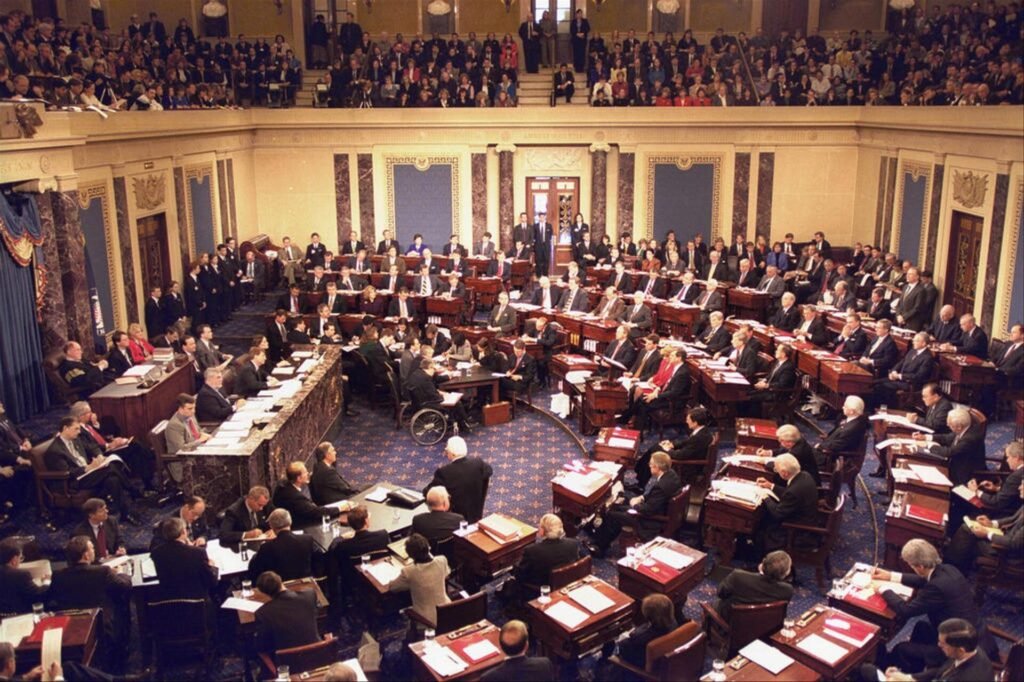
Congress faces a September 30 deadline to pass spending legislation before federal funding expires and a government shutdown begins on October 1, 2026. The Senate has already passed a bipartisan continuing resolution to extend funding through December 11, but the House must still act—and any spending bill moving through the Senate must clear a procedural hurdle that shapes virtually every major piece of legislation. That hurdle is the filibuster, a centuries-old Senate rule that has created an effective 60-vote requirement for passage. This supermajority threshold, far higher than the 51 votes that would normally suffice, means that spending bills and other legislation frequently fail not because they lack majority support, but because one political party can delay them indefinitely unless 60 senators vote to stop the debate.
The filibuster works through a paradox built into Senate rules: the chamber allows unlimited debate, which means that any senator can speak for hours or days to prevent a vote from occurring. This unlimited debate is the core of the filibuster tactic. No senator is forced to yield the floor, and so a single senator, or a coordinated group of senators from one party, can simply keep talking. The only way to force a vote is through a procedure called cloture, which requires 60 senators to agree to end debate. Because 41 senators can block cloture, a minority can indefinitely prevent a vote on any bill—unless the majority agrees to negotiate or withdraw the measure.
How the filibuster works
Technically, the Senate floor operates under the principle of unlimited debate. When a bill is introduced and debated, no rule exists that forces a senator to stop speaking and yield to the next speaker. A senator may speak on any topic they choose, for as long as they choose, without surrendering the floor. This power to speak indefinitely is the foundation of the filibuster tactic.
Historically, senators engaged in talking filibusters—physically holding the floor by speaking continuously to prevent a vote. In modern practice, particularly since the 1970s, the threat of a filibuster is typically enough. When 41 or more senators signal opposition to a bill through what is called a “silent filibuster,” Senate leadership usually abandons the vote without forcing the issue. The majority leader is aware that fewer than 60 senators support the bill, and proceeding to a vote would be futile. This dynamic means that the filibuster shapes legislative outcomes even when no senator actually spends hours speaking.
The filibuster emerged accidentally in 1806, when the Senate eliminated its motion to end debate. The procedure became formalized through Senate Rule XXII in 1917, which established cloture as a mechanism to override a filibuster. The original rule required a two-thirds majority of senators voting to end debate. In 1975, the Senate reduced this threshold to three-fifths of the membership, or 60 votes, lowering the barrier somewhat but preserving the supermajority requirement that persists today.
The cloture process
A cloture motion requires the support of three-fifths of all senators duly chosen and sworn — 60 votes in the 100-member Senate — to end debate. Before 1975, ending debate required a two-thirds majority. Once cloture succeeds, the bill itself needs only a simple majority, 51 votes, to pass.
The 60-vote cloture requirement
The rule governing cloture is codified in Senate Rule XXII. When a senator believes debate on a bill has gone on long enough, they can file a motion to invoke cloture.
When the cloture vote finally takes place, the rule requires an affirmative vote from three-fifths of all senators “duly chosen and sworn.” In the 100-member Senate, this translates to 60 votes. If exactly 60 senators vote for cloture, the motion passes. If 59 or fewer vote for cloture, the motion fails, the filibuster succeeds, and the bill typically dies—the Senate moves on to other business.
When cloture is successfully invoked, the Senate can finally reach a vote on the underlying bill. But that vote then requires only a simple majority, 51 votes, to pass. The 60-vote hurdle exists only to end debate, not to pass the bill itself.
Why it matters for spending bills
The filibuster’s impact on spending legislation is direct and immediate. When Congress must pass a spending bill—whether a full-year appropriations measure or a stopgap continuing resolution—any minority group of 41 senators can block passage unless the bill is modified to attract 60 votes.
This year, the political arithmetic is stark. Neither major party controls 60 seats in the 100-member Senate. This means that spending bills cannot pass on party-line votes; they must attract bipartisan support. The Senate passed its continuing resolution on August 8 by a vote of 90-6, demonstrating that spending measures can attract that supermajority. But spending bills frequently stall or require major concessions to reach 60 votes. Democrats have signaled that they seek restoration of cuts to Medicaid and rural hospital funding in exchange for their votes on any spending measure, while the Trump administration has pushed for changes to election administration and additional defense spending. Each demand represents leverage created by the 60-vote threshold.
Because 41 senators can block cloture, a minority can indefinitely prevent a vote on any bill—unless the majority agrees to negotiate or withdraw the measure.
The accelerating use of filibusters
The filibuster has accelerated dramatically in recent decades. According to the Brennan Center for Justice, more than half of all cloture votes since 1917 have occurred within just the past 12 years. This explosion reflects a shift in Senate culture: the chamber has moved from viewing the filibuster as an extraordinary tool to protect minority interests toward treating it as a routine weapon in partisan conflict. As a result, 60 votes—a supermajority—has become the de facto threshold for passage of almost any significant legislation.
Congress has felt the effects in the appropriations process. Since fiscal year 1997, the House and Senate have failed to complete all 12 annual appropriations bills by October 1, the start of the fiscal year. Instead, Congress has passed 139 continuing resolutions since 1998, funding the government temporarily while appropriations remain unfinished. With the filibuster in place, any minority of 41 senators can force a shutdown unless their demands are met.
What lies ahead
The dynamics will likely play out again in the weeks ahead as Congress confronts the September 30 deadline. Any spending bill that reaches the Senate floor will need to attract bipartisan support to overcome the filibuster. The Senate’s continuing resolution passed with overwhelming bipartisan agreement, but negotiations on amendments or a longer-term spending bill will test whether the supermajority requirement can be overcome before funding expires. The filibuster—a rule created to protect minority rights in the Senate—has become a structural constraint on the government’s ability to carry out routine fiscal functions and stay above a shutdown deadline.
Photo: User:LordHarris contends that this is “C-SPAN’s video coverage of the floor proc · Public domain · via Wikimedia Commons