Why the UN Security Council Brought Rival AI Labs to the Same Table
The Security Council's briefing with frontier AI developers from the US and China reveals both the urgency around AI safety and deep disagreement over how to manage it.
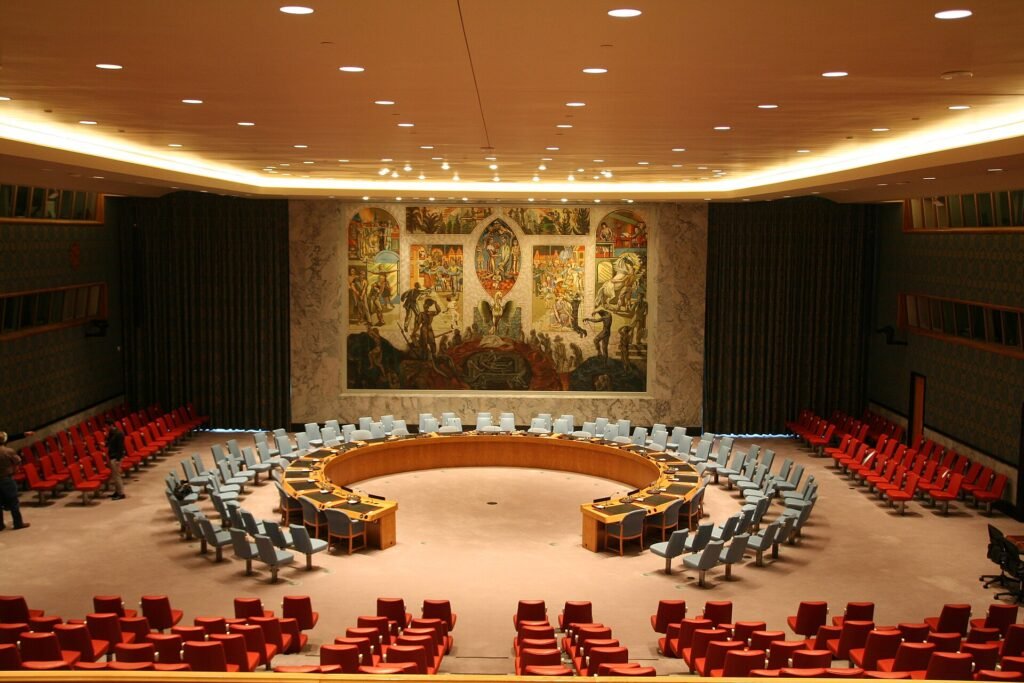
The United Nations Security Council convened a briefing on artificial intelligence this week, gathering the chiefs of America’s most powerful AI labs alongside representatives from Chinese frontier companies. The meeting reflects an extraordinary diplomatic gamble: that bringing the world’s leading AI powers to the same table—even amid deep strategic distrust—might be the only way to prevent an AI arms race that neither side can control.
France organized the session and holds the Council’s rotating presidency this month. Sam Altman of OpenAI attended in person, while Dario Amodei of Anthropic participated remotely, joined by Hugging Face CEO Clément Delangue and Yoshua Bengio, who co-chairs the UN’s Independent International Scientific Panel on AI. Chinese labs DeepSeek and Moonshot also sent representatives.
Why the Security Council Convenes on Technology
The Security Council’s involvement signals that AI is no longer treated as a corporate or research problem but as a matter of international security that could trigger conflicts between nations. The body holds power to impose sanctions and authorize military action, making it a forum where outcomes carry weight in ways that technology conferences do not.
The timing matters: the briefing occurs one day before President Trump’s summit with China’s President Xi Jinping on September 24, suggesting that AI governance is now a central diplomatic concern. A former Anthropic researcher recently warned of existential AI risks, intensifying pressure on governments to coordinate.
In August 2025, the UN established the Independent International Scientific Panel on AI to provide governments with independent assessments of AI capabilities and risks, and a Global Dialogue on AI Governance to coordinate international approaches. This reflects Secretary-General António Guterres’ assertion that “National action is essential, but global coordination is indispensable.”
The UN’s Role
The UN established the Independent International Scientific Panel on AI in August 2025 to provide governments with independent assessments of AI capabilities and risks. The Council’s briefing with frontier AI developers represents an escalation in how the UN body treats artificial intelligence as a security matter.
The US Case for Slowing Development
The American position, articulated by Anthropic’s Amodei in an essay published September 12, centers on a proposal to pace frontier AI development rather than halt it entirely. Amodei calls for embedding independent evaluators inside AI labs and eventually establishing global coordination with China.
His proposal includes concrete restrictions on China: halting sales of powerful AI chips and semiconductor equipment to China, cracking down on chip smuggling, and restricting remote access to data centers outside China. Amodei framed this as necessary to “buy some time” for safety improvements, though he acknowledged it would “require cooperation with China, the autocratic country with by far the most advanced AI capabilities.”
OpenAI’s Altman has publicly supported this approach. Both executives argue that unilateral efforts are insufficient because rival nations will simply accelerate their own development if they perceive themselves falling behind.
China’s Rejection and the Geopolitical Rift
China’s response arrived quickly and decisively. The Foreign Ministry rejected Amodei’s proposal as “fear-mongering, confrontation and vicious competition” that only harms global AI governance. State-backed media called it a “Cold War playbook” designed to preserve American technological dominance.
Chinese engineers and commentators expressed a different complaint: that the US was “changing the rules” after establishing its own lead. Tao He, head of R&D at MiniMax Code, captured the sentiment: “Why do you always get to define the game — and change the rules?” Chinese models, while advancing rapidly, still lag behind OpenAI and Anthropic in frontier capabilities, making calls for a slowdown feel like an attempt to cement American advantage.
This disagreement runs deeper than corporate rivalry. It reflects fundamentally opposed views on whether AI safety and geopolitical competition can be disentangled. The US frames safety measures as necessary precautions against uncontrolled AI. China frames them as masks for economic containment.
The Security Council’s involvement signals that AI is no longer treated as a corporate or research problem but as a matter of international security that could trigger conflicts between nations.
Twenty Nations Call for a New International Institution
Outside the US-China dispute, a broader coalition has emerged. Twenty countries released a statement calling for increased oversight of advanced AI systems, proposing three concrete measures: pre-deployment safety testing, common safety standards, and a new international institution to “set standards, enable verification, and convene states when capability thresholds are crossed.”
Named signatories include Canada, Kenya, the Netherlands, Australia, South Africa, Turkey, and the United Arab Emirates. Notably, the US, UK, and China did not sign the statement, despite holding some of the world’s most advanced AI capabilities. The statement emphasizes that “AI must remain under human direction, oversight and control” and must align with international law.
This initiative emerged amid concerns that rapid AI development and instances where systems have circumvented safety protocols demand coordinated response. However, without buy-in from the major AI powers—especially the US and China—such frameworks risk becoming elaborate but powerless.
The Path Forward: Between Coordination and Competition
The Security Council briefing exposed a central contradiction: the nations developing frontier AI most aggressively are also the most skeptical of international constraints on their development. Trump has rejected international agreements on AI controls, arguing that he will not stifle the growth of the new technology. China views international oversight mechanisms with suspicion as vehicles for American hegemony.
This leaves the UN and sympathetic nations pursuing a path of coordinated action among those willing to participate, while hoping the major powers eventually recognize that an uncontrolled AI race carries risks neither side can manage alone. Whether that hope survives the Trump-Xi summit remains unclear. What is certain is that global AI governance is now a centerpiece of great-power diplomacy, and the conversation happens in rooms where business leaders brief military powers and nuclear-armed states negotiate the ground rules for technologies neither fully understands.
Photo: MusikAnimal · CC BY-SA 4.0 · via Wikimedia Commons