
Why preparation isn’t everything at a World Cup | Jonathan Wilson
The heat and the altitude worried everybody. The 1970 World Cup in Mexico would not be a normal one. So the Bulgarian authorities sent their squad south of Sofia to get used to playing several thousand feet above sea level. Which seemed a great idea until somebody noticed that the temperature in the Pirin Mountains was not in the mid-20s celsius as it is in Mexico but somewhere near freezing. How then could they replicate the effect of playing in intense heat? By restricting water intake so that the players got used to performing while dehydrated.
The plan was not a great success. Bulgaria lost their first two World Cup games in 1970 and had already been eliminated by the time they drew with Morocco. It’s safe to assume that preparations for this World Cup will be rather more sophisticated than they were 56 years ago. Most countries back then seemed to take the view that training at altitude was the logical way to prepare for games in Mexico City, Monterrey and Guadalajara. Israel went to Ethiopia and Colorado. Uruguay played in Quito and Bogotá. Mexico themselves held a five-month training camp that featured 13 friendly internationals in four months before a pair of games against the Scottish side Dundee United.
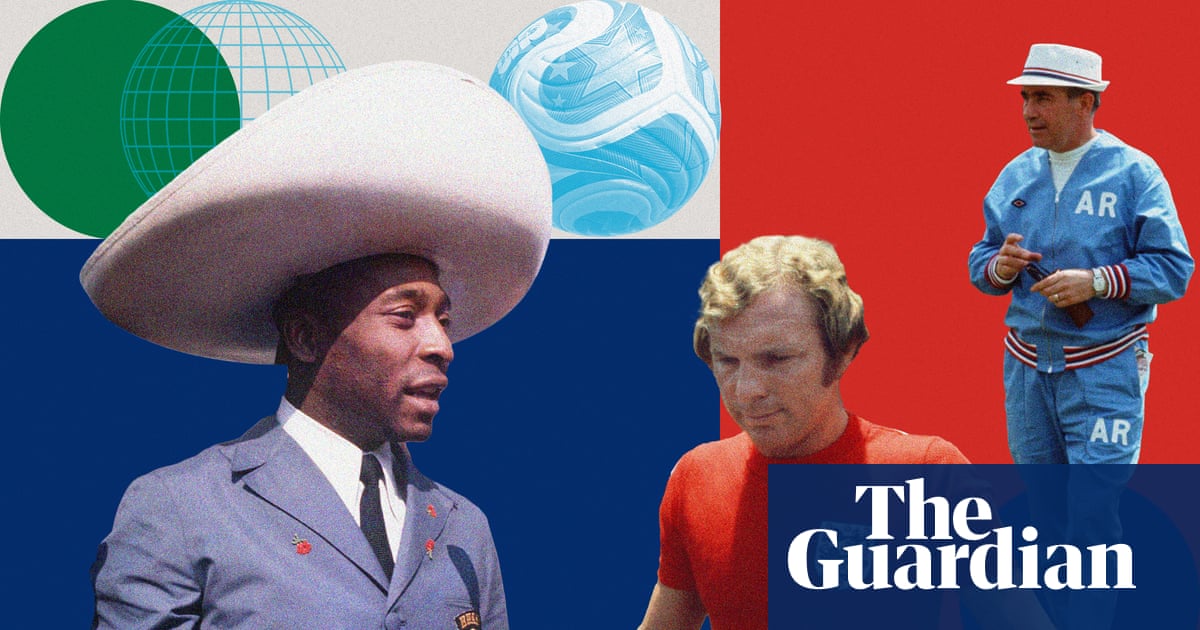
England, the world champions, were paranoid about what they’d find in Mexico. Their team doctor, Neil Phillips, took a course on heat, altitude and tropical diseases, and recommended the players take salt tablets. He also brought in Dr Griffith Pugh, a physiologist who had been on Edmund Hillary’s mission that had climbed Everest. Other measures were less sensible.
The manager Alf Ramsey, for all his gifts as a coach, was a xenophobe to the core. He had been a player in the England side that had lost to the USA in 1950, and remembered the greasy food served in Brazil with horror. A trip to Brazil in 1964 and a further tour of Latin America in 1969 had only heightened his distrust. England, he decided, would import their own bus, food and water. For the Mexicans, already irritated by a string of undiplomatic statements from Ramsey, this was the final straw. The authorities decided that the United Kingdom was beset by foot and mouth, so they impounded all the frozen meat at the docks then burned it, leaving England to subsist on Findus fishfingers and ready meals.
Pre-tournament preparations began with three weeks in Mexico City, where life was so regimented that Ramsey would sit by the pool as players sunbathed, timing 20 minutes with a stopwatch, then blowing a whistle so the players could turn over. England then left for friendlies at altitude in Bogotá and Quito. It was when they stopped on the way back to change planes in Colombia that their captain, Bobby Moore, was arrested, accused of stealing a bracelet from a jewellery shop in the hotel foyer. He was held under house arrest for several days at the home of Alfonso Senior, a senior director of the Colombian football federation. After fevered diplomatic efforts, Moore made it to Mexico in time to play in England’s first game, a 1-0 win over Romania, and was eventually exonerated.
The team that prepared most thoroughly, though, was Brazil. Late in 1969, the coach who led them through qualifying, João Saldanha, met two army officers, Cláudio Coutinho and Lamartine Da Costa, at a churrascaria at the bottom of Sugarloaf Mountain to discuss the best way to get the players ready for the physical challenge ahead. Coutinho would later become coach of Brazil and the LA Aztecs, where he had just finished working when he was killed in a diving accident in 1981. Da Costa was a specialist in biometeorology who taught at the Pontificia Universidade Católica do Rio de Janeiro. Both had attended the 1968 Mexico Olympics, both had made their observations and were keen to employ science to help.
The samba stereotype of Brazilian football, the idea of instinctive footballers wandering off the beach to win tournaments had always been nonsense. The Brazilian golden age, when they won three Worlds Cups out of four between 1958 and 1970 was always based on meticulous preparation. Before the 1970 tournament, the players spent 100 days at army facilities. Everything was monitored in fanatical detail: players’ kit was made to measure and the collars designed so they would not accumulate sweat. There was a lot of talk about using a Nasa training course, although that seems to have amounted to little more than using the Cooper test, a means of monitoring fitness by measuring how far the players could run in 12 minutes. They arrived in Mexico City 32 days before their opening game against Czechoslovakia. And it worked: 12 of the 19 goals scored by Brazil in the 1970 World Cup came in the second half. They outlasted opponents as well as outplaying them.
And there is perhaps a lesson there for 2026. Preparation isn’t everything (as we will see below), and the demands of the domestic calendar mean no contender will have spent four months locked away in isolation to train, but being ready for the conditions and having a gameplan that accounts for it will be a major benefit. There is a lot of randomness in football, much that is settled only on the day, but the higher the starting point the more chance a side has. Subsisting on Findus ready meals has never been a successful basis for winning a World Cup.
On this day …
Cameroon’s preparations for the 1990 World Cup in Italy had been shambolic. Their coach was the Russian Valery Nepomnyashchy, who had turned up two years earlier to run youth development in the country only to be appointed to the senior job. He spoke little French and the players didn’t much like him. They went out of the 1990 Cup of Nations in the group stage. When they moved from Bordeaux to Yugoslavia for a pre-tournament training camp, the balls and kit didn’t turn up. The attacking midfielder Grégoire M’Bida was sent home for missing the bus, then the veteran forward Roger Milla, who had gone into semi-retirement, turned up at the request of the country’s president, Paul Biya.
Before the opening game, against Argentina, played on 8 June 1990, the goalkeeper Joseph-Antoine Bell gave an interview in which he said a 3-0 defeat to the reigning world champions would be a good result. He was dropped and Thomas N’Kono drafted in – so late that his wife missed the game because she’d gone shopping in Milan, believing her husband would be on the bench. Cameroon had two men sent off – and still won 1-0. No sub-Saharan African team had ever previously won a game at the World Cup; Cameroon went on to reach the quarter-final that year.
-
This is an extract from Soccer Desk: World Cup edition, a newsletter from the Guardian US that will run regularly during the tournament. Subscribe for free here.
