Why the EU’s Carbon Border Tax Will Cost American Exporters $230 Million in 2026
The EU's Carbon Border Adjustment Mechanism, now in its definitive regime, prices embedded emissions in imported steel, aluminum, cement and fertilizer at approximately $88 per metric ton of CO₂.
The European Union’s Carbon Border Adjustment Mechanism entered its definitive regime on January 1, 2026, marking the start of a system estimated to cost American exporters over $230 million in 2026 alone and reshape how the EU prices embedded emissions. The mechanism, known as CBAM, applies taxes equivalent to Europe’s own carbon market to six categories of carbon-intensive goods—steel, aluminum, cement, fertilizers, electricity and hydrogen—crossing into the bloc.
After a 27-month transitional period where importers merely reported their emissions without financial penalty, the definitive regime transforms CBAM from an administrative exercise into a financial obligation. Importers must now obtain authorized declarant status from EU regulators, purchase certificates priced at the weekly average of the EU’s own carbon market, and track embedded emissions with newly required third-party verification. For American firms, the stakes are immediate: companies that delay compliance risk losing access to European markets entirely, as importers must submit their authorized declarant application by March 31, 2026 to continue importing CBAM goods while it is reviewed.
From reporting to financial obligation
CBAM operated in a transitional reporting phase from October 2023 through December 2025. During this period, importers submitted quarterly CBAM reports declaring the carbon content of their goods, but faced no financial penalties. The European Commission used this phase to gather data, test reporting systems, and give businesses time to restructure supply chains and emissions tracking. More than 4,100 economic operators had obtained the required authorized declarant status around the January 1, 2026 launch, and by January 7, 2026, customs authorities had validated over 10,000 import declarations carrying CBAM goods.
The definitive regime starting January 1, 2026 introduced requirements that fundamentally changed compliance from administrative to financial. Importers can no longer simply report emissions; they must purchase CBAM certificates equal to the carbon content of their imports and surrender those certificates annually to European authorities. The system operates on a lagging financial timeline that gives importers several months to prepare. Importers must purchase certificates for their 2026 shipments starting in February 2027, at the EU Emissions Trading System’s quarterly average price for the relevant quarter of that year. By September 30, 2027, importers must submit their first annual CBAM declaration covering the full calendar year 2026 and surrender all corresponding certificates. This means that while CBAM becomes financially binding for imports made from January 1, 2026, the actual cash obligations do not materialise until early 2027.
CBAM certificate pricing, early 2026
In the first quarter of 2026, CBAM certificates cost approximately $88 per metric ton of CO₂ equivalent, based on the EU Emissions Trading System’s quarterly average auction price. An importer with 100 tonnes of steel containing 2 tonnes of embedded emissions per tonne would owe roughly $17,600 in certificate costs.
How certificates and emissions reporting work
The CBAM system requires importers to quantify the greenhouse gas emissions embedded in every shipment. Importers exceeding the 50-tonne annual threshold of CBAM-covered goods must obtain authorized declarant status before importing and submit detailed emissions data. They calculate embedded emissions using one of two approved methodologies. The first uses production data—activity records showing production volumes and emission factors from standard references—to estimate direct emissions from the manufacturing process and indirect emissions from electricity consumption. The second measures greenhouse gas concentrations directly at production facilities using flue gas monitoring equipment. Both approaches must be independently verified by a third-party auditor, a requirement that represents a significant administrative and financial burden for many suppliers, particularly those outside the EU who have never had to measure emissions before.
Once importers report their goods’ emissions, they must purchase CBAM certificates corresponding to those emissions. The price of each certificate is set each quarter, based on the average of the European Union Emissions Trading System’s weekly auction prices for the prior three months. In the first quarter of 2026, that price was approximately $88 per metric ton of CO₂ equivalent. For a practical example, an importer selling 100 tonnes of steel with 2 tonnes of embedded emissions per tonne would calculate total embedded emissions of 200 tonnes of CO₂, then purchase 200 CBAM certificates at roughly $88 each, totaling $17,600 in certificate costs. The price is reset each quarter based on EU ETS auctions, meaning costs can rise or fall depending on carbon market conditions.
Default values and the incentive to verify
A critical feature of CBAM advantages American exporters relative to competitors in more carbon-intensive foreign economies. When importers cannot obtain actual emissions data from their suppliers—which is common for goods produced outside the EU or at facilities without prior emissions monitoring—they must use default values that European regulators have calculated for each country and sector. The Commission calculates these defaults for each country and sector, rather than for individual production facilities. In December 2025, the European Commission published revised default values in implementing regulations based on emissions intensity from the bloc’s main trading partners.
Default values are intentionally conservative, typically higher than actual emissions from efficient producers. To discourage reliance on defaults and push importers to demand better data from suppliers, the EU applies a markup that penalizes default value use. In 2026, the markup is 10 percent; it rises to 30 percent by 2028. For American steelmakers with lower-carbon production methods, the default value often overestimates their actual emissions, putting them at a disadvantage unless they provide verified data. Conversely, American firms with clean operations and good emissions accounting can claim substantially lower CBAM costs and gain market share against less efficient foreign competitors facing higher fees.
American steelmakers running cleaner facilities than the EU baseline can also reduce their CBAM liability through verified reporting, a competitive advantage competitors in high-carbon economies cannot match.
Authorization requirements and deadlines
Importers established in an EU member state must apply for authorized declarant status through the CBAM Registry in their country to continue importing CBAM-covered goods. The application process involves five steps: submitting an electronic application with company details, EORI number, estimated import volumes and proof of financial and operational capacity; awaiting review by authorities, which can take up to 120 days, or 180 days for applications submitted before June 15, 2025; undergoing compliance checks and risk assessment; receiving a decision and CBAM account number if approved; and maintaining continuous compliance as authorities can reassess status at any time.
The March 31, 2026 deadline required importers to submit their authorized declarant applications; under the EU’s Omnibus Regulation, importers with a pending application submitted by that date may continue importing while it is reviewed. Applicants must demonstrate financial stability, no significant tax arrears, sufficient standing to cover CBAM certificate liabilities, and proven internal controls and data systems to manage emissions reporting and certificate handling. For American exporters working through EU importers, this means communicating emissions data to European partners in good time to allow importers to meet the March deadline. Companies that fail to submit an application by the deadline risk losing the ability to import their goods into the European market.
The cost to American exporters
Iron and steel accounts for over 60 percent of US CBAM-covered exports to Europe, with the remainder made up of aluminum, cement, fertilizers, and smaller volumes of electricity and hydrogen. According to analysis by the Niskanen Center, the US stands to lose approximately $231 million in CBAM costs in 2026, with costs rising to about $271 million by 2028. Initial 2026 trade data shows significant disruption. Iron and steel exports from the US ran 85 percent below baseline levels by early 2026, while aluminum fell 63 percent below historical volumes.
However, according to 2024 projections by the Climate Leadership Council, the overall burden on American exporters is likely to remain lighter than on competitors from more carbon-intensive economies. The projections found the U.S. would pay less in total CBAM fees than Russia, China, or India, partly because American manufacturing is more carbon-efficient—requiring fewer emissions per unit of steel or aluminum produced—and partly because US firms send only 7 percent of all CBAM-covered global exports to the EU, leaving them freer to redirect goods to other markets without severe penalty. American steelmakers running cleaner facilities than the EU baseline can also reduce their CBAM liability through verified reporting, a competitive advantage competitors in high-carbon economies cannot match.
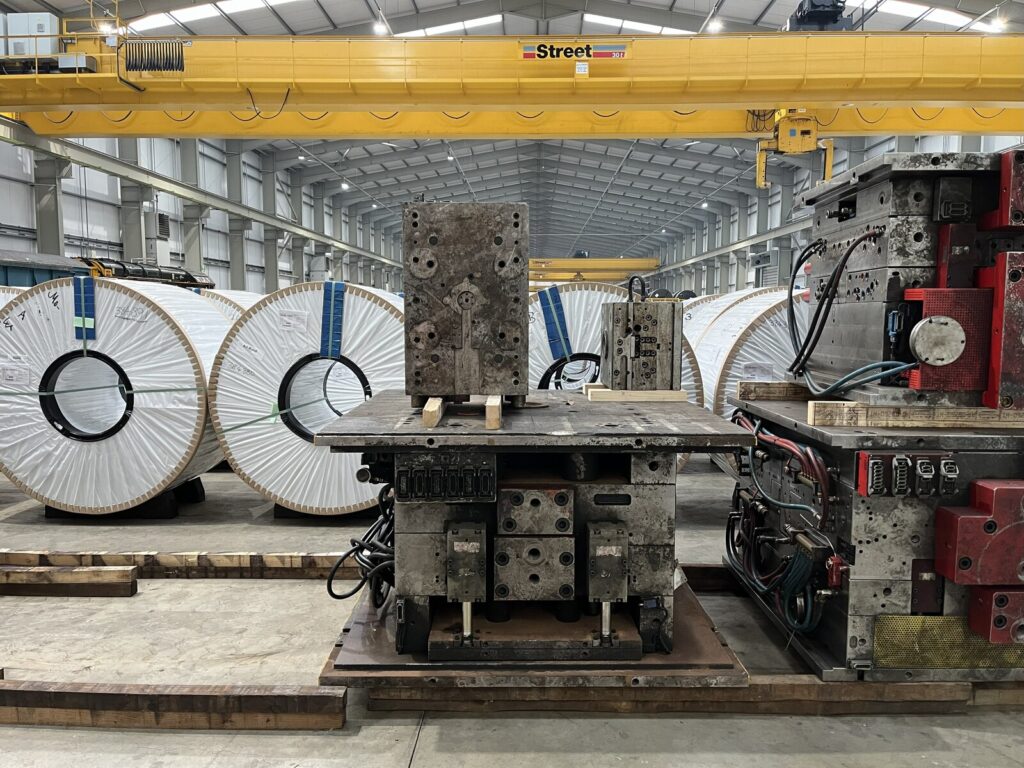
Photo: Adrian Taylor · CC BY-SA 2.0