Why Article 27 Gives Five UN Powers an Absolute Veto
Five countries can each unilaterally block any substantive Security Council action. Here's how Article 27 made them that powerful.
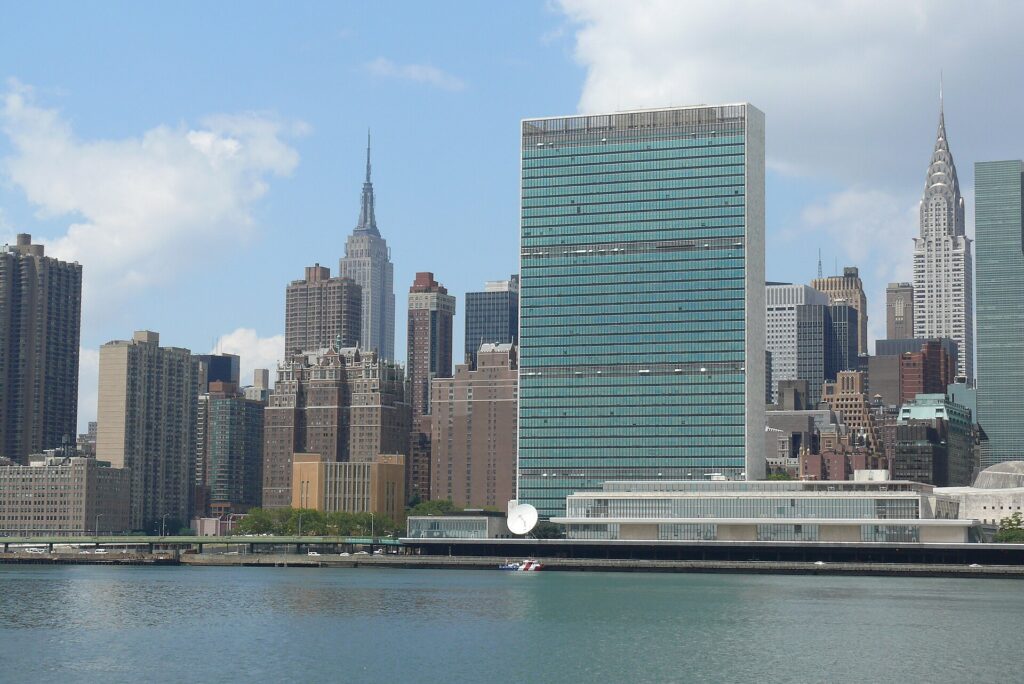
Inside the glass-walled Security Council chamber at the United Nations headquarters in Turtle Bay, a simple rule grants extraordinary power to five countries. Article 27 of the United Nations Charter, written and ratified in 1945, requires that substantive decisions of the Council—those involving peace operations, sanctions, membership and expulsion—receive affirmative votes from nine of the Council’s fifteen members. But that nine-vote majority is not enough. The same Article 27 also demands “the concurring votes of the permanent members,” meaning all five of them: the United States, Russia, China, France and the United Kingdom.
This requirement translates into an absolute veto. A single permanent member’s negative vote defeats any substantive resolution, regardless of how many other countries support it. The rule sits at the foundation of global diplomacy, giving each of five nations the power to prevent international military action, sanctions regimes and formal responses to crises. Yet the Charter’s framers knew that no major power would agree to an international organization where others could force it to act against its interests.
What Article 27 requires
The full text of Article 27(3) states: “Decisions of the Security Council on all other matters shall be made by an affirmative vote of nine members including the concurring votes of the permanent members.” The language is spare, but its effect is absolute. A substantive decision—defined as anything other than a procedural question—requires nine votes in favor, and not a single permanent member can dissent.
This differs sharply from procedural matters, which need only nine affirmative votes and allow permanent members to vote no without consequence. When the Security Council debates whether to place an issue on its agenda or adjourn a meeting, the math is simple majority rule. But when it considers military intervention, humanitarian action or formal sanctions, the five permanent members hold equal veto power regardless of Council size.
The veto covers what matter most: peace operations, sanctions, troop deployments, membership admissions and the selection of the Secretary-General. It does not cover statements of concern, fact-finding missions or debates on principle, which can pass without permanent member consensus. This distinction means the Council can speak to a crisis with no binding effect, but cannot act against any permanent member’s wishes.
The numbers on the veto
Since February 16, 1946, permanent members have cast 322 vetoes: Russia and the Soviet Union 157 times, the United States 94 times, the United Kingdom 30 times, China 23 times and France 18 times.
Why the founders granted the veto
The veto was not an accident or an oversight. At the 1945 San Francisco Conference, where delegations gathered to write the United Nations Charter, the permanent members made clear they would not join an organization without the power to block actions against their interests. Three months earlier, at the Yalta Conference, the Soviet Union, United States and United Kingdom had already agreed that the new organization would include a Security Council with five permanent seats—originally the U.S., USSR, China, Britain and France—each with veto authority.
The logic was straightforward: without the veto, the largest military powers could be outvoted and forced to participate in conflicts they opposed. More fundamentally, without it, they would be bound by international decisions made by smaller nations. The founders believed the five permanent members had to consent to major Council actions for the organization to function.
This arrangement meant the Council reflected the military reality of 1945. The Soviet Union, United States, China, Britain and France possessed the most military capacity and the most at stake in global conflict. Giving them individual veto rights made the Council an institution of great-power consensus, not democratic rule. The smaller nations accepted this because the alternative was no international organization at all.
How the veto has been used
The veto has been invoked 322 times since February 16, 1946, when the Soviet Union cast the first one. Russia and the Soviet Union account for 157 of those vetoes, the United States for 94, the United Kingdom for 30, France for 18 and China for 23. The raw numbers show that the veto power has been far from equally distributed, reflecting both Cold War tensions and diverging interests in recent years.
Cold War divisions created the heaviest veto use. The Soviet Union and United States held fundamentally opposing views on which conflicts warranted Council intervention, which countries deserved membership and which regimes merited sanctions. After the Cold War ended in 1991, veto use fell sharply among the Western permanent members. France and the United Kingdom have not cast vetoes since 1989. But Russia and China dramatically increased their use after 2011, particularly on conflicts in Syria. Russia cast 14 vetoes on Syria between 2011 and recent years, while China cast 8.
The veto power has meant that some crises go unaddressed by the Council. When a permanent member opposes action, the Council cannot authorize military force, impose sanctions or even formally condemn a situation. Rwanda’s genocide in 1994, when the United States and France threatened vetoes that blocked an effective UN intervention, and the Syrian civil war beginning in 2011, where Russia and China repeatedly vetoed resolutions, have proceeded without Council authorization.
A single permanent member’s negative vote defeats any substantive resolution, regardless of how many other countries support it.
The headquarters in New York
The UN Security Council operates from the headquarters building in Turtle Bay, Manhattan. Although the United Nations was founded in 1945, it took several years to select a site and build its headquarters in New York. Before the permanent headquarters existed, the Council met in temporary locations. Its first New York sessions occurred at Hunter College in the Bronx from March 25 to August 15, 1946. The Council then moved to Lake Success on Long Island before the Manhattan building opened.
The veto power, embedded in Article 27, has remained unchanged for more than eighty years despite repeated calls for reform. No amendment to the Charter has ever altered the permanent members’ veto rights, making it the most durable feature of the Council’s structure.
Efforts to constrain the veto
The permanent members’ veto power has been both celebrated as ensuring great-power cooperation and criticized as paralyzing the Council during humanitarian crises. Reform proposals have proliferated, but none have succeeded because they would require Charter amendments, which themselves need permanent member support—meaning any permanent member could veto its own loss of power.
The closest the world has come to a voluntary constraint is the Accountability, Coherence and Transparency (ACT) Group’s code of conduct, launched in 2013. It encourages permanent members to refrain from vetoing resolutions on genocide and crimes against humanity. As of January 2020, 120 countries endorsed the code, including France and the United Kingdom, though Russia, China and the United States have not formally committed. The code has no enforcement mechanism and remains voluntary.
The veto persists because the permanent members benefit from it. Each retains the power to prevent actions it opposes, whether involving military intervention, sanctions or diplomatic recognition. Article 27’s requirement for unanimous permanent member consent means that major-power consensus is the price of Council action, a structure the five nations that wrote it saw as essential to their willingness to participate in global governance.